
CertiPUR-US certified foam mattresses have flexible polyurethane foam that meets the certification’s criteria. The certification applies to the foam, not the entire mattress, which may include other materials and components it does not assess.
It’s reasonable to look for a certification when choosing a mattress, especially if you’re considering how its materials may affect indoor air quality. CertiPUR-US® certified foams are evaluated for content, emissions and durability, and have low VOC emissions of less than 0.5 parts per million.
This guide explains what the certification covers, how foam emissions relate to indoor air quality, and what its limits mean when comparing mattresses. You’ll also learn how foam certification differs from product-level certification, so you can understand what a label does and does not tell you.
Key Takeaways
- Learn why a foam certification doesn’t automatically certify every material or component in a mattress.
- Understand what chemical restrictions and emissions testing can tell you about certified foam.
- See how foam-level certification differs from certifications that assess finished products.
- Use these distinctions to compare mattress materials and explore options from The Mattress Boutique.
Does CertiPUR-US® mean the entire mattress is certified?
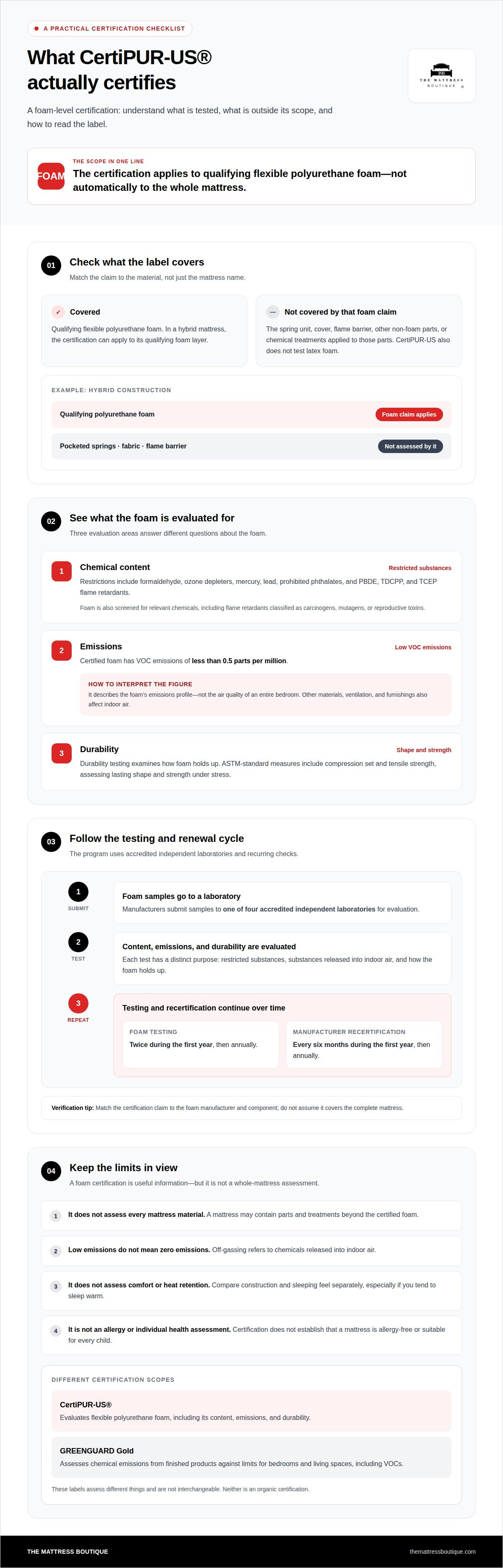
No. CertiPUR-US® applies to flexible polyurethane foam, not automatically to every mattress component. This distinction matters when assessing the cover, fire barrier, or other materials.
Certified Foam Components
Certification applies to the foam component, so it doesn’t certify a mattress as a complete product. A hybrid mattress, for example, may combine polyurethane foam with pocketed springs, fabric, and a flame barrier. The certification covers only qualifying foam, not the spring unit, cover, or other non-foam parts. CertiPUR-US also doesn’t test latex foam, so a latex layer isn’t covered.
Foam Testing and Restricted Substances
Certified foam is evaluated for chemical content, emissions, and durability. Restrictions include formaldehyde, ozone depleters, mercury, lead, prohibited phthalates, and PBDE, TDCPP, and TCEP flame retardants. The foam is also screened for relevant chemicals, including flame retardants classified as carcinogens, mutagens, or reproductive toxins. These restrictions concern the foam, not treatments applied to other mattress components. CertiPUR-US doesn’t assess mattress flame-barrier systems or chemical treatments on non-foam parts. Foam testing and non-foam materials therefore answer different questions.
How do certified memory foam mattresses compare with latex and hybrid mattresses? Memory foam is made with polyurethane foam, which the certification can cover. CertiPUR-US doesn’t test latex foam, while certification for a hybrid applies only to its qualifying foam layer.
How can I verify a mattress’s certification and validity? Match the certification claim to the foam manufacturer and component, rather than assuming it covers the whole mattress. Foam is tested twice during the first year and annually thereafter; manufacturers recertify every six months during the first year and annually afterward.
What are the best certified foam mattresses in Singapore? The right mattress depends on your preferred feel and construction, not certification alone. Compare the foam type and the materials used beyond the foam.
What warranty, trial period, and return rules should Singapore buyers check? Read the written warranty, trial-period conditions, and return rules before buying. Note the coverage, eligibility, and process set out for each.
How do Singapore’s climate and humidity affect foam choice and care? Consider bedroom ventilation and the mattress’s full construction when choosing foam. Follow care instructions for the cover and materials, particularly in humid conditions.
VOC emissions and indoor air quality
VOC emissions describe chemicals released into indoor air from materials such as foam. CertiPUR-US® sets a low-emissions standard for certified foam, while GREENGUARD Gold assesses chemical emissions from finished products.
VOC Emissions and Indoor Air
Volatile organic compounds, or VOCs, can be released by materials into a room’s air. CertiPUR-US certified foams have low VOC emissions, measured at less than 0.5 parts per million. This figure helps you understand the foam’s emissions profile, not the air quality of your entire bedroom. A mattress includes other materials, and room ventilation and furnishings also affect indoor air. For a more useful comparison, distinguish foam emissions from whole-room conditions.
Emissions Limits and Comparisons
GREENGUARD Gold certifies products against chemical emission limits for bedrooms and living spaces, including VOCs. Its scope is product emissions, while CertiPUR-US applies to foam. The certifications assess different things, so their labels aren’t interchangeable. A finished-product certification can provide information about emissions beyond the foam layer. Neither label is an “organic” certification: emissions testing and organic material standards address different questions. Read each claim according to the material or product it covers.
Off-Gassing and Other Concerns
Off-gassing refers to chemicals released into indoor air; a low-emissions result doesn’t mean zero emissions. CertiPUR-US addresses foam emissions, not heat retention, comfort, or every mattress material. Compare construction and sleeping feel separately, especially if you tend to sleep warm.
Are certified foam mattresses safe for babies, children, and people with allergies? The certification provides information about foam emissions and restricted chemicals, but doesn’t establish that a mattress is allergy-free or suitable for every child. It isn’t an individual health assessment.
What are the drawbacks or risks, including off-gassing and heat retention? Low VOC emissions don’t mean zero emissions, and the certification doesn’t assess heat retention. Consider room ventilation, the mattress’s full construction, and your comfort preferences alongside the foam certification.
CertiPUR-US® certification for flexible polyurethane foam
The CertiPUR-US certification program began in 2008 for flexible polyurethane foam. It is administered by the Alliance for Flexible Polyurethane Foam, Inc., a nonprofit trade organization representing the flexible polyurethane foam manufacturing industry. Independent, accredited laboratories test the foam. This structure helps define what the program evaluates: foam materials and their performance, rather than every feature of a finished mattress.
Manufacturers seeking certification submit foam samples to one of four accredited independent laboratories. Evaluation covers content, emissions, and durability, with a distinct purpose for each test. Content testing checks restricted substances; emissions testing assesses substances released into indoor air; and durability testing examines how foam holds up. ASTM-standard measures include compression set and tensile strength, which assess lasting shape and strength under stress.
The program tests foam twice during the first year and annually thereafter. Manufacturers also recertify foam every six months during the first year and annually afterward. These requirements tie certification to ongoing production rather than a single sample. For shoppers, that continuing review is part of what the certification represents.
Restrictions cover formaldehyde, ozone depleters, mercury, lead, prohibited phthalates, and PBDE, TDCPP, and TCEP flame retardants. The foam is also screened for relevant chemicals, including flame retardants classified as carcinogens, mutagens, or reproductive toxins. These criteria address harmful substances in foam; they don’t establish that every mattress material has the same chemical profile.
CertiPUR-US Technical Guidelines and testing requirements are updated periodically to reflect current science and new health, environmental, and safety regulations. The standard can therefore evolve as its technical criteria are revised. Understand the certification as a defined assessment of flexible polyurethane foam, including its chemical content, emissions, and durability, not as a general claim about comfort or all mattress materials.
Finished-product mattress certifications
A finished-product certification assesses more than a foam-only certification. This matters if you want information about the mattress beyond its polyurethane foam, such as its cover or other materials. Check the certification’s exact scope before treating a label as evidence about every component. The certification name alone doesn’t show which parts were assessed.
OEKO-TEX Standard 100, Class I tests finished products against human-ecological criteria for harmful substances. This gives the certification a product-level scope, unlike a foam-specific assessment. It can help you understand whether the finished item has been assessed for harmful substances, but it isn’t a blanket statement about every performance feature. For example, chemical testing doesn’t tell you whether a mattress suits your preferred firmness.
UL Formaldehyde-Free independently validates that a finished product has no added formaldehyde or formaldehyde precursors. This addresses a specific chemical concern across the finished product, rather than only its foam. It doesn’t mean the product has no other chemicals or has been tested for every substance, such as heavy metals. Read it as a defined claim, not a universal guarantee.
Other standards focus on the origin of particular materials. GOTS covers organic integrity from farm through finished product. GOLS addresses organic latex sourcing and processing from the farm to the finished material. These standards serve a different purpose from emissions or harmful-substance testing. A material’s organic-sourcing claim doesn’t answer questions about VOC emissions.
For a practical comparison, identify exactly what each label covers: foam, a finished product, or a material’s sourcing and processing. Then match that scope to your priority, whether emissions, formaldehyde, or organic integrity. A mattress may contain multiple materials, so don’t assume one certification covers every layer. Comparing scope with the specific claim gives you a clearer basis for assessing labels.
The Mattress Boutique: King Koil Mattresses
The Mattress Boutique can help you compare mattress options once you understand what foam certification covers. When weighing CertiPUR-US certified foam mattresses against other constructions, consider how the materials and feel suit your preferences, alongside any certification claims about the finished product.
Compare various foam and hybrid models by their construction and feel, as well as any specific claims about their materials. Certification alone doesn’t determine comfort or whether a mattress suits your needs. This distinction helps you weigh certification information against your everyday sleeping preferences.
For a closer look at mattress options, contact The Mattress Boutique or visit themattressboutique.com.
Choose your next mattress with confidence
Your next mattress choice can start with the way you sleep, then use certification claims to refine your shortlist. If you’re considering CertiPUR-US certified foam mattresses, identify what matters most: foam composition, emissions information, or an assessment of the finished product. Weigh the relevant label alongside firmness, support feel, and the mattress’s other materials. This keeps certification useful without letting it make the entire decision.
Consider whether you prefer the feel of foam or want to compare another mattress construction. That preference can help narrow your options before you weigh certification claims. The Mattress Boutique offers King Koil, Slumberland, and Dunlopillo mattresses, giving you brand options to explore while keeping comfort priorities in view. For help considering your choices, contact The Mattress Boutique. Take your next step at your own pace and choose with confidence.
Frequently Asked Questions
What Is CertiPUR-US®?
CertiPUR-US® is a certification program for flexible polyurethane foam used in products such as mattresses. Established in 2008, it is administered by the Alliance for Flexible Polyurethane Foam, Inc., a nonprofit trade organization representing the foam manufacturing industry. Independent, accredited laboratories test foam samples. For shoppers, the name identifies a foam-focused program, not a general certification for every type of mattress material.
How often is the foam retested?
CertiPUR-US® foam is tested twice during the first year and annually thereafter. Manufacturers also recertify their foam every six months during the first year and annually afterward. These are separate requirements: testing evaluates the foam, while recertification renews its certification status. If the label matters to your purchase, look for a current claim identifying the foam rather than assuming it covers the mattress’s entire construction.
What happens if a foam fails CertiPUR-US® certification?
A failed evaluation means the tested sample hasn’t demonstrated that it meets the program’s certification criteria. It shouldn’t be treated as qualifying certified foam. This distinction matters when a mattress label makes a certification claim: the claim should relate to foam that meets program requirements, not merely to the presence of polyurethane foam. Certification describes tested foam, not a guarantee of comfort or suitability.
What does CertiPUR-US certification mean for foam mattresses?
The claim concerns qualifying flexible polyurethane foam, not every part of the mattress. A mattress may include foam alongside a cover, springs, or a flame barrier. Treat certification as one piece of product information, then consider the mattress’s construction and feel separately. This lets you compare material claims without assuming the label assesses qualities such as firmness or sleeping comfort.
Which foam chemicals and emissions does CertiPUR-US test for?
The program evaluates foam content and emissions, including restrictions on formaldehyde, ozone depleters, mercury, lead, prohibited phthalates, and PBDE, TDCPP, and TCEP flame retardants. Certified foams also have low VOC emissions, at less than 0.5 parts per million. These criteria offer specific information about the foam’s chemical profile; they don’t describe every substance or treatment used elsewhere in a mattress.
Does CertiPUR-US certify the entire mattress or only its foam?
It applies to flexible polyurethane foam, not automatically to the entire mattress. A mattress can include non-foam components, such as fabric, springs, or a flame barrier, that the certification doesn’t assess. CertiPUR-US also doesn’t test latex foam. If a mattress combines polyurethane foam with latex, the certification claim relates to qualifying polyurethane foam, not the latex layer or complete product.