

A firmer mattress isn’t automatically made with denser foam. To understand what mattress foam density is, look at the mass of foam within a given volume, expressed in Singapore as kilograms per cubic metre (kg/m³). Density tells you how much material is present; firmness describes how hard or soft the mattress feels.
It’s easy to treat density as a shortcut for comfort or quality, but it doesn’t tell the whole story. Foam construction and firmness matter too, while ILD indicates how much force it takes to compress foam. A density-based feel chart can help you compare options, as long as you understand what it can and can’t tell you.
Here, you’ll learn how foam density is measured, what it can suggest about durability and feel, and how it differs from ILD. We’ll also explain how to read density figures for individual foam layers, helping you compare mattresses more confidently.
Key Takeaways
- Separate density from firmness when comparing foam: one describes the material amount, while the other describes the feel under pressure.
- Use PCF figures to compare foam density, and remember that different foam types have different density classifications.
- Consider density as one clue to durability; foam below 23 kg/m³ may lose its original qualities sooner with regular adult use.
- Treat density-based feel labels as a guide, not a firmness guarantee, and use ILD to understand resistance to compression.
How is Foam Density Measured?
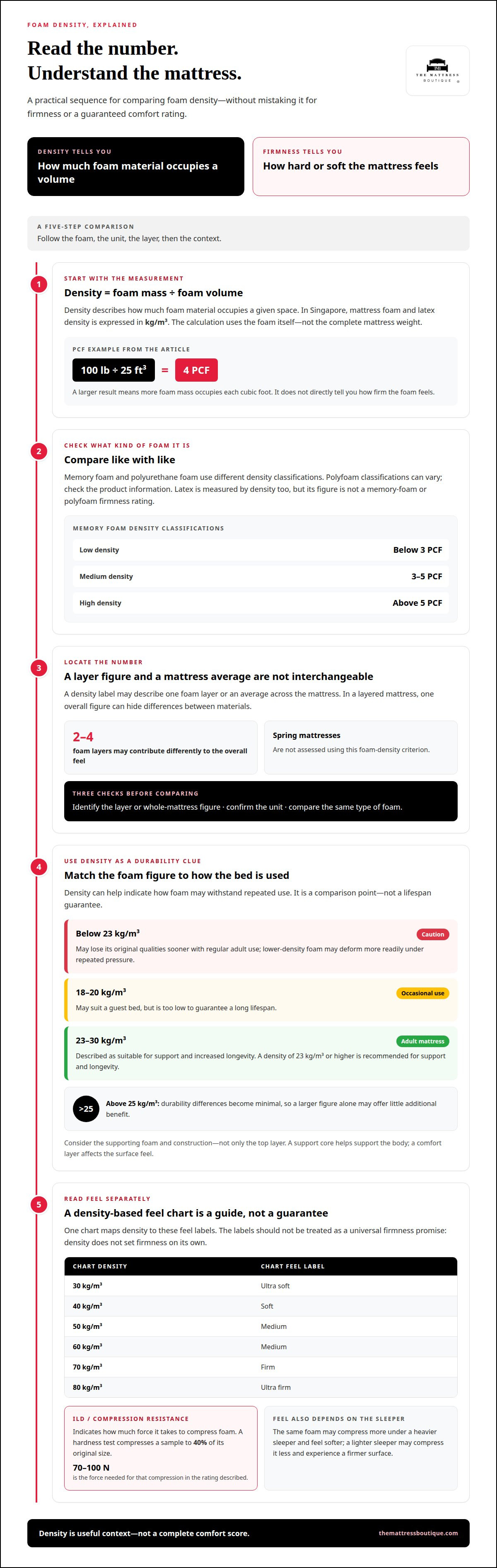
Foam density measures the mass of foam within a given volume. In Singapore, mattress foam and latex density is expressed in kilograms per cubic metre (kg/m³). To calculate it, divide the foam’s mass by its volume. The result describes how much material occupies that space, not how soft the mattress will feel.
Memory foam and polyurethane foam use different density classifications, so compare like with like. Memory foam is low density below 3 pounds per cubic foot (PCF), medium density from 3 to 5 PCF, and high density above 5 PCF. Polyfoam density classifications can vary, so check the product information to understand how its density is described. Latex is also measured by density, but its figure shouldn’t be treated as a memory-foam or polyfoam firmness rating.
Density and firmness answer separate questions. Density describes the amount of material; firmness describes how hard or soft the mattress feels when you lie down. Foam density can affect pressure resistance, but it doesn’t set firmness on its own. Foam hardness testing compresses a sample to 40% of its original size. A 70-100 N rating means that much force is needed for that compression.
Your body weight also affects how firmness feels. The same foam may compress more under a heavier sleeper, which can make it feel softer and increase pressure at contact points. A lighter sleeper may compress it less and experience a firmer surface. Density is useful context, but it cannot replace assessing a mattress’s support and comfort.
For Singapore shoppers, compare the unit and what the label describes. A density figure may refer to one foam layer or an average across the mattress; those measurements aren’t interchangeable. Some mattresses contain 2-4 different foam layers, each contributing differently to the overall feel. Spring mattresses aren’t assessed using this foam-density criterion.
How foam density is measured in pounds per cubic foot
Pounds per cubic foot, or PCF, expresses foam mass relative to its volume. The calculation uses the foam itself, not the mattress’s overall weight: divide the foam’s weight in pounds by its volume in cubic feet. This gives you a density figure for comparing foam materials measured in the same unit.
For example, a foam layer weighing 100 pounds and measuring 25 cubic feet has a density of 4 PCF. The calculation is 100 divided by 25. A larger result means more foam mass occupies each cubic foot. It doesn’t directly tell you how firm that layer feels or how much force it takes to compress.
Foam densities commonly range from 1.5 to 5 PCF or more. The material type matters when interpreting the number: a PCF figure for memory foam and one for polyurethane foam may fall into different density classifications. Compare similar materials and specifications rather than treating every PCF value as equivalent.
To interpret a PCF figure, follow this sequence:
- Identify whether the number describes a foam layer or the whole mattress.
- Confirm that the unit is PCF, not kilograms per cubic metre.
- Compare it with figures for the same type of foam.
A mattress’s total weight alone cannot establish foam density. Covers, springs and other components add weight, but the calculation requires the foam’s own mass and volume. In a layered mattress, one overall figure can also hide differences between materials. One layer may have a higher PCF value than another, even though both are part of the same mattress.
Use PCF as a material comparison, not a complete comfort score. Pair it with information about firmness or compression resistance to understand how the foam may feel under pressure. For example, a 4 PCF layer gives a density measurement, while its firmness assessment answers a different question about how it responds when compressed.
Density and mattress durability
Foam density helps indicate how much material is packed into a layer, which can affect how well it withstands repeated use. For an adult mattress, foam below 23 kg/m³ may not retain its original qualities for long. A density of 23 kg/m³ or higher is recommended for support and longevity. This is a useful comparison point, not a guarantee of a mattress’s lifespan.
Lower-density foam may deform more readily under repeated pressure, particularly for heavier sleepers. As it compresses night after night, the sleeping surface may lose some of its original shape and support. That makes the density of the supporting foam important, not just the feel of the top layer. Consider the mattress’s construction alongside its density figure.
Foam rated at 18 to 20 kg/m³ may suit a guest bed, where use is occasional, but it is too low to guarantee a long lifespan. For a frequently used adult mattress, 23 to 30 kg/m³ is described as suitable for support and increased longevity. These ranges help frame a choice around use, rather than treating every mattress as if it faces the same demands.
Higher density doesn’t mean durability rises endlessly. Differences in durability become minimal above 25 kg/m³, so a larger figure alone may offer little additional benefit. Compare the foam’s role and construction, then weigh density alongside the support and comfort you need. A high figure should be read in context, rather than as a simple quality ranking.
Support cores often use high-density polyfoam or latex to form the mattress’s structural base. The comfort layer matters too: it affects the surface feel, while the core helps support the body. For example, a durable core with a softer upper layer can combine structural support with a gentler feel. Density helps explain material resilience, but it doesn’t describe the whole experience.
Density-based foam feel chart
A density-based feel chart can look like a direct comfort guide, but its labels need careful reading. One chart places foam at 30 kg/m³ in the ultra-soft category and 40 kg/m³ in the soft category. It labels 50 kg/m³ and 60 kg/m³ as medium, 70 kg/m³ as firm, and 80 kg/m³ as ultra firm.
- 30 kg/m³: Ultra soft
- 40 kg/m³: Soft
- 50-60 kg/m³: Medium
- 70 kg/m³: Firm
- 80 kg/m³: Ultra firm
Read these labels as a chart’s shorthand, not a universal rule. Density measures how much foam material is present in a volume; it doesn’t directly measure how hard the foam feels. Firmness depends on resistance to compression, so foams with the same density can still feel different. Use the chart to understand its own scale, not to predict how every mattress will feel.
Material type also matters. Memory foam, polyurethane foam and latex have different structures, so a density figure should be compared with the same material and unit. A label of 50 kg/m³, for example, belongs to a density category; it doesn’t by itself establish that the mattress will feel medium to every sleeper.
Use the chart as an initial filter, then consider the mattress construction and the feel you prefer. A foam layer’s position matters: a comfort layer and a support core do different jobs. Sleeper weight also affects compression, so a surface that feels soft to one person may feel firmer to another. For a more direct firmness comparison, look for an ILD rating, which describes the force needed to compress foam.
The practical takeaway: use the chart to compare density labels, not to choose firmness on its own. Consider the figure alongside material type, layer role and resistance to compression for a clearer picture of the mattress.
The Mattress Boutique: King Koil Mattresses
The Mattress Boutique can help you compare mattress options once density and firmness figures have helped narrow your preferences. If you’re considering foam, latex or spring construction, focus on how the mattress feels and supports you, not density alone. The range includes various high-quality mattresses, with different brands and constructions to consider as you weigh comfort and design.
Turn to The Mattress Boutique when you’re ready to connect technical details with your everyday comfort needs. Understanding what is mattress foam density helps explain foam, but your preferred feel and the mattress’s overall construction matter too.
Visit themattressboutique.com to explore mattress options or contact The Mattress Boutique.
Choose with Your Sleep Preferences in Mind
Understanding what mattress foam density means is a useful starting point. Next, decide what matters most in everyday use. Think about the feel you prefer, how the mattress supports you, and whether you’re choosing for yourself or sharing the bed. These priorities help you compare options without letting one technical label make the decision for you.
As you narrow your choices, consider the mattress as a complete design rather than focusing on a single foam layer. Materials work together, and your preferred balance of comfort and support should guide the comparison. Knowing your priorities makes it easier to discuss suitable mattress options.
Talk with The Mattress Boutique about your mattress preferences and take the next step towards a choice that feels right for your bedroom.
Frequently Asked Questions
What is ILD in a mattress?
ILD is a measure of the force needed to compress a foam sample. The test described here compresses foam to a depth of 4 inches by 25% over an area of 50 square inches. A higher ILD indicates greater resistance during that test. Use ILD to compare compression response, rather than treating it as a density value or a complete prediction of mattress comfort.
What does mattress foam density mean?
Mattress foam density indicates how much foam material is present in a given volume. It describes the foam itself, not the weight of the complete mattress. For a practical comparison, make sure the figures refer to the same foam type and unit. Density can help you understand the material, but it cannot describe how the whole mattress will feel on its own.
What are typical foam density ranges for mattress comfort and support layers?
Ranges depend on foam type and the layer’s role. Foam densities commonly run from 1.5 to 5 PCF or more. For adult mattress support and longevity, 23 kg/m³ or higher is recommended; 23 to 30 kg/m³ is described as a suitable range for support and increased longevity. Support cores typically use high-density polyfoam or latex, while comfort layers contribute to the surface feel.
How does foam density affect mattress durability and lifespan?
Density can help indicate how well foam withstands repeated compression, but it doesn’t provide a precise lifespan. Adult foam below 23 kg/m³ may lose its original qualities sooner, while density of 23 kg/m³ or higher is recommended for support and longevity. Consider how often the bed is used and which layers carry the body, rather than judging durability by one number alone.
Does higher mattress foam density mean a firmer mattress?
No. A higher density means more foam material occupies a given volume; it doesn’t automatically mean a firmer feel. For example, a density-based chart may label 50 kg/m³ as medium, but that label isn’t a universal firmness measurement. The foam’s resistance to compression, layer position and how your body loads the mattress also influence what you feel.
What is the difference between foam density and mattress firmness?
Density describes how much foam material is present in a volume; firmness describes the resistance or softness you feel as the mattress compresses. Two foam layers with matching density figures but different compression responses can feel different under the same sleeper. For a fuller comparison, consider density alongside an ILD rating and the mattress’s layer construction.