

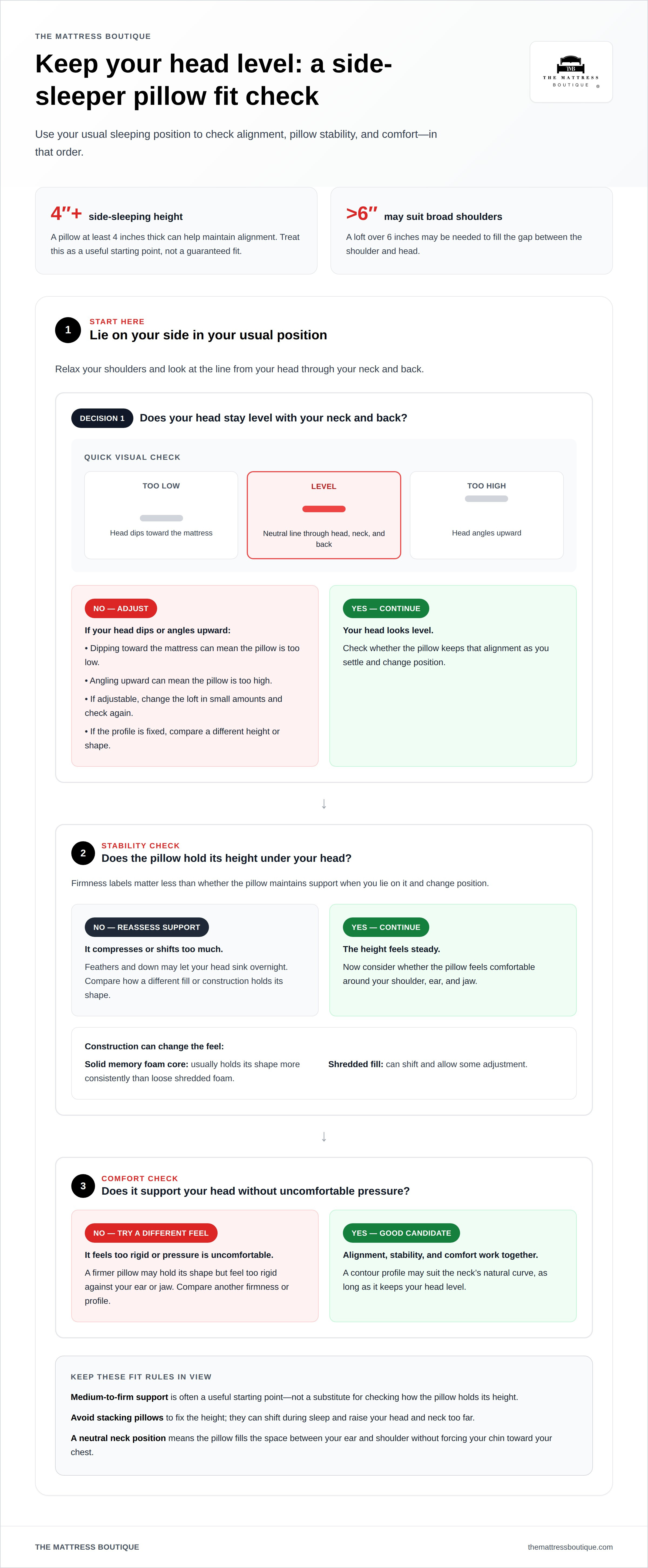
The best pillow fill may matter less than whether its height keeps your head level with your neck and back. For side sleeping, a pillow at least 4 inches thick can help maintain alignment, while medium-to-firm support is often a useful starting point. A side sleeper pillow for neck alignment should also feel stable enough to support your head without pushing it upward.
Choosing a side sleeper pillow for neck alignment can be tricky: one that feels comfortable at first may compress or shift, and the right profile depends on your build and mattress. This guide explains how materials, firmness, adjustability and construction affect support, then compares common pillow shapes and profiles. Use these practical criteria to narrow your options and find a pillow that suits the way you sleep.
Key Takeaways
- Prioritise a pillow that keeps your head level and supports a neutral neck position; a contour profile may suit the natural curve of your neck.
- Choose firmness by how well the pillow holds its height under your head, not by a firmness label alone.
- Consider how each fill responds overnight: feathers and down may compress enough for your head to sink.
- Compare pillow height and shape with your shoulder width and sleeping position to narrow down profiles that feel supportive.
What Pillow Materials Are Best for Side Sleepers?
For side sleeping, compare how each material supports your head and cushions your shoulder. The right choice balances neck support, comfort and steady pressure relief.
Ergonomic Neck-Support Options
A contour pillow has a groove shaped to sit beneath the neck’s natural curve. Unlike a flat profile, it gives the head and neck distinct support zones. Choose a contour that lets your head rest level rather than tilted. In Singapore, this ergonomic design is one option to consider for neck pain concerns, but fit depends on your shoulder width and mattress.
Spinal Alignment Support
Alignment depends on the line from your head through your neck and back. A pillow that is too low lets your head dip toward the mattress; one that is too high angles it upward. Side sleepers often need more height than back or stomach sleepers. The pillow should fill the space between your ear and shoulder without forcing your chin toward your chest.
Pressure Relief for Side Sleepers
Your shoulder bears pressure against the mattress, so your pillow should support your head without straining your neck. Medium-to-firm support can help maintain alignment if the pillow holds its shape under your head. Softer fill may feel comfortable at first, but feathers or down can let your head sink overnight. Compare support and pressure comfort, not softness alone.
Singapore prices vary with fill, construction, and profile, so compare the pillow’s support features rather than relying on a single cost estimate.
For side-sleeper neck alignment in Singapore, consider a contour profile or another supportive pillow that keeps your head level. Match its height and feel to your shoulder width and sleeping position.
| Option | Neck support | Pressure consideration |
|---|---|---|
| Contour pillow | Groove supports neck curve | Distinct head and neck zones |
| Flat profile | Less shaped support | May not fill shoulder space |
| Feather or down fill | Can compress overnight | Head may sink |
Choose a pillow that keeps your head level while easing pressure on your shoulder.
Replace a pillow when it no longer holds supportive height. One commenter described replacing theirs every 3-4 years, but that is an individual example, not a fixed schedule. Clean the cover according to its care label, and follow the label before washing the pillow itself.
Pillow firmness and adjustability
Firmness describes how much a pillow resists pressure, while adjustability lets you change its height or feel. Match both to your shoulder width and resting position.
Adjustable Pillow Options
An adjustable pillow lets you alter its loft, often by adding or removing fill where the design allows. That makes it different from a fixed-height pillow: you can fine-tune support if your head feels tilted or the pillow compresses too much. For broad shoulders, a loft over 6 inches may be needed to fill the gap between the shoulder and head.
If the fill is adjustable, change it in small amounts, then lie on your side and check whether your head stays level. A pillow that is too high can angle your neck upward; one that is too low can let it dip. Avoid stacking pillows to compensate: they can shift during sleep and raise your head and neck too far.
Cervical Pillow Options
A cervical pillow uses a shaped profile, such as a contour, to support the neck’s curve. Unlike an adjustable-fill design, its support comes mainly from its built-in shape and height. Choose a profile that feels stable beneath your neck without pushing your head out of line with your back.
Adjustable and cervical pillows are available through bedding retailers in Singapore. Return policies vary by seller and product, so the applicable terms determine whether a pillow can be returned and under what conditions.
Firmness is personal, but the useful test is whether the pillow maintains its height under your head when you change position. A soft surface can feel comfortable at first yet compress more than you want; a firmer pillow may hold its shape but feel too rigid against your ear or jaw. Compare how each option supports your head and neck while you lie on your side, rather than judging it by touch alone.
Use this quick fit check: lie in your usual position, relax your shoulders, then notice whether your head tips up or down. Adjust the loft, if possible, until your neck feels neutral. If the pillow’s shape cannot be changed, compare a different firmness or profile.
Pillow fill materials and construction
Fill determines how a pillow compresses, rebounds and distributes pressure. Construction matters too: a single-piece core behaves differently from loose fill that shifts inside a chamber.
Memory foam moulds around your head and neck under pressure, creating a close, cradling feel. A solid foam core usually holds its shape more consistently than loose shredded foam, while shredded fill can shift and allow some adjustment. If you sleep warm, consider the cover and foam design together. A “cooling” feature alone does not determine how comfortable the pillow will feel through the night.
Latex usually feels springier than slow-response memory foam. Its quicker rebound can make it easier to change position without leaving a deep impression in the fill. The feel depends on construction: a solid core offers a more uniform surface, while a shaped or perforated core changes the pillow’s structure. Compare the actual feel rather than assuming every latex pillow has the same firmness.
Feather and down fill can be moulded by hand, but may let your head sink during the night. That movement can change the support level after you settle in. Polyester fibre is another familiar fill; its loft and resilience depend on the amount of fill and how the pillow is stitched. With either option, check whether it holds its shape after compression.
Use these construction details to compare options:
- Single-piece core: keeps fill in one continuous form.
- Shredded fill: allows movement within the pillow and may be adjustable.
- Chambered construction: separates fill into sections, limiting how freely it shifts.
- Quilted cover: adds a fabric layer that affects the surface feel.
Press the pillow, then lie on it in your usual side-sleeping position. Notice whether the fill rebounds, shifts or stays compressed, and compare the cover’s feel with your preferences for cooling and softness.
Pillow shapes and profiles
Shape describes the pillow’s outline; profile describes its height and support surface. Both affect how your head rests beside your shoulder.
Pillow Shapes
A standard rectangular pillow offers a broad, even surface that lets you shift position easily. A contour pillow has a groove designed to support the neck’s natural curve, creating distinct areas for your head and neck. Choose based on whether the shaped surface remains comfortable as you move between side-sleeping positions.
Pillow Profiles
A low, flat profile provides less lift than a medium or high one. Side sleepers often need more height than back or stomach sleepers because the shoulder creates space between the head and mattress. A contour profile adds shaped support, while a traditional profile relies on an even surface. Compare the pillow’s height after lying down, not only before it compresses.
Pillow Height Factors
Shoulder width affects the gap a pillow must fill: broad shoulders may call for a loft over 6 inches. Side sleepers usually need at least 4 inches of pillow thickness to help keep the head, neck, and spine aligned. These are useful reference points, not a substitute for checking your resting position. Your head should remain level rather than tipped toward or away from the mattress.
Mattress firmness affects how deeply your shoulder settles. On a softer mattress, your shoulder may sink farther, reducing the height you need from the pillow. On a firmer surface, your shoulder stays higher, so a taller profile may feel more suitable. Test the pillow on the mattress you use nightly, as the same profile can feel different on another surface.
For a practical comparison, lie on your side with your usual mattress and pillow. Notice whether your head tilts, then compare a different profile or shape. Avoid stacking pillows: they can shift during sleep and raise your head and neck too far. Choose a profile that keeps your head level and feels stable around your neck and shoulder.
Explore pillow options to compare shapes and profiles for your sleeping position.
The Mattress Boutique: Pillows
The Mattress Boutique offers pillows for comparing height, shape and support for side sleeping. Use the criteria in this guide to narrow your preferences: consider your shoulder width, how well a pillow holds its shape, and whether a contour or standard profile feels comfortable. Your mattress also affects how your shoulder settles, so assess the pillow alongside your sleep surface.
If you’d like help choosing a pillow, contact The Mattress Boutique.
Make Your Next Pillow Choice With Confidence
Your next step is to connect pillow fit with the way you actually sleep. Notice whether your current pillow shifts, compresses or leaves your head tilted, then use those observations to focus on a suitable profile and feel. A side sleeper pillow for neck alignment should support your preferred position without making comfort feel like a compromise.
Your mattress also shapes how your shoulder settles, so consider the sleep surface alongside your pillow. The Mattress Boutique offers pillows and mattresses to help you weigh those choices together.
If you’d like help choosing your next pillow, contact The Mattress Boutique. A thoughtful choice can make your nightly routine feel more comfortable and consistent.
Frequently Asked Questions
What is a contour pillow?
A contour pillow has a shaped surface, usually with a dip for the head and a raised area beneath the neck. This differs from the even surface of a standard rectangular pillow. To assess the fit, lie on your side and settle your head into the shaped area. The neck support should feel comfortable, without the raised edge pushing your head forward.
What is the best pillow for neck pain?
The best choice supports your usual sleeping position without forcing your neck into an awkward angle. For side sleeping, a side sleeper pillow for neck alignment should feel comfortable beneath your head and suit your shoulder width. Try it in your preferred position rather than judging it while sitting up. Persistent or worsening neck pain deserves attention from a healthcare professional.
What pillow height is best for side sleepers to keep the neck aligned?
A pillow at least 4 inches thick is a useful starting point for side sleepers, but the right height depends on your shoulder width and how much the pillow compresses. Broad shoulders may call for loft over 6 inches. Compare the pillow while lying on your usual mattress, since your shoulder’s position changes the gap the pillow needs to fill.
How can side sleepers check if their pillow keeps the head and spine level?
Lie in your normal side-sleeping position and relax your shoulders. Ask someone to view your posture from behind, or take a side-view photo, to see whether your head tips toward or away from the mattress. Check again after settling into the pillow. If your chin angles toward your chest or your head dips, try a different height or profile.
What pillow materials are best for side sleepers with neck pain?
Choosing a side sleeper pillow for neck alignment means considering how its fill responds under your head. Memory foam can conform closely, while latex tends to rebound more quickly; either may suit you if it provides steady support. Shredded fill can shift, and feathers or down may compress. Compare the pillow after lying on it, not only by pressing it with your hand.
Are contour or cervical pillows effective for side-sleeper neck alignment?
Contour and cervical pillows can support side-sleeper alignment when their height and shape suit your body. Their shaped support differs from a flat pillow, but the contour alone does not determine fit. Lie in your usual position and check whether your head rests comfortably without tilting. If the raised section feels intrusive or pushes your head out of line, try another profile.