

The softest mattress isn’t automatically the best choice for undisturbed sleep. A motion isolation mattress for light sleepers should absorb movement without sacrificing the support and comfort you need; memory foam is known for absorbing movement, while pocketed coils can reduce transfer compared with interconnected coils.
If you share a bed, a motion isolation mattress for light sleepers can help reduce disturbances when your partner shifts position. The right choice depends on how you sleep, how much cushioning feels comfortable, and whether you prefer foam, latex or a hybrid design. This guide explains how mattress materials affect movement and how to compare options for couples. You’ll also learn how pocketed coils work, so you can weigh motion isolation against support and comfort.
Key Takeaways
- Compare foam, latex, hybrid and innerspring designs by how they balance movement absorption with the support and feel you prefer.
- Factor in your sleep position and your partner’s comfort needs when narrowing down mattress firmness and cushioning.
- Pocketed coils move more independently than interconnected coils, which can help limit movement across a shared bed.
- Use mattress construction and thickness as clues when comparing options, then explore suitable choices from The Mattress Boutique’s mattress brands.
1. How to Find the Right Motion-Isolating Mattress for You?
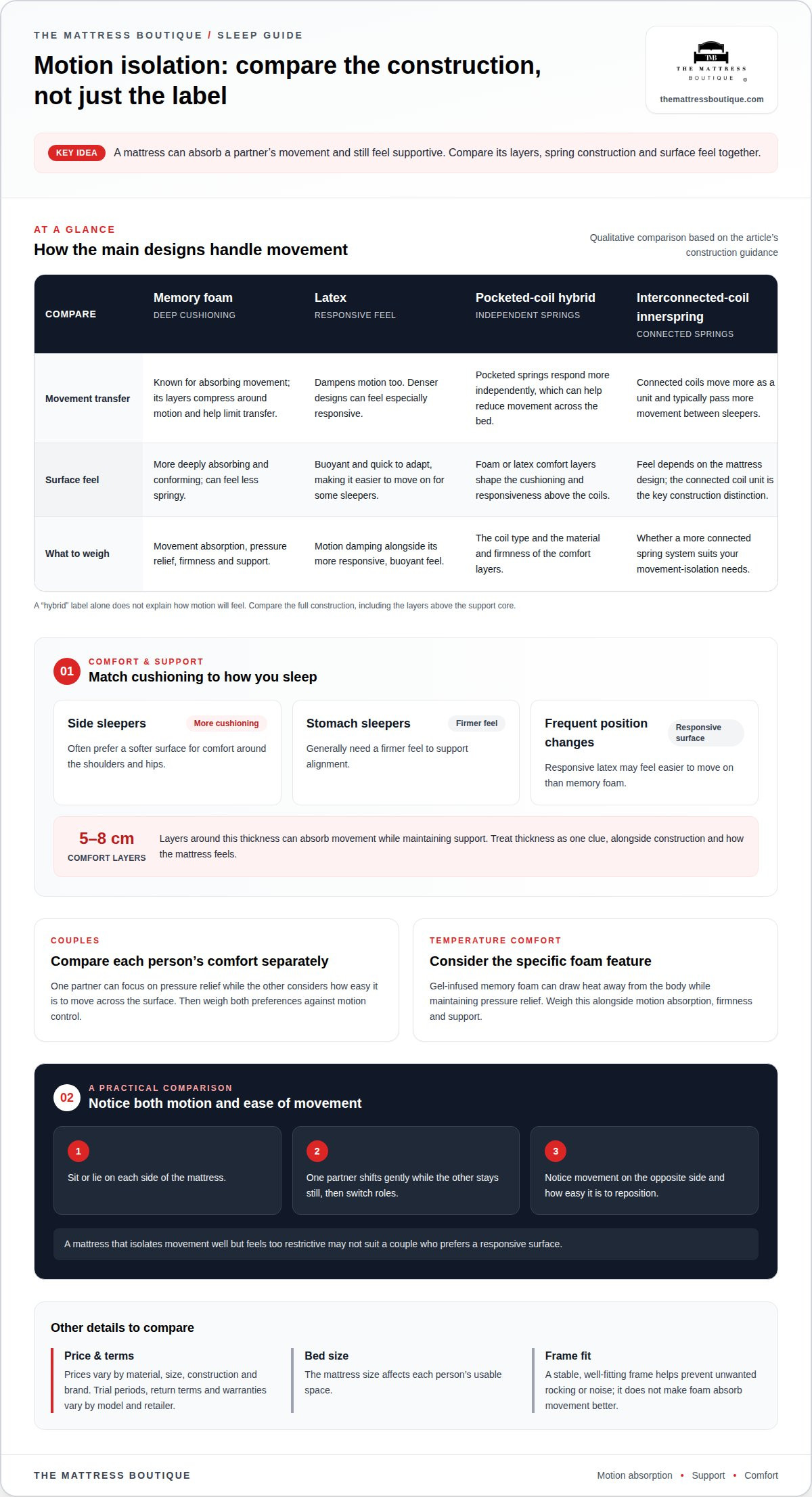
Memory foam generally absorbs the most movement, making it a useful starting point for light sleepers sharing a bed. Its cushioning layers compress around movement, limiting how much a partner’s turning travels across the surface. Latex also dampens motion, but feels more responsive, particularly in denser designs. Both all-latex and hybrid latex mattresses can reduce movement. Firmness, support and comfort help determine which suits you.
Compare the construction, not just the material name. A hybrid combines comfort layers, such as foam or latex, with a coil support core. Pocketed coils move more independently than interconnected coils, helping reduce motion transfer. Traditional innerspring designs with interconnected coils typically pass more movement between sleepers. Latex can feel buoyant and adapt quickly, while memory foam tends to absorb movement more deeply.
Next, consider your sleep position and the cushioning above the support core. Comfort layers around 5-8 cm can absorb movement while maintaining support. Side sleepers often prefer a softer surface for shoulder and hip comfort; stomach sleepers generally need a firmer feel to support alignment. If you change positions often, responsive latex may feel easier to move on than memory foam. A couple with different preferences can compare firmness and support separately from motion control.
In Singapore, mattress prices vary by material, size, construction and brand, so there is no single price for motion-isolating designs. Trial periods, return terms and warranties also vary by model and retailer, so compare the written terms for the specific mattress. For couples, mattress size affects each person’s usable space, while a stable, well-fitting frame helps prevent unwanted rocking or noise. The frame itself does not make foam absorb movement better.
Highly conforming foam can feel less springy than latex, which matters if you prefer an easier, more responsive surface. For temperature comfort, gel-infused memory foam can draw heat away from the body while maintaining pressure relief. Weigh that feature alongside motion absorption, firmness and support. The best fit balances fewer disturbances with a surface that feels comfortable through the night.
2. Mattress recommendations for light sleepers and couples
For couples, judge a mattress by how movement reaches the other side, not just by its label. One partner may turn frequently while the other wakes easily; a surface that absorbs movement can help reduce disruption. Memory foam is a strong option for limiting transfer, while latex offers a more responsive feel. Choose based on the balance you both prefer, rather than assuming one material suits every sleeper.
Sleep position helps narrow down the comfort choice. A side sleeper may need more cushioning around the shoulders and hips, while a stomach sleeper generally benefits from a firmer feel. If partners sleep differently, look for a combination of cushioning and support that works for both. For example, one person can assess pressure relief while the other focuses on how easy it is to move across the mattress.
A hybrid can suit couples who want cushioning with a spring-supported feel. Pocketed coils move more independently than interconnected coils, which can reduce movement transfer across the mattress. The comfort layers above them matter too: foam or latex changes how the surface responds when a partner shifts. Compare the whole construction, since the word “hybrid” alone does not tell you how motion will feel.
Common questions are practical: will a partner’s movement still be noticeable, and will a more responsive bed feel less isolating? The answer depends on the combination of materials, firmness and how each person moves. If one partner prefers a buoyant surface and the other wants deeper cushioning, compare those sensations separately before deciding. Explore mattress options for couples with those preferences in mind, then weigh comfort alongside motion control.
3. Pocketed coils in hybrid mattresses
A hybrid mattress places a coil support core beneath comfort layers such as foam or latex. In pocketed designs, each spring is individually wrapped, so it responds more independently than connected innerspring coils. When one partner turns, nearby springs compress without pulling the whole coil unit with them. This construction helps reduce movement transfer across the surface, a useful distinction for couples sharing a bed when one sleeper wakes easily.
The layers above the pocketed coils also shape how movement feels. Foam absorbs motion and creates a closer, more cushioned surface, while latex feels more responsive. A medium feel can offer a middle ground for partners who want cushioning without a deeply sinking sensation. The right combination depends on sleep position and comfort preferences. For example, side sleepers often look for cushioning around their shoulders, while a partner who changes position may prefer a surface that responds quickly.
Compare a pocketed-coil hybrid with a traditional innerspring by focusing on how the springs connect. Interconnected coils move as a more unified system, which can carry movement farther across the mattress. Individually wrapped coils work more independently, limiting that shared movement. This does not make every hybrid feel identical: foam or latex layers, firmness and overall support also affect the experience. Look at the whole construction, rather than choosing by the word “hybrid” alone.
For a practical comparison, sit or lie on each side and notice how a change in position feels on the opposite side. One partner can shift gently while the other stays still, then switch roles. Pay attention to both movement and ease of repositioning. A mattress that isolates movement well but feels too restrictive may not suit a couple who prefer a responsive surface. Pocketed coils offer spring support while reducing transfer, and the comfort layers determine much of the surface feel.
4. Best mattresses for motion isolation
The best choice depends on how much movement you want to absorb and how you sleep. Memory foam prioritises motion absorption, while latex offers a more responsive feel and can reduce motion. A hybrid combines comfort layers with a support core, and its pocketed coils can move independently. For couples, compare the whole construction rather than choosing by material name alone. Firmness should also suit each sleeper’s position and pressure needs.
Mattress thickness can help guide your shortlist. Designs around 12-14 inches generally offer more volume to absorb movement. Thickness isn’t a substitute for suitable materials, though: a taller mattress with interconnected coils can still transfer movement. Check the layers and support system together. For example, a foam comfort layer over pocketed coils combines cushioning with individually responsive support.
Comfort remains part of the decision. Side sleepers need pressure relief around the shoulders and hips, while stomach sleepers generally benefit from firmer support. Couples with different preferences can compare how the surface responds when one person changes position. Cooling features may matter too: phase-change materials in mattress covers regulate surface temperature, while breathable cotton or Tencel covers can improve moisture-wicking.
Use a short checklist to make a practical comparison: identify the material and coil design, assess firmness for your sleep position, then consider thickness and cover. For warranty protection against manufacturing defects, a useful benchmark is at least 10 years. This doesn’t determine motion isolation, but it helps you assess product protection alongside construction. For a focused comparison, explore mattress options and weigh their materials, comfort layers and support design against your needs.
The Mattress Boutique
The Mattress Boutique helps you compare mattresses when a partner’s movement disrupts your sleep. Its range includes Sofzsleep mattresses, with different materials, firmness levels and support options to consider. Use the construction points in this guide to identify what matters most: motion absorption, a responsive feel, pressure comfort or a balance of these qualities. This can help narrow your choice to options suited to your sleep position and shared-bed preferences. The Mattress Boutique offers personal guidance to help you compare these priorities across its mattress range. Contact The Mattress Boutique to discuss which motion isolation mattress for light sleepers may suit your needs.
Make Your Next Mattress Choice With Confidence
Choosing a motion isolation mattress for light sleepers means finding a surface that suits both people, not just one that reduces movement. Before deciding, consider which compromise matters most in your shared bed: deeper cushioning, easier repositioning, or a balance of both. That preference gives you a practical way to compare options without getting distracted by a single feature or label.
If you’re still weighing different materials and feels, consider how a motion isolation mattress for light sleepers would match your sleep positions and comfort preferences. The Mattress Boutique can help you explore mattress options with those priorities in mind. Starting with what matters most makes the decision easier to discuss and refine.
Contact The Mattress Boutique to explore your mattress options and take the next step towards more comfortable shared sleep.
Frequently Asked Questions
How to Find the Right Motion-Isolating Mattress for You?
Start by deciding what matters most: less disturbance, easier movement, or a particular pressure feel. Then compare those priorities with your usual sleep position and your partner’s preferences. For example, if one person sleeps on their side and the other changes position often, assess shoulder comfort and ease of turning separately. This helps you choose a mattress that works for both sleepers.
Which firmness level is best at isolating motion?
No single firmness level guarantees the best motion isolation. Materials and construction affect how movement travels, while firmness affects how the surface feels and supports each sleeper. If partners prefer different feels, consider which firmness lets both rest comfortably in their usual positions. A mattress that reduces movement but feels uncomfortable for one person may not be the right choice for both.
Which mattresses have the best motion isolation in Singapore?
Memory foam is a strong material to consider for absorbing movement, while individually pocketed springs can help limit transfer compared with connected coils. In The Mattress Boutique’s range, Slumberland Vitalize 1 lists an Individual Pocketed Spring System and Non-Disturbance Technology. King Koil Cool Radiance lists an Advanced Individual Pocketed Spring system. These features make them options to compare, not a universal ranking.
How can I test mattress motion isolation before buying?
Test the mattress with both partners present, using the positions you normally sleep in. Have one person turn, sit down and get up while the other stays still and notices movement around the shoulders and hips. Then switch roles. Compare the sensation across mattresses, while also checking whether each person can change position comfortably.
What mattress firmness is best for light sleepers and couples?
The best firmness is the one that supports each sleeper’s position and feels comfortable to both partners. For instance, a side sleeper may prioritise cushioning at the shoulders, while a stomach sleeper may prefer a firmer surface. If your preferences differ, discuss which feel is least comfortable for either person, then compare options that balance support and pressure relief.