

The plushest-looking mattress isn’t automatically the softest or the most supportive. In the pillow top vs euro top mattress comparison, the main difference is how the cushioning is attached: a pillow top is stitched onto the mattress surface with a small gap, while a Euro top is sewn flush beneath the outer fabric. Both add a plush comfort layer, typically about 1 to 4 inches thick.
That construction difference affects a mattress’s appearance and can influence how its edges feel, but it does not tell you everything about comfort or support. Materials, firmness and the support core matter too, so the right choice depends on how you sleep and what feel you prefer.
This guide explains how pillow-top and Euro-top mattresses are built, how they may wear over time, and what to consider if you sleep on your side or have back discomfort. You’ll also learn how a Euro pillow-top combines features of both styles and how to compare the details that matter when choosing a mattress in Singapore.
Key Takeaways
- Look at how the comfort layer is attached: pillow tops sit visibly above the mattress, while Euro tops are sewn flush with the edges.
- Compare the cushioning materials and support core, not just the top style, to judge feel, support and how the mattress may wear.
- Use the typical lifespan ranges as a guide: pillow tops generally last 5-7 years, while Euro tops can be expected to last 8-10 years.
- Match the surface feel to your sleeping position: extra cushioning may suit side sleepers, while a flatter, steadier feel may appeal to back or stomach sleepers.
- Explore how a Euro pillow-top blends a cushioned surface with a more even, structured edge.
What is a pillow-top mattress, and how is it constructed?
A pillow top is a plush comfort layer stitched onto a mattress surface, usually with a small gap beneath it. Pillow-top and Euro-top layers are approximately 1 to 4 inches thick, but their attachment and edge finish differ.
For couples, motion isolation depends more on the support core than on either top style. A memory foam pillow-top layer may also help reduce motion transfer.
Pillow-Top Construction and Comfort Layers
A pillow top is a separately made pad stitched onto the mattress surface. Its rounded, raised profile and slight gap around the edge make it distinct from the mattress below. The cushioning may be foam, fibre or latex, including memory foam.
A Euro top also adds foam, fibre or latex, but its comfort layer is sewn beneath the outer fabric and sits flush with the mattress edges. This creates a flatter, more uniform appearance. Either style can feel plush: the materials and underlying mattress shape the actual comfort.
Mattress Core and Comfort
The core supports the sleeper, while the top layers cushion the body. For example, a pocketed spring core has a different structure from a foam core, even when the mattresses have similar-looking tops. The core and firmness usually affect the feel more than the choice between pillow-top and Euro-top construction.
Consider the whole construction rather than judging only the surface. A soft top over a supportive core may feel cushioned without the same sinking sensation as soft padding over a less supportive base. The number and type of comfort layers also shape how the mattress responds.
A tight top has no extra padding above its main surface, so it tends to feel firmer than a padded style. A smooth top describes fabric that extends over the mattress edge, partly or fully wrapping it. These terms describe different construction details. Quilting can appear on tight-top, smooth-top, Euro-top or pillow-top styles.
Use this comparison to distinguish visible construction from the factors that affect feel:
| Style | Top construction | Appearance and feel |
|---|---|---|
| Pillow top | Separate comfort layer stitched onto the surface | Raised, rounded profile with plush cushioning |
| Euro top | Comfort layer sewn beneath outer fabric | Flat, even profile, flush with the edges |
| Tight top | No additional padding on top | Typically firmer surface |
| Smooth top | Fabric extends over the mattress edge | Continuous surface with a wrapped edge |
When comparing mattresses, note the top style first, then assess the core, firmness and cushioning materials separately.
For example, two mattresses with memory foam comfort layers may still feel different if one has pocketed springs and the other a foam core. The top style alone won’t explain the difference. Check the edge finish, layer materials and core together to understand the full construction.
Durability and sagging
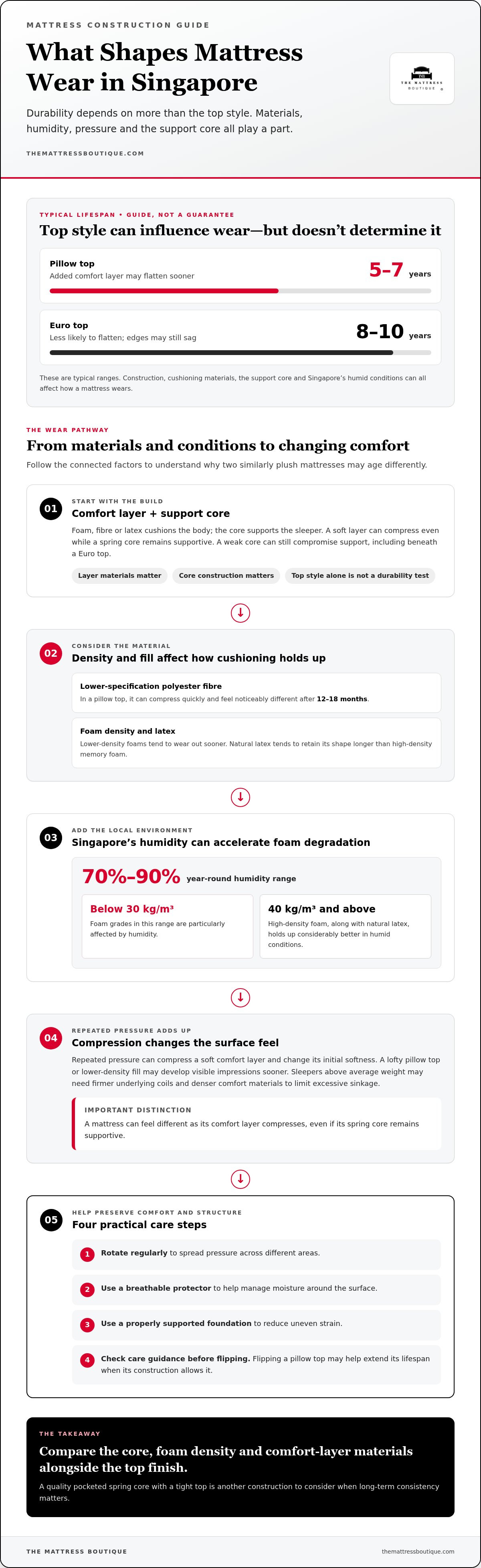
A pillow top may feel plush at first, but its added comfort layer can flatten sooner than a Euro top. Construction, cushioning materials, the support core and Singapore’s humid conditions all influence wear. Top style alone cannot predict durability.
Pillow tops generally last 5-7 years, while most Euro-top mattresses can be expected to last 8-10 years. These are typical ranges, not a guarantee for every build. A lofty pillow top or lower-density fill can develop visible impressions sooner. Euro tops are less likely to flatten, though their edges may still sag.
Material choice helps explain the difference. Lower-specification polyester fibre in a pillow top can compress quickly and feel noticeably different after 12-18 months. Natural latex tends to retain its shape longer than high-density memory foam, while lower-density foams and traditional innerspring builds tend to wear out sooner. A hybrid’s spring core and comfort-layer materials both matter.
Singapore’s year-round humidity typically ranges from 70% to 90%. Humidity accelerates foam degradation, particularly in grades below 30 kg/m³. Natural latex and high-density foam at 40 kg/m³ and above hold up considerably better in humid conditions. For perspective, a low-density-fill pillow top that might last four years in a temperate climate may feel noticeably different after two years in a Singapore bedroom.
Firmness and cushioning affect how wear feels during sleep. A soft comfort layer can compress under repeated pressure, changing the initial softness even if the spring core remains supportive. Sleepers above average weight may need firmer underlying coils and denser comfort materials to limit excessive sinkage. A Euro top’s more integrated construction may wear more evenly, but a weak core can still compromise support.
Follow a few practical steps to help preserve comfort and structure:
- Rotate the mattress regularly to spread pressure across different areas.
- Use a breathable protector to help manage moisture around the surface.
- Place the mattress on a properly supported foundation to reduce uneven strain.
- Follow the mattress’s care guidance before flipping it; flipping a pillow top can help extend its lifespan when the construction allows it.
Compare the core, foam density, and comfort-layer materials alongside the top finish. These mattress construction details help explain why two similarly plush beds may age differently. If long-term consistency matters most, a quality pocketed spring core with a tight top is another construction to consider for five-plus years of use.
What's the Difference Between a Pillow-Top and a Euro-Top?
The main difference is how each comfort layer joins the mattress and finishes at the edges. That construction shapes the surface feel and edge support, but does not determine firmness on its own.
Pillow-Top Design and Feel
A pillow top has a cushioned layer stitched onto the mattress surface, with a visible indentation around its perimeter. This raised, rounded design often feels plush and conforming from the outset. Its padding may cushion the shoulders and hips, while the separate layer can feel more distinct from the mattress beneath than a Euro top does.
Euro-Top Design and Feel
A Euro top’s comfort layer is sewn beneath the outer fabric and sits flush with the mattress edges. This creates a flatter, neatly stacked appearance rather than the pillow top’s raised profile. Euro tops often use denser materials, which can give them a more structured feel and firmer perimeter while retaining cushioning through the centre.
Firmness and Plush Feel
A Euro top is not automatically firm, and a pillow top is not always softer. Foam, latex or fibre, along with the core’s construction, determine how each mattress feels. Euro-top materials are often denser, so the surface may feel less plush. A pillow top may feel plusher initially, but its softness still depends on the materials and underlying support.
Surface Cushioning and Sinkage
Across the surface, a pillow top typically provides plush, conforming cushioning. Its added padding may soften pressure at contact points, but a top that is too soft may let the hips sink too far if the support core is not strong enough. A Euro top may feel more even near the edges, with cushioning in the centre and a firmer perimeter.
Both styles add comfort without changing the mattress’s underlying support level. Compare how they feel across the centre and edges, then assess the support core separately. A mattress can have a plush top and supportive core, or a firm-feeling top over a different core construction.
| Criterion | Pillow top | Euro top |
|---|---|---|
| Attachment | Stitched onto the surface | Sewn beneath outer fabric |
| Appearance | Raised, rounded profile | Flat, flush edges |
| Typical feel | Plush, conforming cushioning | Structured, often firmer at edges |
| Edge support | May be weaker at the perimeter | Generally more even and supportive |
Test the feel you prefer at the centre and perimeter, then give more weight to the materials and core than to the top style alone.
Suitability for side sleepers and people with back pain
Your sleeping position helps identify the balance of cushioning and support to look for. The pillow top vs euro top mattress comparison is most useful when you assess each surface against your usual sleeping posture.
Side sleepers place pressure on their shoulders and hips, so a softer top may cushion those contact points. The pillow top vs euro top mattress decision should also account for how deeply your hips settle. If the comfort layer is too soft for the support core, your hips may sink excessively and affect spinal alignment. Look beyond the first impression and assess how the whole mattress supports your body.
For back discomfort, stiffness or joint discomfort, a medium to medium-firm hybrid with a Euro top can be a starting point. Its surface cushioning pairs with a steadier feel. The top label alone does not establish support, so consider firmness and the core together. A softer surface may feel comfortable at first but still be a poor fit if your lower back feels strained in your usual sleeping position.
Back and stomach sleepers often prefer a flatter, more supportive feel. A Euro top’s even surface and firmer perimeter may suit those who like a structured feel. Stomach sleepers should notice whether their hips dip into the mattress, since excessive sinkage can make the body feel uneven. Side sleepers who prefer a firmer bed can also consider less-plush cushioning rather than choosing by top style alone.
Materials affect temperature as well as comfort, especially in Singapore’s warm climate. Memory foam in a pillow-top layer may retain body heat. Breathable padding and cover materials help air circulate, while the mattress core also contributes to the overall feel. If you tend to sleep warm, compare the top materials and ventilation features rather than relying on the style name.
Test a mattress in your usual sleeping position before deciding. Lie as you normally would for two minutes, then notice how your lower back feels and whether your shoulders or hips feel pressured. Couples can also observe motion when one person changes position. Motion isolation depends more on the support core than on whether the mattress has a pillow or Euro top.
- Side sleepers: prioritise shoulder and hip cushioning without excessive hip sinkage.
- Back sleepers: compare medium to medium-firm support with comfortable surface cushioning.
- Stomach sleepers: look for a flatter, firmer feel that helps keep the hips from dipping.
- Warm sleepers: consider whether memory foam or more breathable materials suit your comfort needs.
Use your sleeping position, pressure points, temperature preference and lower-back comfort as a checklist. Testing the whole mattress can help you judge whether its cushioning and support work together for your routine.
Euro pillow-top mattress examples
A Euro pillow-top description suggests a blend of surface cushioning and a neater, more structured finish. The useful comparison is not the label alone. Look at the comfort materials, support core and how the top layer meets the mattress edges. Those details indicate how a specific combination may feel.
Imagine a Euro-style surface with a plush foam comfort layer over a pocketed spring core. The flush edge gives the mattress a more uniform profile, while the foam cushions above the springs. This combination may suit someone seeking pressure relief without a visibly separate, rounded pillow-top pad. The core and foam firmness still shape the overall feel.
Other illustrative combinations show why material details matter:
- Latex over springs: A latex comfort layer provides cushioning over a spring core. Compare the layer’s feel with the mattress firmness rather than assuming every Euro finish feels the same.
- Foam over springs: A foam top can add contouring above the support core. Memory foam may retain body heat, so material and breathability matter in Singapore.
- Fibre over a firmer core: Fibre adds a different kind of surface cushioning. The core remains central to the bed’s support, even when the top feels plush.
These are construction examples, not product names or guarantees. Pillow-top and Euro-top comfort layers are generally about 1 to 4 inches thick, and both styles can use foam, latex, or fibre. A mattress described as a Euro pillow-top may combine a Euro-style, flush appearance with noticeable upper cushioning. Inspect the seams and surface rather than relying on wording alone.
For pressure relief, consider where your body meets the bed. A side sleeper may prefer more cushioning at the shoulders and hips, while someone seeking a steadier perimeter may value the flush edge. If the comfort layer is too soft for the support core, the hips can sink too far. The top-style name cannot tell you whether that balance is right.
Use this sequence to assess an example: identify the comfort-layer material, note how the top joins the edge, then consider the core and firmness. A breathable cover and airflow-promoting coil base may help reduce warmth from dense foam. To assess durability, compare materials and construction rather than assuming every Euro-style combination resists sagging equally.
Explore mattress options for cushioned comfort and compare the construction details that matter to your preferred feel.
The Mattress Boutique: King Koil Mattresses
The Mattress Boutique offers quality mattresses for shoppers comparing comfort layers, firmness and support. Its range includes various premium mattress options, giving you several selections to consider as you weigh a plush surface against a more structured feel.
Use the construction points in this guide to narrow your preferences: note your sleeping position, preferred cushioning materials and how much support you want at the edges. Then compare those priorities across the mattress options instead of choosing by the top-style label alone.
For a considered next step, contact The Mattress Boutique to discuss your mattress preferences, or visit themattressboutique.com.
Make Your Mattress Shortlist Work for You
Turn your pillow top vs euro top mattress decision into a shortlist based on your everyday priorities. Before choosing, note how you want the surface to feel, what support matters most and which details you’re willing to compromise on. This gives your comparison a clear purpose beyond appearance or a familiar label.
The Mattress Boutique offers King Koil, Slumberland and Dunlopillo mattresses to consider as you refine your preferences. Focus on finding an option that suits your comfort priorities and feels right for your bedroom routine, rather than choosing a style in isolation.
When you’re ready to explore your options, contact The Mattress Boutique and take the next step toward a more considered mattress choice.
Frequently Asked Questions
What is a Euro Top?
A Euro top is a mattress style with cushioning integrated beneath the outer cover, creating a tidy, level finish. The label describes how the comfort layer is joined, not a guaranteed firmness. Compare the materials and the mattress beneath the top to understand the overall feel.
Does a pillow top or Euro top have a longer lifespan?
Euro tops generally have the longer expected lifespan: pillow tops typically last 5-7 years, compared with 8-10 years for most Euro tops. These ranges are useful for planning, not a prediction for every mattress. A low-density fill, frequent pressure in one spot, or a weak support core can change how a mattress feels. Check care guidance for rotation or flipping to help distribute wear.
How Do the Two Match Up?
A pillow top prioritises a visibly cushioned, plush surface, while a Euro top gives cushioning a more integrated finish. To compare them, lie near the centre, then move toward the edge and notice how each area feels. Couples can also observe movement when one person changes position. The mattress core influences motion isolation more than the top label does.
What about quilted tops?
Quilting describes stitching in the mattress cover, not a separate top style. A quilted cover can be used with tight-top, smooth-top, Euro-top or pillow-top construction. For example, a quilted cover alone does not mean the mattress has a thick cushion layer that feels separate. Look at the mattress profile and how the padding meets the edges to distinguish quilting from the overall top design.
What are the most common mattress top types?
Common top styles include pillow top, Euro top, tight top and smooth top. Pillow and Euro tops add cushioning, while a tight top has no extra padding above its main surface. A smooth top describes fabric that extends over the edge. These labels refer to surface construction, so do not confuse them with core types such as pocketed spring, memory foam or latex.
What else should you consider when choosing a mattress top type?
Consider the mattress core, comfort-layer materials, firmness, sleeping position and edge feel together. In Singapore’s humid climate, foam density and breathable materials also matter, as humidity can accelerate foam degradation, particularly in lower-density foam. If the added top makes the mattress taller, check that your fitted bedding still sits securely. Testing the mattress in your normal sleeping position can help reveal pressure or sinking.
What is the difference between a pillow top and a Euro top mattress?
The main difference is the attachment and finish: a pillow top is stitched onto the mattress surface, while a Euro top is integrated beneath the outer fabric. This gives the pillow top a raised appearance and the Euro top a flatter profile. To choose, compare how the centre and edges feel, then consider the materials and support core beneath the surface.
How are pillow top and Euro top mattress layers constructed?
A pillow top uses a separately made comfort layer stitched onto the mattress, often leaving a visible gap around its perimeter. A Euro top’s cushioning is sewn beneath the outer fabric and sits flush with the edges. Either style may use foam, latex or fibre. Inspect the seam and edge profile to identify the construction, then consider the layer materials to understand more about comfort.