

The best mattress for couples with different weights isn’t necessarily the firmest one. It should support the heavier partner while giving the lighter partner enough pressure relief. The right feel depends on how each person sleeps and what keeps them comfortably supported.
It’s easy to assume one firmness level will suit both people, but differences in body weight can change how a mattress feels on each side. If one partner sinks too far while the other feels pushed up, comfort and support may be uneven.
This guide explains how to compare support, firmness, edge stability and motion transfer when choosing a shared bed. You’ll also learn how foam, latex and spring constructions can feel different, and which trade-offs to consider. Use these practical checks to narrow your options based on both partners’ needs, rather than relying on a firmness label alone.
Key Takeaways
- Assess edge support to understand how much usable sleeping space each partner can comfortably enjoy.
- Compare how firmness and support feel for both partners, rather than relying on one label to suit everyone.
- Consider motion isolation if one partner’s movements tend to disturb the other’s sleep.
- Use mattress construction and each partner’s comfort needs to narrow down suitable options.
How does edge support benefit couples with different weights?
A stable perimeter, supportive core and balanced comfort layers can help limit sagging and the feeling of rolling towards the middle.
Edge Support and Usable Sleeping Space
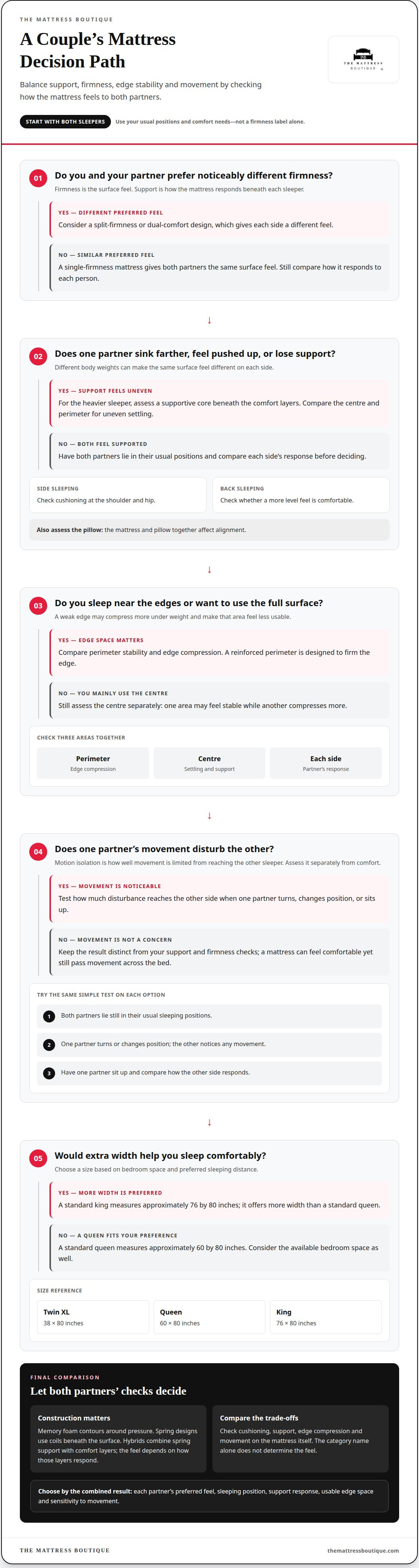
Edge support is the stability around a mattress’s perimeter. It matters when partners sleep near opposite edges, because a weak edge may compress more under weight and make that area feel less usable. A standard queen measures approximately 60 by 80 inches, while a standard king measures approximately 76 by 80 inches. A twin XL typically measures 38 by 80 inches. Within each size, stronger edge support can help partners use more of the surface without crowding the centre.
Support and Durability for Two Sleepers
Two sleepers put pressure on different areas, while movement and regular use also affect the mattress surface. A hybrid combines spring support with comfort layers, but how it feels depends on how those layers respond to each partner. Compare the perimeter and centre separately: one area may feel stable while another compresses more.
For a heavier sleeper, look for a supportive core beneath the comfort layers. If one partner sinks farther, a stable perimeter and balanced centre can help reduce uneven settling. Both partners should lie in their usual sleeping positions and compare how each side responds. Check whether either person feels pulled towards the middle or loses support near the edge.
| Option | Perimeter stability | Support to assess | Potential fit |
|---|---|---|---|
| Reinforced perimeter | Designed to firm the edge | Check edge compression | Partners using the full surface |
| Hybrid layers | Depends on perimeter design | Compare spring and comfort response | Partners seeking a layered feel |
| Softer comfort layers | May feel different from the centre | Assess sink and support together | Partners balancing cushioning and stability |
Compare the edge, centre and each partner’s support needs, rather than relying on the firmness label alone.
Firmness and support for partners with different body weights
Firmness describes the surface feel; support describes how the mattress responds beneath each sleeper. Choose for both partners’ needs instead of relying on one firmness label.
Firmness Options for Couples
Firmness ranges from soft to firm, but the same surface can feel different to partners with different body weights. A lighter sleeper may find a mattress comfortable while a heavier partner sinks deeper. Compare sleeping positions and pressure points: side sleepers often need cushioning at the shoulder and hip, while back sleepers may prefer a more level feel. Assess the mattress and pillow together, since the pillow also affects alignment.
Multiple and Split-Firmness Options
Split-firmness or dual-comfort designs give each side a different feel, unlike a single-firmness mattress with one shared surface. This can help when partners prefer noticeably different firmness levels. Memory foam contours around pressure, while spring and hybrid designs combine materials in different ways; the category name alone doesn’t determine the feel. Focus on how each side supports its sleeper and whether movement transfers across the surface.
How much do suitable mattresses for couples cost in Singapore dollars? Price depends on factors such as size, materials and construction. Compare similar features rather than assuming firmness determines the cost.
Are split-firmness or dual-comfort mattresses available in Singapore? These terms describe mattresses with a different feel on each side. A single-firmness design gives both partners the same surface feel.
Singapore mattress sizes include queen and king options. A standard queen measures approximately 60 by 80 inches, while a standard king measures approximately 76 by 80 inches. The king offers more width for partners who want extra room; choose based on bedroom space and preferred sleeping distance.
To narrow the choice, compare each partner’s preferred firmness, sleeping position and response to motion transfer. Explore mattress options with those criteria in mind.
What Else Is Important When Buying a Mattress for Couples?
Partners can share firmness preferences yet still notice each other’s movement. Compare how a mattress responds when one person turns, gets up, or changes position.
Motion Isolation
Motion isolation describes how well a mattress limits movement reaching the other sleeper. It matters when partners have different sleep patterns, such as when one person gets up earlier. A surface that absorbs movement can make those changes less noticeable. Assess this separately from comfort: a mattress may feel comfortable to both partners yet still pass movement across the bed. Notice how much disturbance reaches the other side when one partner shifts position.
Motion Transfer
Motion transfer is movement that travels through a mattress when someone moves. A partner who turns frequently may create a different sensation on the other side, depending on the materials and construction. Contouring materials respond around the person applying pressure, while a more connected surface may transmit movement across the bed. Consider which matters more to you: close contouring or a more responsive feel.
Compare materials with a simple test together: lie still, turn into your usual sleeping positions, then have one partner sit up. Memory foam contours around pressure, while spring designs use coils beneath the surface. These constructions can feel different, so assess comfort and movement in the positions you actually sleep in.
Use your usual sleep habits as the test. If one partner wakes easily, notice whether they feel movement when the other changes position. If both partners move often, repeat the test with turns and changes between back and side sleeping. Discuss the results together: one person may notice movement while the other prioritises cushioning.
Assess motion isolation separately from support and firmness. A mattress can limit movement yet still feel too soft or firm for one sleeper. Compare each quality on its own, then decide which trade-off best suits both partners.
Mattresses for couples with different body weights
Which mattress types work best for couples with a large weight difference? Hybrid, memory foam, latex and pocketed spring designs may suit different needs, but construction and feel matter more than the category name. Compare how each option supports both partners in their usual sleeping positions.
Mattress choices in Singapore include pocketed spring, memory foam, latex and Bonnell spring designs. Their constructions differ, so assess the actual surface response rather than assuming every mattress in one category feels alike. A hybrid combines materials, while an all-foam design uses foam layers. One partner may prefer a firmer feel while the other wants more cushioning.
For a heavier sleeper, look for a supportive core and a suitable stated weight rating. Treat that figure as a capacity, not a guarantee of comfort or durability. Both partners should assess how the mattress responds to their weight and sleeping position.
What mattresses for couples with different weights can you find in Singapore, and how do they compare? The Mattress Boutique offers SofzSleep and Slumber Pedic mattresses, as well as pocketed spring, memory foam, latex and Bonnell spring types. Compare construction, firmness, support and comfort layers rather than assuming a brand name predicts the feel.
- Memory foam: Compare the contouring and how supported each partner feels.
- Latex: Assess its surface feel against both partners’ comfort preferences.
- Pocketed spring: Compare support and movement response for each sleeper.
- Hybrid mattress: Consider how its combined materials balance comfort and support.
Choose by testing both sides together and noting which partner needs a firmer or more cushioning feel. Compare mattress options for couples to narrow your shortlist by construction and support needs.
The Mattress Boutique
The Mattress Boutique offers King Koil, Slumberland, Dunlopillo and SofzSleep mattresses for couples weighing different comfort needs. Compare their construction and feel against what each partner wants from the sleeping surface. This gives you a practical starting point for narrowing down suitable options together.
One partner may prefer a firmer feel while the other wants more cushioning. Discussing these priorities helps you focus on options that could work for both, rather than choosing by brand name alone. Talk with The Mattress Boutique about mattress options for your shared comfort needs.
Choose a Mattress You Can Both Settle Into
Turn each partner’s preferences into a shared decision. Agree on what matters most, such as a steadier feel for one person or more cushioning for the other, then use those priorities to compare options. The best mattress for couples with different weights supports both sleepers in practice, not just on the label.
The Mattress Boutique offers King Koil, Slumberland and Dunlopillo mattresses to consider as you narrow your choices. A focused conversation can help you decide which construction and feel to explore together, while keeping both partners’ comfort in view.
Contact The Mattress Boutique for help choosing a mattress that suits both of you. A thoughtful choice can make your shared bed feel more comfortable for each partner.
Frequently Asked Questions
Bottom Line: What’s the Best Mattress for Couples?
The best mattress for couples with different weights lets both partners rest comfortably while feeling supported. Decide together which trade-off matters most: closer contouring for pressure relief, a more responsive surface or a different feel on each side. Compare options against those shared priorities rather than choosing by reputation or label alone.
What Does a Bed for Couples Need?
A shared bed needs enough room for both people to change position without crowding, and a mattress and base that work together. Consider the bedroom layout, space to move around the bed, and whether both sleepers can get in and out comfortably. A well-matched frame also provides a stable foundation for your mattress.
What features should couples with different weights look for in a mattress?
Look for a mattress that responds well to both partners, not just the heavier sleeper. Compare how it feels under each person and whether either notices a dip where their bodies meet. Consider the stated weight capacity and whether support feels consistent across the areas each person uses most. These checks help distinguish a suitable design from one that feels comfortable only at first.
How should mattress firmness be chosen for partners with different body weights and sleep positions?
Choose firmness by considering each partner’s weight and usual sleeping position together. Have both partners lie in their typical positions and notice whether they feel supported, rather than judging firmness by touch alone. If one partner mainly sleeps on their side and the other on their back, compare how each person’s shoulders, hips and lower back feel on the same mattress.
How can couples test a mattress together before buying, and what risks should they watch for?
Test the mattress together: lie in your usual positions, then take turns changing position while the other stays still. Notice whether movement bothers either partner, and try the edge as well as the centre. Don’t rely on a quick solo test or let one person’s preference decide. Check that the mattress also suits your bed frame before choosing.