

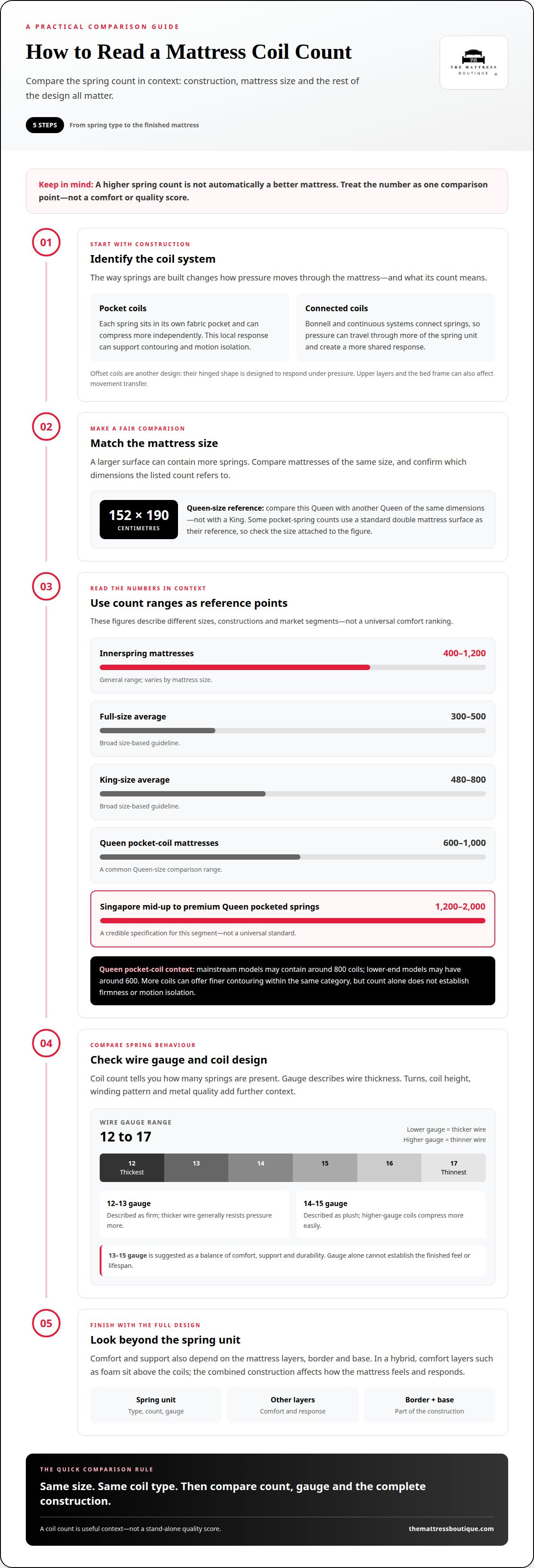
A higher spring count doesn’t automatically mean a better mattress. A coil mattress uses springs to support the sleeper, and for Queen-size pocketed spring mattresses in Singapore’s mid-up to premium range, 1,200 to 2,000 coils is a credible specification. When coil count in spring mattresses is explained alongside coil type, mattress size and construction, the number becomes a useful comparison point, not a quality score.
When comparing mattresses, it’s natural to look for a clear number, but the same coil count can mean different things in different designs. This guide explains what a coil mattress is, how spring types and mattress sizes affect the count, and why the number alone can’t tell you how comfortable or supportive a mattress will feel.
You’ll learn how pocketed and continuous coil systems differ, what to consider when comparing counts across sizes, and how springs work with the mattress’s other layers. This context makes it easier to focus on the specifications that matter to your comfort.
Key Takeaways
- Identify whether a mattress uses pocketed or continuous coils, since the design changes how its spring count should be interpreted.
- Compare coil counts only across mattresses of the same size, and consider wire gauge and coil design alongside the total.
- Look beyond the spring unit: comfort and support also depend on the mattress layers, border and base.
- Use these details to narrow your options, then explore King Koil mattresses at The Mattress Boutique as one spring-mattress choice.
What is a coil mattress?
A coil mattress uses metal springs as part of its support system. In an innerspring design, coils form the core; a hybrid adds comfort layers, such as foam, above them. Understanding coil count in spring mattresses through construction details is more useful than looking at the total alone.
Coil Count, Gauge, and Turns
Coil count refers to the number of springs, while turns describe how the wire winds within each spring. These are separate measures, so a mattress with more coils doesn’t necessarily have more turns per coil.
Turns, wire thickness, coil height and coil type all affect how a spring compresses and responds. For example, two pocketed spring units with the same count can feel different if their springs have different wire gauges or winding patterns. Consider these details to interpret coil count as one part of the design, not the whole story.
Wire Gauge and Firmness
Wire gauge describes the thickness of the metal used to make a coil. Mattress coil wire gauges typically range from 12 to 17, with 12 the thickest and 17 the thinnest.
A lower-gauge coil uses thicker wire and resists pressure more, generally creating a firmer feel. Higher-gauge coils compress more easily and can create a plusher feel. The page describes 12-13 gauge coils as firm and 14-15 gauge coils as plush. Gauge helps you compare firmness, but it can’t establish the finished feel or lifespan on its own.
Coil Count Compared With Gauge
Coil count tells you how many springs are present; gauge describes their wire thickness. Each figure answers a different question, so neither replaces the other when comparing an innerspring or hybrid mattress.
A higher count may mean more springs within a given design, while thicker, lower-gauge wire may resist compression more strongly. The ideal coil count depends on coil type, coil height, coil gauge and metal quality. A gauge in the 13 to 15 range is suggested as a balance of comfort, support and durability, but the full construction determines how the mattress responds.
Pocket coil vs continuous coil - what's the difference?
Pocket coils sit separately in fabric pockets, while Bonnell and continuous systems connect springs into a shared unit. This construction affects how pressure travels through the mattress and how to interpret its coil count.
Types of Spring Coils
Bonnell, continuous, offset and pocket coils describe different spring constructions, helping explain a mattress’s feel beyond its count. Bonnell coils have an hourglass shape and connect with neighbouring springs. Continuous coils are formed from connected wire, while offset coils have a hinged shape designed to respond under pressure.
In a pocket spring unit, each coil sits in its own fabric pocket, and the pockets join together. This lets each spring compress more independently than springs in connected open-coil designs. Coil type influences how pressure spreads, so two mattresses with similar counts can respond differently.
Pocketed Springs and Open Coil Systems
Pocketed springs move more independently, creating point elasticity: pressure in one area may compress nearby springs less than in a connected unit. This local response can support contouring and motion isolation, though the upper layers and bed frame also affect movement transfer.
Open-coil systems, including Bonnell and continuous designs, connect springs, allowing pressure to travel through more of the spring unit. This can create a more shared response across the sleeping surface. The difference matters when considering how a partner’s movement or concentrated pressure feels, not just how many coils are listed.
Pocket and Bonnell Coil Differences
The key difference is that pocket coils are individually wrapped, while Bonnell coils are connected in an open unit. A typical mainstream Queen-size pocket-coil mattress contains around 800 coils; lower-end Queen pocket-coil mattresses may have around 600.
For comparison, a good Queen mattress coil count is 600-1,000, while Singapore’s mid-up to premium Queen pocketed spring mattresses may list 1,200 to 2,000 coils. These ranges describe different market segments, not a universal comfort ranking. More pocket coils can offer finer contouring within the same category, but count alone doesn’t establish firmness or motion isolation. Consider the spring construction and comfort layers together.
Interpreting coil count and mattress size
In Singapore, compare spring mattresses by size, coil type, coil gauge and construction, not count alone. Each coil is counted individually, but the quoted total may refer to a standard double surface or another reference size.
Coil Counts by Mattress Size
A coil count is useful only when matched to the mattress dimensions, because a larger surface can contain more springs. Innerspring mattresses generally contain 400 to 1,200 coils, depending on size.
As broad guidelines, full-size mattresses average 300-500 coils, while king-size mattresses average 480-800. Queen guidance varies by construction and market segment: 600-1,000 is a common range, while 1,200 to 2,000 is cited for mid-up to premium pocketed spring mattresses in Singapore. Treat these as comparison points, not a single rule.
Counting Coils in Queen and King Mattresses
The total counts each spring in the mattress unit, including individually wrapped pocket coils where that construction is used. For a Queen-size mattress measuring 152 cm × 190 cm, compare its count with another Queen of the same dimensions, rather than a king.
Some pocket spring counts use a standard double mattress surface as their reference. A Queen or King figure may describe the ordered size, a reference size or a product family. Check which size the figure applies to, and consider the mattress width and length alongside it.
Comparing Spring Mattress Specifications
A useful comparison records the exact size, coil count and spring construction together. In Singapore, also note whether the springs are wrapped individually, since pocketed and connected coil units distribute pressure differently.
Then compare coil gauge, coil height and the materials above and below the springs. Thinner wire can compress more easily, while construction and comfort layers also influence firmness and motion transfer. If specifications use different reference sizes or coil types, their totals aren’t a like-for-like comparison.
Why coil count alone does not determine comfort or support
Coil count describes quantity, not the complete response you feel on the mattress surface. A hybrid mattress also relies on its comfort layers, border and base to manage pressure and weight.
Coil Count and Body-Contour Support
Body-contour support depends on how springs and upper layers respond to pressure across the body. Within the same pocketed spring category, a Queen mattress with 1,500 coils can offer more contouring precision than one with 800 coils.
A higher count doesn’t automatically mean greater comfort. A side sleeper, for example, may prefer a softer surface that yields around the shoulders, while someone seeking a firmer feel may prefer less compression. Coil gauge, coil height and comfort layers all shape that response.
Limits of Coil Count for Support
Coil count alone can’t establish support because it doesn’t describe coil height, diameter, geometry, wire or arrangement. For example, 800 high-quality tempered steel coils may perform better than 2,000 poorly constructed coils.
The rest of the mattress matters too. Foam above the springs, the border and the base carry load alongside the coil unit, so the finished mattress works as a system. Individually enclosed pocket springs also don’t eliminate movement transfer through the upper layers or bed frame.
Sleeping position and body weight help explain why the same coil count can suit one person but not another. Back and stomach sleepers may prefer firmer support, while side sleepers often look for more pressure relief at the shoulders and hips. These are preferences for how a mattress responds, not outcomes guaranteed by a number.
Zoning adds another design factor. A 5-zone or 7-zone pocketed spring system varies support across selected areas, but the zone count alone doesn’t establish whether its response suits you. Consider where the zones are and what changes between them.
Compare a mattress by considering its spring construction, comfort layers and firmness together, not by choosing the largest count. Explore spring mattress options with these factors in mind.
The Mattress Boutique: King Koil Mattresses
The Mattress Boutique can help you compare spring mattress options using more than coil count alone. When considering your ideal spring mattress, compare the spring construction with the firmness and mattress layers to understand how the design may suit your preferences.
The available range also includes various premium foam and hybrid options. Compare these choices with your preferred sleeping position and mattress size to focus on the specifications that matter to your comfort, rather than choosing by the largest number on a label.
For a closer look at mattress options, contact The Mattress Boutique.
Choose Your Next Mattress With Confidence
Use the specifications as a starting point, then focus on how a mattress feels under your body. Understanding coil count in spring mattresses gives you a clearer way to compare designs, but your comfort preferences should guide the final choice. Consider whether you prefer a firmer or softer surface, how you usually sleep, and which mattress size fits your room.
When you’re ready to move from comparing numbers to exploring mattresses, The Mattress Boutique can help you consider options that suit your preferences. Browse the range and take the next step at your own pace.
Contact The Mattress Boutique to discuss your mattress options. A considered choice can make your bedroom feel more comfortable and better suited to your everyday routine.
Frequently Asked Questions
What are mattress coils?
Mattress coils are shaped metal springs built into the support unit of an innerspring or pocketed mattress. They compress under body load and help distribute it across the sleeping surface. Coil designs differ in shape, height and arrangement, so the total doesn’t describe every part of the spring system. Think of each coil as one working component, not the whole mattress.
Are coils and springs the same?
Yes. In mattress descriptions, “coil” and “spring” usually refer to the same individual metal component. The wording can vary by context: a coil count totals individual springs, while “spring unit” can mean a connected assembly or a group of pocketed springs. For example, “pocket springs” describes the system’s construction, not a different material from coils.
Is a higher coil count always better?
No. A larger total isn’t a reliable shortcut to comfort. Compare mattresses of the same size and spring type, then consider whether the count includes mini-coils, stacked units or border springs. These components may be counted alongside the main core, but the total doesn’t show how the finished mattress responds. Treat the figure as one specification, not the sole basis for choosing.
What does coil gauge mean and why does it matter?
Coil gauge describes the thickness of the wire in a spring. A lower gauge means thicker wire, while a higher gauge means thinner wire. Read gauge alongside the spring unit and coil design, since the number alone doesn’t establish the finished firmness or mattress lifespan.
What does the number count, and over what area?
A coil count usually totals the springs in a specified mattress unit, but the reference area must be clear. Some pocket-spring totals are quoted for a standard double mattress surface, rather than for every size sold. If a product family includes Queen and King versions, the number may relate to one reference size, so interpret it alongside the mattress dimensions.
What is gauge, and why does a lower number mean a firmer spring?
Gauge describes wire thickness: a smaller gauge value corresponds to thicker spring wire. Thicker wire resists compression more, so a lower-gauge coil generally feels firmer than a higher-gauge coil in a comparable design. For example, don’t compare gauge figures without knowing the measurement convention and other spring details; the finished mattress includes more than the coil.