

Good mattress care is a routine, not a rescue job. A mattress typically lasts 7 to 10 years, depending on its type, use and maintenance. Learning how to extend the life of your mattress starts with consistent upkeep, rather than waiting for visible sagging or stains to appear.
When choosing a mattress, it’s easy to focus on comfort and overlook the habits that help preserve it. In Singapore’s humid climate, moisture management matters alongside protecting the surface and providing stable support. A few practical steps can help keep your sleep setup cleaner and more comfortable over time.
This guide covers how to use a mattress protector, choose a suitable bed base, clean without damaging materials, and rotate or flip a mattress when its design allows. It also explains how construction and care affect longevity, so you can maintain the mattress you have and make a more informed choice when it’s time to replace it.
Key Takeaways
- Use a mattress protector as a barrier against spills and humidity, and wash it every 1 to 2 months.
- Choose a sturdy bed base that suits your mattress, since uneven support can contribute to sagging.
- Vacuum periodically and follow the mattress’s care instructions to avoid damaging its materials.
- Rotate your mattress every 3-6 months when appropriate, but don’t flip a one-sided design.
- Material, quality, use and upkeep all influence how long a mattress stays supportive.
1. Using a mattress protector
In Singapore, care and warranty terms depend on the mattress and its manufacturer, so follow the product’s care instructions and warranty document. Some manufacturer warranties are limited to 2 years, while others offer 10 years or up to 15 years. These are general examples, not a guarantee for every brand or mattress when learning how to extend the life of your mattress.
A mattress protector helps shield the surface from everyday spills and stains. Choose a breathable, waterproof protector and place it over the mattress, beneath the bottom sheet. It forms a barrier without changing your usual bedding arrangement and can help keep accidental drink spills from reaching the mattress layers.
Singapore’s humid climate makes moisture control an important part of mattress care. Damp conditions can encourage mould and mildew, so keep the bedroom ventilated and deal with damp bedding promptly. A protector can limit moisture reaching the mattress, but it does not replace good airflow. Don’t cover damp bedding with a dry sheet.
Keep the protector clean as well as the mattress beneath it. Wash the protector every 1 to 2 months, following its own care label. Change and wash bedding at least once a week to clear sweat, dust and everyday residue. For example, if a drink spills, remove the sheet and protector promptly, then wash the protector before putting it back on a fully dry bed.
After washing the protector, check that it fits smoothly. A loose or bunched layer can affect comfort, while one that pulls tightly may not sit properly. Choose a size that covers the sleeping surface and stays in place beneath the sheet. Replace a torn protector or one that has lost its waterproof barrier, so spills and moisture do not pass through.
A protector helps prevent stains and moisture from reaching the mattress, but it cannot repair sagging, damaged springs or an unsuitable bed base. Before cleaning or applying heat, read the mattress’s care instructions. When purchasing from The Mattress Boutique, always follow the specific guidance and warranty terms for your particular model rather than assuming every brand has the same requirements.
Build the routine into regular bedding changes: inspect the protector for tears, wash it every 1 to 2 months, and let all layers dry completely before remaking the bed. This simple sequence helps preserve cleanliness and comfort while keeping moisture from lingering against the mattress.
Care instructions and warranty terms vary by mattress model. Use a protector, wash it according to its care label, keep the bed ventilated and dry, and check the manufacturer’s instructions before cleaning or applying heat. Following the specific guidance provided by The Mattress Boutique helps you avoid applying care practices that may not suit your specific mattress materials.
2. Choosing a suitable bed base
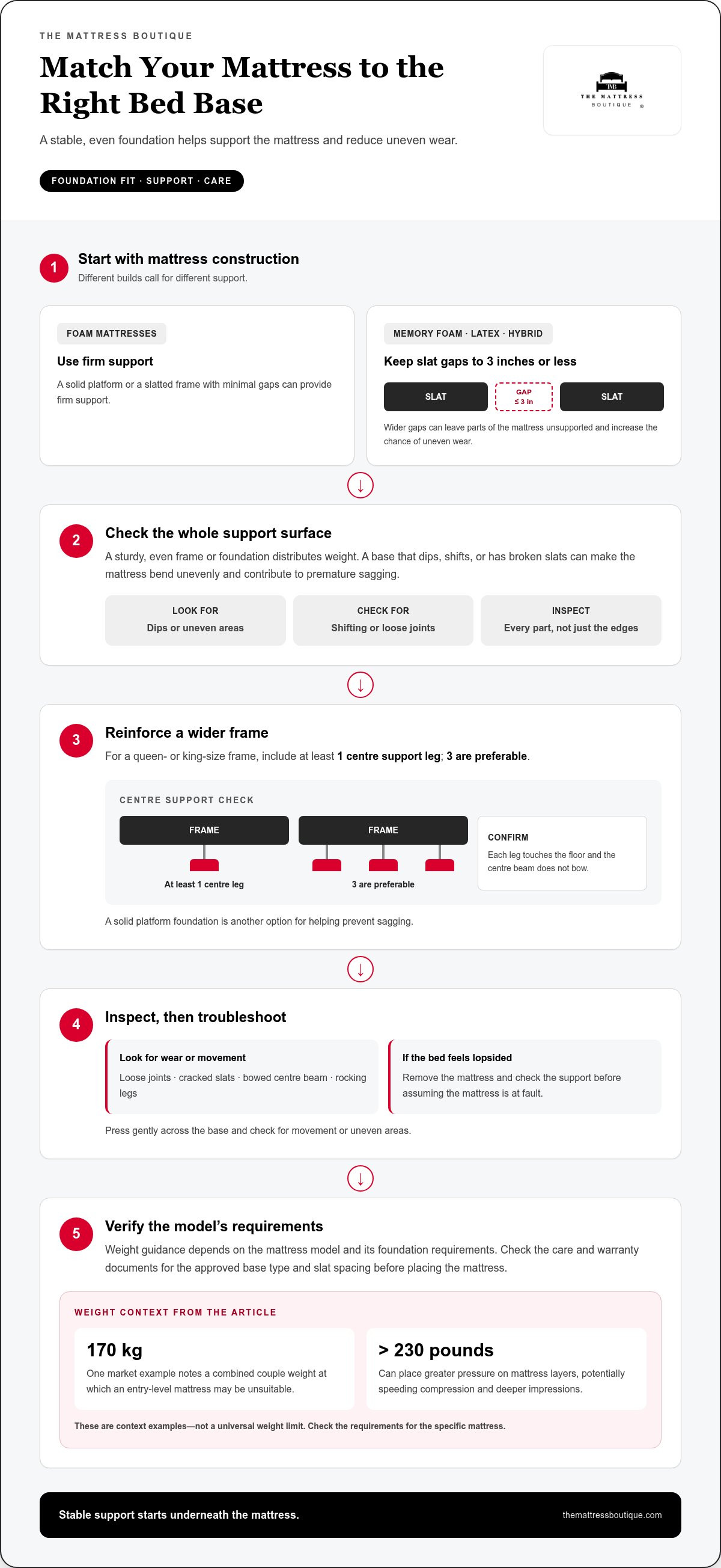
Mattress support starts with the bed base. A sturdy, even frame or foundation distributes weight and helps prevent premature sagging. If the base dips, shifts or has broken slats, the mattress may bend unevenly. Inspect the entire support surface, not just the visible frame edges.
There isn’t one weight limit that applies to every mattress. Weight guidance depends on the mattress model and its foundation requirements. For context, one market example notes that a combined couple weight of 170 kg may make an entry-level mattress unsuitable. People weighing more than 230 pounds can also place greater pressure on mattress layers, potentially speeding compression and deeper impressions.
Match the base to the mattress construction. Foam mattresses need firm support, such as a solid platform or a slatted frame with minimal gaps. Memory foam, latex and hybrid mattresses work well on slats no more than 3 inches apart. Wider gaps can leave parts of the mattress unsupported, increasing the chance of uneven wear.
For a queen- or king-size frame, include at least 1 support leg in the middle; 3 are preferable. Those legs help carry weight across a wider span and reduce strain on the frame. Check that each leg touches the floor and that the centre beam doesn’t bow. A solid platform foundation is another option for helping prevent sagging.
The base can also affect warranty coverage. Before placing the mattress, check the care and warranty documents for the model’s approved base type and slat spacing. A warranty does not make an unsuitable base supportive: the mattress still needs stable, even support underneath.
Inspect the frame regularly for loose joints, cracked slats, a bowed centre beam or a rocking leg. Press gently across the base and look for movement or uneven areas. If the bed feels lopsided, remove the mattress and check the support before assuming the mattress is at fault. Include the base and surrounding floor in routine cleaning, since dust and allergens can collect beneath the bed.
When choosing a replacement, consider the mattress size, construction and how the frame carries weight. For example, a foam mattress needs a firm, closely spaced support surface, while a wide bed benefits from centre reinforcement. The right foundation supports comfort as well as structure. These details are useful when comparing mattress support options and matching them to a suitable bed base.
3. Monthly vacuuming and periodic cleaning
Singapore’s humidity can encourage mould and mildew, especially when moisture remains around a mattress. Keep the bedroom ventilated, open windows when practical, and air a stripped mattress in a well-ventilated room. Airing a stripped mattress in a well-ventilated room can help reduce moisture; avoid leaving it in direct sunlight.
Vacuum the mattress every month with a soft attachment to lift dust, allergens and debris from the surface and seams. Move slowly across the top, sides and edges, paying attention to stitched borders where particles collect. This simple step helps maintain a cleaner sleep surface without soaking or stressing the mattress materials.
Treat stains promptly. Apply a small amount of mild detergent to a damp cloth and blot the stain rather than scrubbing, which can push liquid deeper or roughen the fabric. Use as little water as possible, then let the area dry completely before replacing the sheets or sleeping on the mattress.
Before using a cleaning product, follow the mattress maker’s care instructions. Baking soda can be left on the surface for several hours or overnight, then vacuumed away. Avoid harsh chemicals that may damage the cover or internal materials, and don’t assume a cleaning method suitable for one mattress is right for another.
Rubberized coir needs particular care. Don’t soak it or use harsh chemicals, as excess water and strong cleaners can cause damage. If a spill reaches the surface, gently blot it with a barely damp cloth and let the area dry thoroughly. Make sure the mattress and bedding are completely dry before use.
Air a stripped mattress once a month or after a deep clean, and keep the room ventilated during drying. A clean, dry surface supports comfort and helps protect your investment. If the mattress feels damp, leave bedding off until it has dried; covering it too soon can trap moisture against the fabric.
Build cleaning into a practical routine. Vacuum monthly, inspect for stains or damage every 2 to 3 months, and use only methods suited to the mattress material. For example, a rubberized coir mattress needs gentle, low-moisture care, while another construction may have different instructions. Proper cleaning preserves the mattress’s ability to provide support, but it cannot correct sagging or structural damage.
4. Rotating a mattress to distribute wear
Sleeping in the same position can place repeated pressure on familiar areas. Over time, that pressure may contribute to body impressions or uneven comfort. Rotating moves the head end to the foot end, changing where sleepers apply pressure. Cirrus recommends rotating a mattress every 3-6 months to promote more even wear.
For many modern mattresses, rotation means turning the mattress 180 degrees while keeping the same side facing up. Check the care label first, because designs and instructions vary. A new mattress can be rotated once after its first month or two to help it settle more evenly. After that, use the maker’s recommended schedule.
Flipping means turning the mattress over so the underside becomes the sleeping surface. Don’t assume your mattress is designed for this. Some one-sided mattresses, including some with zoned support, are not made to be flipped. Turning one over can put the wrong surface beneath your body and alter its intended comfort and support.
Some older spring mattresses were designed to be flipped, while many modern models have a specific top and bottom. If a spring mattress develops sagging, flipping will not repair damaged springs or a weakened support system. Rotate it only if its care instructions allow, and check for dips before moving it.
Rotating and flipping every few months is sometimes suggested as one routine, but these actions aren’t interchangeable. A 180-degree rotation preserves the intended sleeping surface; a flip changes it. For a one-sided mattress, rotate only. For a double-sided design, follow the manufacturer’s instructions for whether to rotate, flip, or do both.
Move the mattress carefully. Remove the bedding, use two people for a heavy mattress, and lift it rather than dragging it across the frame. Keep hands clear of hinges and frame edges, then centre the mattress evenly on its base. This helps reduce strain and prevents the cover from catching on the frame.
Use a calendar reminder every 3-6 months, or follow the specific interval supplied with your mattress. During each rotation, check the sleeping surface for uneven areas and confirm the base remains level. If the mattress has handles, use them to guide the turn, not to lift its full weight. A regular rotation can help distribute wear, but it won’t reverse existing sagging or structural damage.
5. Mattress lifespan by material and quality
A mattress typically lasts 7 to 10 years, depending on its type, use and maintenance. That range is a guide, not a replacement schedule for every bed. A mattress that remains comfortable and supportive may serve differently from one showing deep impressions. Material, construction, care and the support underneath all affect its lifespan.
Traditional innerspring mattresses typically last 5 to 8 years, while memory foam mattresses typically last 7 to 10 years. Natural latex mattresses can remain supportive for 15 to 20 years when properly maintained. These differences reflect how materials respond to repeated pressure and wear. They don’t mean every mattress of one type will reach the same age.
Quality also matters. Higher-quality materials and construction can help a mattress retain support, while weaker layers may compress sooner. Some high-end mattresses can last up to 15 years with suitable materials and careful maintenance. Rather than judging by the label alone, consider the construction, how evenly it supports your body, and whether it suits your sleeping needs.
Repeated pressure in the same area can contribute to impressions, especially when sleepers always use the same side. A suitable base and rotation at the interval recommended for the mattress can help distribute wear more evenly. Spills and lingering moisture can also damage materials, so use surface protection and clean promptly with methods suited to the mattress.
Use visible changes and comfort as practical signals. Check for uneven surfaces, reduced support or persistent impressions. If a mattress that is only 2 years old starts sagging, the cause may involve its quality, support, maintenance or manufacture. A calendar age alone cannot show whether the sleeping surface still provides consistent support.
Understanding how to extend the life of your mattress starts with matching its material to your needs and following its care instructions. A natural latex mattress may offer a longer potential lifespan, while memory foam provides a different feel and support response. Consider your preferred comfort, sleeping position and how much pressure you place on the mattress. The right choice should suit both your body and bed base.
These same factors help explain how to extend the life of your mattress after purchase: follow care guidance and watch for changes in support. Compare mattress types and materials to find a construction that fits your comfort preferences and care routine.
The Mattress Boutique: King Koil Mattresses
If persistent sagging, uneven support or discomfort remains after checking the base, it may be time to consider a replacement. Regular care can help preserve a mattress, but it cannot restore worn-out materials. The Mattress Boutique offers King Koil mattresses for shoppers comparing options.
Compare King Koil, Slumberland, Dunlopillo and SofzSleep mattresses by considering your preferred feel, sleep needs and bed base together. This helps narrow your options based on comfort and support, rather than brand name alone.
For help comparing mattress options, contact The Mattress Boutique or visit themattressboutique.com.
Make your next mattress choice with confidence
Use your care routine to identify what matters most in your next sleep setup. Notice which mattress feel suits you, whether your bed base provides steady support, and which care instructions fit your household habits. These observations can help you make a considered choice when replacement becomes the practical next step.
Knowing how to extend the life of your mattress is useful, but care cannot restore comfort when a mattress no longer supports you well. When comparing replacements, focus on the feel and construction that suit your needs, not the name alone. The Mattress Boutique offers King Koil, Slumberland and Dunlopillo mattresses to consider.
For a helpful next step, contact The Mattress Boutique to explore mattress options. A thoughtful choice today can support a more comfortable sleep routine ahead.
Frequently Asked Questions
How often should you rotate or flip a mattress?
Cirrus recommends rotating a mattress every 3-6 months to encourage even wear. Turn it 180 degrees, moving the head end toward the foot of the bed. Flip only if the mattress is designed for two-sided use; one-sided or zoned models should stay upright. Check the care label first, since the design determines whether rotation, flipping, or both are suitable.
How often should you clean and vacuum a mattress?
Vacuum the mattress every month using a soft attachment, then inspect it for debris, marks or damage. A quick routine works well when changing bedding: remove the sheets, vacuum the surface and seams, then remake the bed once everything is dry. For deeper cleaning, follow the mattress maker’s instructions. Avoid soaking the mattress, since moisture trapped inside can take longer to dry.
What is the best way to protect a mattress from spills, dust mites, and bed bugs?
Use a breathable, waterproof mattress protector beneath the fitted sheet to help guard against spills, stains and allergens. Wash it according to its care label, and check seams after laundering for tears or gaps. For bed bugs, a standard protector isn’t a treatment. Inspect mattress seams and bed-frame joints, keep bedding off the floor, and address any signs of infestation promptly.
How do you remove stains and odours from a mattress safely?
Blot a fresh spill with a clean cloth, working from the edge inward to avoid spreading the stain. Dab the area with a cloth lightly dampened with mild detergent, then blot again with clean water. Don’t scrub or soak the mattress. Let it dry completely before adding bedding. For lingering odours, leave baking soda on the surface for several hours, then vacuum it away.
Does using the right bed frame or slats extend mattress life?
Yes. A suitable, stable frame helps keep the mattress level and reduces unsupported areas that can contribute to wear. For memory foam, latex and hybrid mattresses, slats spaced no more than 3 inches apart provide closer support. Check for a bowed centre beam, loose joints or broken slats if the bed feels uneven. Also match the foundation to the mattress maker’s requirements.
How long do different mattress types last, and what affects their lifespan?
Traditional innerspring mattresses typically last 5 to 8 years, memory foam mattresses 7 to 10 years, and natural latex mattresses 15 to 20 years when properly maintained. These are typical ranges, not a guarantee for an individual mattress. Construction quality, sleeping pressure, support from the base, moisture exposure and care habits can all affect how long it remains comfortable and supportive.
What signs show a mattress needs replacing rather than repairing?
Consider replacing a mattress if persistent sagging, deep impressions, damaged internal components or uneven support remain after you check the bed base. A surface stain or loose frame slat may be addressed without replacing the mattress, but cleaning will not restore worn materials. Compare how the mattress feels across different areas and note whether discomfort continues when it rests on a stable base.