

If you’re asking, “can two single beds make a king,” the answer depends on their combined dimensions and how well the mattresses, frames and bedding work together. Measure the beds rather than relying on their labels to see whether they’ll fit the space and feel comfortable as a pair.
Combining two beds can create a wider sleep surface and make use of mattresses you already own. But a difference in width or length can leave the result smaller or larger than expected, while a centre gap, uneven mattress heights or shifting frames can affect comfort.
This guide explains what to measure, how to reduce the gap and keep the mattresses in place, and which bedding options can make the surface feel more unified. It also covers frame fit and the trade-offs between paired mattresses and one king mattress.
Key Takeaways
- Can two single beds make a king? They can create a king-like sleep space when their combined measurements and setup suit the intended bed size.
- Measure each mattress yourself, then compare the combined width and each mattress’s length with a king mattress.
- Check how mattress height, firmness and edge feel affect comfort where the two beds meet.
- Use a suitable, level supporting surface and align both mattresses carefully to help them stay in place.
- Separate mattresses allow different sleep preferences on each side, while one king mattress provides a continuous surface.
Can Two Single Beds Make a King? The Short Answer
Sometimes. Whether two single beds can make a king-like sleep space depends on the mattresses’ actual width and length, and whether the frame or supporting surface can hold them securely. The pair may come close to a king’s overall footprint, but it won’t feel exactly like one king mattress. The join between the beds, differences in height and how the edges feel can all affect comfort.
Think of two mattresses placed side by side, not one larger mattress. Their combined width may suit the space, but they remain separate sleeping surfaces with a boundary in the middle. If the mattresses differ in length, height or firmness, that boundary may be more noticeable. The frame also matters: it needs to support both mattresses without leaving edges unsupported or pushing them out of alignment.
Measurements matter more than the size label. Measure both mattresses and compare their combined footprint with the king mattress you have in mind.
What does it mean to make a king from two singles?
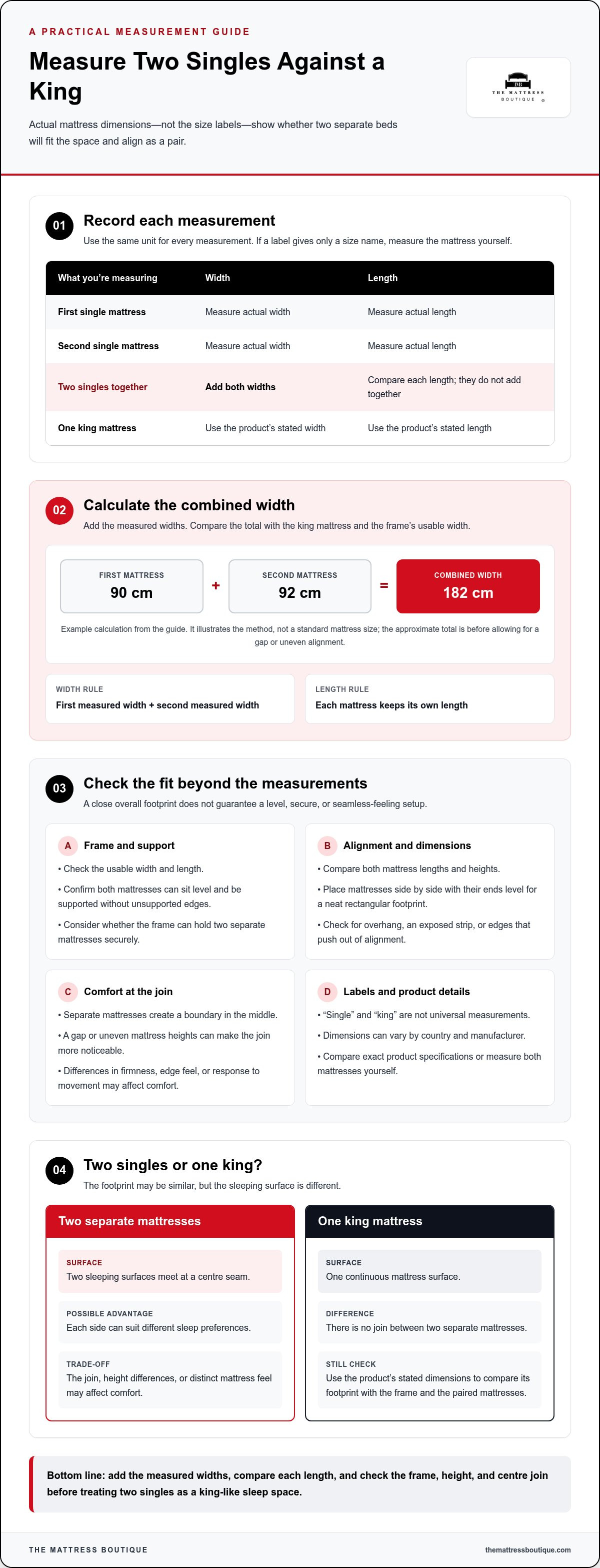
To estimate the combined width, add the width of the first mattress to the width of the second. Their lengths don’t add together: each mattress retains its own length, edges and sleeping surface. For a neat rectangular footprint, place them side by side with their ends level.
Even if the outside dimensions are similar to a king, the feel can differ. One king mattress has a continuous surface; two singles meet at a seam. You may notice the join when lying near the centre, and each mattress can respond differently to movement or pressure.
Why the answer depends on where the mattress sizes come from
“Single” and “king” are labels, not universal measurements. Dimensions can vary between countries and manufacturers, so a size name alone can’t confirm that two mattresses will match a particular king bed. The bed sizes and dimensions reference shows how bed-size terms and measurements differ across regions.
Compare the actual dimensions of both mattresses with those of the intended king mattress, using current product specifications where available. Don’t assume that measurements described overseas as “twin” or “single” apply to your mattresses. Even products with the same size label may not match exactly, so use a tape measure and record each mattress’s width and length.
Measure the bed frame or supporting surface as well. A pair that fits the room may not fit the frame correctly, and a frame made for one mattress may not support two separate bases. Check the usable width and length, then consider whether both mattresses will sit level and stay aligned. These checks help distinguish a close visual match from a setup that works comfortably in practice.
Measure Two Singles Against a King Mattress Before Combining Them
Compare the measured dimensions of both mattresses with those of the intended king mattress and bed frame. Labels such as “single” and “king” are a useful starting point, but measurements show whether the pair will align or leave an awkward edge.
Combined width equals the first mattress’s measured width plus the second mattress’s measured width. Compare that total, and each mattress’s length, with the king mattress you plan to match.
| Setup | Width to record | Length to record |
|---|---|---|
| First single mattress | Measure actual width | Measure actual length |
| Second single mattress | Measure actual width | Measure actual length |
| Two singles together | Add both widths | Compare each length; they do not add together |
| One king mattress | Use the product’s stated width | Use the product’s stated length |
How to calculate the combined mattress width
Use the same unit for every measurement, such as centimetres. Measure each mattress at its widest point, keeping the tape straight across the surface, then add the two widths. Compare this total with the king mattress and the frame’s usable width. Measure both lengths separately too: a matching combined width won’t make up for mattresses that are too short or extend too far.
For example, if the first mattress measures 90 cm wide and the second 92 cm, the combined width is 182 cm. That is the pair’s approximate overall width before allowing for a gap or uneven alignment. These figures illustrate the calculation only, not a standard mattress size.
Which dimensions and labels should you check?
Look for the exact width and length on the mattress label or in the product specifications. If the label gives only a size name, measure the mattress yourself. Compare the mattress heights too, and check that the frame’s usable sleeping area can support both mattresses side by side. A mismatch can leave one mattress overhanging the frame or an exposed strip along an edge.
Mattress terminology and specifications provide context, but they don’t replace measurements of the items in your room. The International Sleep Products Association shares mattress industry information; for a broader overview of mattress selection, see this Singapore mattress buying guide.
Once you’ve recorded the figures, compare the mattresses and frame before arranging the beds. If you’re weighing a combined setup against a single mattress, explore mattress options as part of your decision.
What Changes When Two Single Mattresses Share a Bed?
Can two single beds make a king feel like one continuous bed? Even if their combined footprint suits the frame, the mattresses remain separate. Their edges meet in the middle, and each mattress keeps its own response to pressure and movement. Separate surfaces can be useful for sleepers with different preferences, but the centre seam may be a noticeable trade-off.
How the arrangement feels depends on the mattresses and where you sleep. A gap, different surface heights or a contrast in firmness can make the join easier to feel. Placing both mattresses on one frame doesn’t turn them into one mattress or remove those differences.
The centre gap, movement, and shared comfort
The meeting point can feel like a shallow dip, raised edge or firm line, depending on how the mattresses sit together. If they shift apart, the gap may become more obvious and interrupt the sleeping surface. Each mattress may also compress differently under pressure, so movement on one side won’t necessarily feel the same on the other.
Consider your usual sleeping positions. If either person sleeps near the centre or stretches across it, the seam may matter more than it would for sleepers who stay on their respective sides. The same applies to reading or sitting together in the middle of the bed. Try those positions to see whether the join is comfortable for both of you.
- Check the centre: Lie near the join and notice whether you feel a gap, ridge or change in support.
- Compare movement: Notice whether one mattress shifts or compresses differently from the other.
- Try usual positions: Test the spots each sleeper uses, especially if either person often sleeps across the middle.
When separate mattresses may suit different sleepers
Separate mattresses can be useful if each sleeper prefers a different firmness or feel. Each person can choose a surface that suits their preference rather than compromising on one shared mattress. This flexibility works best when the mattresses also fit together: noticeably different heights or edges can create an uneven transition at the centre.
Compare the feel along the joining edges as well as across the main sleeping areas. One mattress may feel firmer or more supportive at its edge than the other, making the boundary more apparent even when their tops look level. Choose based on personal preferences and how well the surfaces fit together, rather than assuming separate beds will automatically improve sleep.
If you’re weighing up mattress feel and support more broadly, expert mattress buying guides offer further selection context to help you choose wisely.
How to Set Up Two Single Beds as One King-Like Sleep Space
A comfortable setup starts with the support beneath the mattresses, not just the way they look together. Check the room, frame and mattress dimensions before moving the beds. Then align the surfaces and assess the join before choosing bedding. This helps you spot fit issues early and decide whether one shared frame or two separate bases will work better.
Prepare the frame and mattresses
Measure the frame’s usable width and length, then compare them with the combined mattress footprint. The supporting surface should be level and large enough for both mattresses to sit securely without unsupported edges. A shared frame keeps the arrangement within one footprint; two bases offer another option but need to fit together neatly in the room.
- Measure the available space. Check that the room can accommodate the combined bed with enough clearance to move around it and access nearby furniture. Consider doors, walkways and drawers on storage bed frames.
- Measure each mattress and the frame. Record both mattresses’ width, length and height, then compare their combined footprint with the frame’s usable surface. Don’t rely on the labels alone.
- Prepare the support. Position the shared frame or two bases where they’ll be used. Check that the supporting surfaces are level, stable and suitable for the arrangement.
- Place and align the mattresses. Set them side by side, with their outer edges aligned and their ends level. Check that both sit securely on the frame and that neither overhangs or sits higher than the other.
- Test the join before making the bed. Lie near the centre and move across the surface. Notice any gap, shifting or difference in height, firmness or edge feel.
Reduce separation and finish the bedding
If the mattresses drift apart or the centre seam feels distinct, optional aids may help. A mattress bridge fills some of the gap, while a securing strap can help keep the pair together. A suitable topper may soften the transition across the join. These additions can reduce the sensation of separation, but they won’t make different mattresses identical or correct uneven support.
Choose bedding after positioning the mattresses and confirming their combined width, length and depth. One fitted sheet may suit some combinations, while separate fitted sheets may be more practical for others, particularly if two bases need to move independently. Check the bedding’s stated dimensions and depth against your setup rather than assuming one king-size sheet will fit every pair.
Mattresses and frames work best as a coordinated choice. If you’re comparing options for your setup, explore mattresses and bed frames at The Mattress Boutique.
When to Choose Two Singles, and When One King Mattress Is Simpler
The right choice depends on what matters most in your room and to the people sharing the bed. Two separate mattresses allow more individual choice, while one king mattress provides a continuous sleeping surface. Neither arrangement is automatically better. Compare the dimensions, frame support and comfort preferences before deciding.
Choose two singles when the setup solves a real need
Separate mattresses may suit sleepers who prefer different firmness levels or surface feels. Each person can choose a mattress to suit their preferences while sharing a wider bed footprint. This can be useful when personal comfort matters more than an uninterrupted surface.
Use this checklist to decide whether the arrangement makes practical sense:
- Dimensions: The combined width and individual lengths fit the intended frame and available room space.
- Sleeper preferences: Different mattress feels are valuable enough to outweigh the central seam.
- Room layout: The paired setup leaves enough space to move around the bed and use nearby furniture.
- Frame compatibility: The supporting surface can hold both mattresses securely and level.
- Seam tolerance: Both sleepers are comfortable with a join that may be noticeable, especially when lying near the middle.
Two mattresses are most convenient when they stay aligned and both sleepers are comfortable with their separate surfaces. If the pair shifts, sits unevenly or makes the seam distracting, the extra choice may not be worth the trade-off. Check the fit in the room, not just on paper.
Choose one king mattress when continuity matters most
A single king mattress avoids the join between two separate sleeping surfaces. It may be the more straightforward option if either sleeper often rests near the centre or if you want one consistent surface across the bed. You’ll still need to match the mattress dimensions to a suitable frame and confirm that the full setup fits your room.
Frame choice is part of the decision, especially if storage is a priority. Compare the frame’s usable sleeping area with the mattress dimensions, and consider storage bed frame options as you plan the layout. The mattress and frame need to work together, whether you choose one mattress or two.
In short, can two single beds make a king-like sleep space? Yes, when the dimensions, support and sleeper preferences line up. If you value different surfaces and can live with a seam, two singles may suit you. If a continuous surface and simpler alignment matter more, one king mattress may be easier to live with.
Once you know which setup fits your needs, explore mattress and bed frame options to compare suitable choices.
Choose the Setup That Fits Your Sleep and Space
Before changing your bed, consider how you and your sleep partner use it. Do you value a choice of mattress feel on each side, or would a continuous surface make bedtime simpler? The question “can two single beds make a king” matters less than whether the finished setup suits your room, frame and everyday preferences.
Use the dimensions you recorded to guide your next step. If you’re considering a new mattress and frame together, compare them as a coordinated choice. The Mattress Boutique offers mattresses from King Koil, Slumberland, Dunlopillo, SofzSleep and MaxCoil, alongside storage and divan bed frames. These product options give you a starting point for choosing both the sleep surface and its support.
Explore mattresses and bed frames at The Mattress Boutique to compare options for your space and preferred sleep setup. With a little planning, you can choose an arrangement that works for the people sharing it.
Frequently Asked Questions
Is a split king the same as two single beds?
Not necessarily. A split king usually describes two mattresses designed to form a king-sized setup, while “two single beds” may refer to mattresses with different dimensions depending on the market and manufacturer. The question “can two single beds make a king” isn’t answered by the split-king label alone. For example, two single mattresses may not match the footprint of the king frame you plan to use.
Can two single mattresses be different firmness levels?
Yes, two single mattresses can have different firmness levels, which may suit partners who prefer distinct feels. The practical question is whether the difference is comfortable at the centre: a softer side may compress more under pressure, creating a noticeable change across the join. If either sleeper often moves across the middle, try lying there before settling on the pairing. Choose for each person’s comfort, not firmness labels alone.
Can you put one mattress topper over two single mattresses?
Yes, one topper can cover both mattresses if its width and length suit their combined surface. It may make the centre seam less noticeable, but it won’t make two different mattresses respond identically. Check that the topper lies flat and stays in place during normal movement, since a poor fit can bunch or shift. Remember to account for its added depth when selecting fitted bedding.
Do two single beds need to be from the same brand?
No, they don’t have to be from the same brand, but they should work well together in size and feel. Matching widths and lengths won’t ensure a level surface if one mattress is thicker or has a different edge profile. Compare product specifications and, if possible, test the mattresses side by side. Similar heights and edge responses can make the transition between them feel more even.
Can two single beds work for guests who need separate sleeping spaces?
Yes. Two single beds can suit guests who prefer separate sleeping spaces, especially if the room allows them to sit apart. Use separate bedding and leave a clear route to each bed rather than forcing the mattresses into a joined arrangement. Independent beds can also make it easier to adapt the room layout for guests with different preferences about where they sleep.
Is one king mattress easier to make than two single mattresses?
Often, one king mattress is simpler to make because it uses one fitted sheet instead of separate fitted sheets for each mattress. However, a larger sheet or duvet may take more effort to lift and tuck, while two singles let you handle each side separately. If using shared bedding over paired mattresses, compare its dimensions and depth with the full setup for a better fit.