

A firmer mattress isn’t automatically the best choice for shoulder discomfort. If you sleep on your side, a surface that doesn’t cushion your shoulder enough may leave you waking with pressure and interrupted rest. Finding the best mattress for shoulder pain means balancing pressure relief with support, not simply choosing the softest or firmest feel.
Comfort depends on your sleep position, body, and personal preference, so there’s no single answer for everyone. This guide explains what to compare, including mattress feel and the differences between memory foam, latex, and pocketed spring designs. You’ll learn how to consider cushioning and support together, then narrow your options without assuming one material suits everyone. You can explore a wide variety of these mattress types at The Mattress Boutique to find the right fit for your sleeping style. If shoulder discomfort persists or affects your daily life, mattress shopping isn’t a substitute for medical advice.
Key Takeaways
- The best mattress for shoulder pain depends on how you sleep and how well a mattress balances cushioning with support.
- Firmness alone doesn’t determine comfort. A mattress can feel firm yet create pressure for some side sleepers.
- Compare memory foam, latex, and spring constructions by their general feel and potential trade-offs. Designs and experiences vary.
- Test each option in your usual sleeping position, especially on your side, and notice both shoulder comfort and overall support.
- Use your preferred feel and fit to build a shortlist, then compare mattress brands such as King Koil, Slumberland, Dunlopillo, SofzSleep, and MaxCoil.
Best Mattress for Shoulder Pain: Comfort and Support
Waking with shoulder discomfort can make mattress shopping confusing, especially when advice seems to point in opposite directions. A useful starting point is pressure relief: reducing concentrated pressure where your body meets the mattress. The goal isn’t simply to make the bed feel soft. Comfort depends on your sleep position, body shape, and how you respond to a mattress’s feel and support.
The best mattress for shoulder pain is a personal fit, not a universal model. A mattress may affect how comfortable you feel while resting, but it can’t diagnose or treat a medical condition. If discomfort continues, worsens, or concerns you, seek appropriate medical advice rather than relying on a mattress change alone.
Why can side sleeping create shoulder pressure?
When you lie on your side, your body weight rests across the shoulder and hip closest to the mattress. If the surface doesn’t cushion these areas enough for your body, pressure may feel concentrated or uncomfortable. The sensation varies from person to person and doesn’t, by itself, identify what’s causing the discomfort. Other factors can contribute, so consider your overall experience rather than assuming the bed is the only cause.
What should a shoulder-comfort mattress balance?
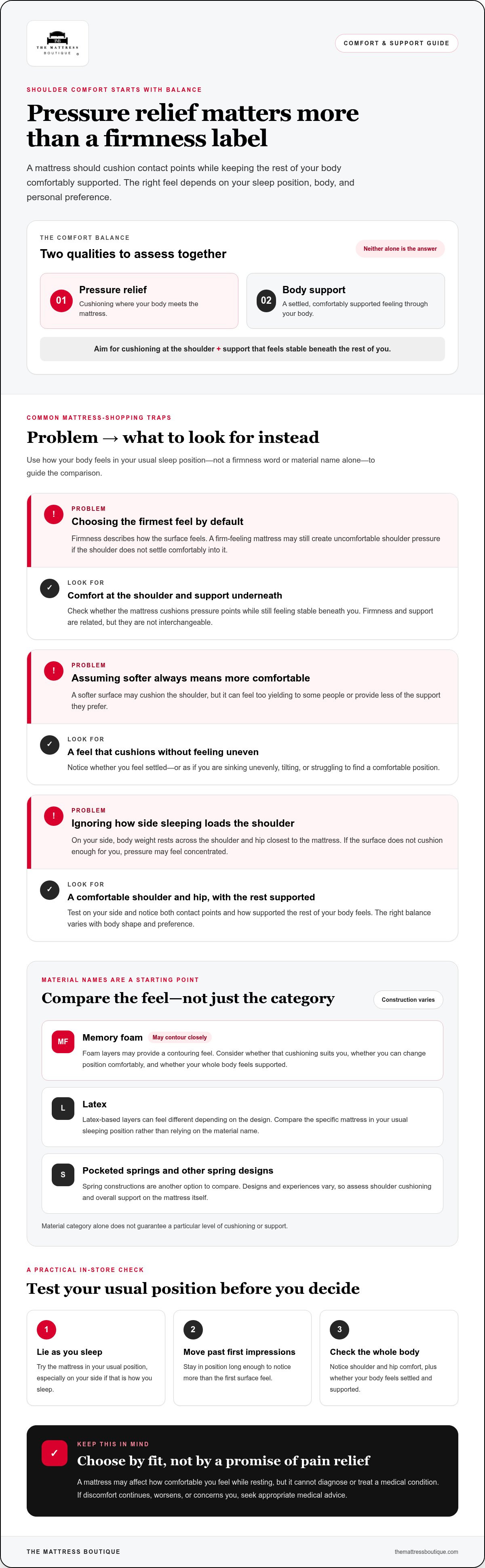
A suitable mattress cushions pressure points while supporting the rest of your body comfortably. For a side sleeper, enough give around the shoulder may help avoid a compressed feeling, while support through the body can help you feel settled rather than uneven or as if you’re sinking. The right balance depends on your build and sleep position, so a mattress that feels comfortable to one person may not feel the same to another.
Pressure relief reduces concentrated pressure at contact points, while support helps your body feel comfortably aligned. These qualities work together; neither softness nor firmness alone tells you whether a mattress will suit you. A very soft surface may feel welcoming at first but lack the support you prefer, while a firmer one may not cushion your shoulder enough. Focus on how the whole mattress feels in your usual sleeping position.
Construction is one factor behind that feel. Foam, latex, and spring designs can be built in different ways, so the material name alone doesn’t guarantee a particular level of cushioning or support. For a general overview of different types of mattresses and their construction, it can help to learn the terms you’ll encounter as you compare options. Use that background as a starting point, then judge comfort by how a mattress feels for you.
Firmness, Pressure Relief, and Alignment: What Matters Most?
The firmest mattress isn’t automatically the best choice for aches or discomfort. Firmness describes how the surface feels, but it doesn’t tell you exactly how it will cushion your shoulder or support your body. A mattress can feel firm overall and still create uncomfortable pressure for a side sleeper if the shoulder doesn’t settle comfortably into the surface.
Pay attention to your experience rather than treating a firmness label as a verdict. Too little cushioning might feel like concentrated pressure at the shoulder or hip. Insufficient support may feel like your body is sinking unevenly or that you’re working to find a comfortable position. These observations can guide your comparison, but they aren’t a diagnosis or proof that the mattress is the only cause.
Is a soft mattress better for shoulder pain?
A softer feel may provide more cushioning around the shoulder, but that doesn’t make it universally comfortable. Your body weight, sleep position, body shape, and preferences all affect how a mattress feels. A surface that cushions one side sleeper well may feel too yielding to another. There’s no single firmness that guarantees comfort, so use softness as one comparison point, not the whole decision.
How can you notice poor alignment while testing?
Lie in your usual position long enough to move past the first impression. Notice whether your body feels settled or instead tilted, strained, or pressed in a way that makes it difficult to relax. If you sleep on your side, check how your shoulder and hip feel against the mattress and whether the rest of your body feels comfortably supported.
Firmness is how a mattress feels at the surface; support is how it holds your body. They’re related but not interchangeable. During a test, compare both: does the mattress cushion pressure points while still feeling stable beneath you? If you’re considering different feels, compare mattress options with your sleep position and comfort preferences in mind. A thoughtful fit matters more than choosing the firmest label.
Memory Foam, Latex, or Springs: Which Mattress Type Should You Compare?
Material can influence how a mattress cushions your shoulder, responds as you move, and feels under your body. Category names are only a starting point: comfort depends on the mattress’s specific construction and your preferences. Compare options by lying in your usual sleeping position and noticing both shoulder pressure and how supported the rest of your body feels.
| Mattress type | Construction and general feel | Potential benefits | Considerations |
|---|---|---|---|
| Memory foam | Foam layers; may contour closely to the body. | That contouring feel may suit shoppers seeking cushioning around pressure points. | Notice whether you can change position comfortably and whether your whole body feels supported. |
| Latex | Latex-based layers; the feel varies with the design. | Worth comparing if you want a different response from memory foam. | Don’t assume every latex mattress feels the same or provides the same level of cushioning. |
| Pocketed spring | Individual springs sit in fabric pockets, with the overall feel shaped by the full mattress design. | A spring-based option to compare for its balance of cushioning and support. | Assess the surface comfort as well as how supported you feel when resting on your side. |
| Bonnell spring | Spring construction using connected coils; the mattress’s other layers affect its feel. | Offers a distinct spring category to include in your comparison. | Don’t infer shoulder comfort from the spring type alone; test the complete mattress. |
What might memory foam feel like for a side sleeper?
Memory foam may contour around the body, but the sensation varies by mattress and sleeper. As you test one, notice whether your shoulder feels comfortably cushioned and whether you can change position without feeling restricted. Check that your body as a whole feels settled, rather than focusing on the shoulder alone.
How do latex and spring mattresses differ in feel?
Latex and spring mattresses can each feel different depending on their layers and design. Pocketed spring and Bonnell spring are distinct construction categories, so compare them separately rather than treating all spring mattresses as alike. Foam, latex, and spring designs offer different feel possibilities, but personal fit matters more than the material name.
There’s no universal winner. The best mattress for shoulder pain is the one that feels comfortable to you while keeping your body supported in your usual sleep position. Use material to create a shortlist, then judge each mattress by how it feels.
How to Test and Choose a Mattress for Shoulder Comfort
A consistent test makes it easier to compare mattresses without relying on a quick first impression. Start with your usual sleep position, where you notice discomfort, and the feel you generally prefer. Then use the same checks for each option.
- Set your baseline. Note whether you mainly sleep on your side, back, or in another position. Record where you feel pressure or discomfort and whether you prefer a more cushioned or firmer surface.
- Test in your usual position. Lie as you normally would, especially on your side if that’s how you sleep. Don’t force a posture just to fit the mattress.
- Check shoulder and hip comfort. Notice whether these areas feel supported or seem to sink noticeably or be pushed upward. Also check whether your body feels settled overall.
- Compare movement and feel. Shift position as you would at home. Note whether it feels easy to move and whether the mattress remains comfortable after you’ve settled.
- Keep simple notes. Record pressure, overall comfort, and ease of movement for each option. Compare similar mattress feels using the same sleeping position and a similar amount of test time.
A brief test can help you rule out options that feel immediately uncomfortable, but it can’t predict how a mattress will feel every night. Treat your notes as a practical shortlist, not a guarantee of future comfort.
What should you check during an in-person mattress test?
Focus on how the mattress feels beneath your body, rather than trying to hold a perfect-looking position. In your usual posture, check whether your shoulder feels comfortable and whether your hips and shoulders seem supported, not noticeably sinking or pushed upward. Use the same position and a similar test duration for each mattress to make the comparison more useful.
When should you consider changing your pillow or sleep setup?
Your pillow height and sleeping posture can also affect how your neck and shoulder feel. Assess your pillow and mattress together: a different pillow may change how your head and neck rest, while the mattress affects how your body is supported. Comfort observations can’t identify a medical cause. For more guidance on comparing beds, read the complete Singapore mattress choosing guide.
Use your observations to narrow down the best mattress for shoulder pain for your needs, then compare suitable materials and feels. Explore mattress options to continue your comparison.
Choose a Shoulder-Comfort Mattress by Fit, Not by Pain-Relief Claims
Build your shortlist around how you sleep and what you notice during a mattress test, not a promise that a particular bed will ease shoulder pain. Keep four points in view:
- Sleep position: Prioritise how the mattress feels in the position you use most.
- Pressure relief: Notice whether your shoulder feels comfortably cushioned rather than uncomfortably pressed.
- Alignment: Check whether your body feels settled and supported, not tilted or strained.
- Preferred feel: Compare cushioning and firmness according to your own comfort, not a label alone.
The best mattress for shoulder pain is a personal fit, and a material or brand name can’t guarantee a particular result. Treat product claims as a starting point for comparison, then consider how the whole mattress feels beneath you.
How can you compare the retailer’s mattress range?
Compare memory foam, latex, pocketed spring, and Bonnell spring mattresses by construction and feel. Memory foam may feel more contouring, while latex and spring designs can respond differently depending on their build. Pocketed and Bonnell springs are separate construction categories, so test each option rather than assuming all spring mattresses feel alike.
The Mattress Boutique offers these mattress types alongside brands including King Koil, Slumberland, Dunlopillo, SofzSleep, and MaxCoil. Use brand and material to organise your shortlist, not as evidence that a mattress treats shoulder pain. For more brand-specific background, read the King Koil mattress buying guide.
What if shoulder pain continues despite a mattress change?
A mattress choice can help you compare comfort, but it can’t identify or resolve every source of shoulder pain. If discomfort persists, worsens, or feels unexplained, consult a qualified healthcare professional. Shopping is not a substitute for medical assessment, and you don’t need to keep changing mattresses in search of a solution to ongoing symptoms.
For a comfort-focused comparison, explore the mattress options by material and preferred feel. Choose based on your sleep position and what feels comfortable to you, not on a promise of pain relief.
Choose a Mattress That Fits Your Sleep
The best mattress for shoulder pain isn’t defined by firmness alone or by a promise on a label. Start with your usual sleep position, then compare how each mattress cushions your shoulder while supporting your body comfortably. Personal feel matters: a surface that suits one sleeper may not suit another.
Testing options in your normal position can help you notice pressure, support, and ease of movement. Compare mattress materials such as memory foam, latex, and spring types, and consider options from King Koil, Slumberland, Dunlopillo, SofzSleep, and MaxCoil. These choices offer different ways to explore comfort, but no brand or construction can guarantee pain relief. If shoulder discomfort persists, worsens, or feels unexplained, consult a qualified healthcare professional rather than treating mattress shopping as medical care.
Ready to narrow your shortlist by material and feel? Compare mattress options at The Mattress Boutique and take the next step towards a choice that feels right for you.
Frequently Asked Questions
What is the best mattress for shoulder pain when you sleep on your side?
The best mattress for shoulder pain as a side sleeper is one that cushions your shoulder while keeping your body comfortably supported. There’s no single material or firmness that suits everyone. Try a mattress in your usual side-sleeping position and notice whether your shoulder feels pressed, your hips feel supported, and you can relax without forcing your posture. Body shape and personal comfort both influence how a mattress feels.
Is a firm mattress better for shoulder pain?
Not necessarily. A firm surface may feel supportive to some sleepers, but it can still create uncomfortable pressure at the shoulder if it doesn’t provide enough cushioning. Softness alone isn’t a reliable guide either, since a very yielding feel may not suit your preferred level of support. Compare how the mattress feels beneath your shoulder and the rest of your body in your usual sleep position rather than choosing by firmness label alone.
Can a memory foam mattress help with shoulder pressure?
Memory foam may contour around your body, which some sleepers find comfortable around pressure points, but the feel varies between mattresses and individuals. During a test, notice whether your shoulder feels comfortably cushioned and whether you can change position easily. Check your overall sense of support too. A memory foam mattress may suit your preferences, but the material itself can’t promise to relieve shoulder discomfort.
Which mattress material is best for shoulder pain: latex, foam, or springs?
No material is best for everyone. Memory foam may feel contouring, while latex and spring mattresses can respond differently depending on their construction. Pocketed spring and Bonnell spring mattresses are distinct types, and designs within each category can also vary. Compare each complete mattress in your usual position, paying attention to shoulder comfort, support, and ease of movement instead of relying on the material name.
Can changing my pillow help with shoulder discomfort while sleeping?
Changing your pillow may affect how your head and neck rest, so it can be useful to assess your pillow alongside your mattress and sleeping posture. Notice whether the pillow feels comfortable in your usual position and whether your neck feels supported without strain. These observations can help you review your sleep setup, but they can’t determine the cause of shoulder discomfort or replace medical advice if symptoms persist or concern you.
How should I test a mattress for shoulder comfort?
Test each mattress in your normal sleeping position, especially on your side if that’s how you usually sleep. Give yourself time to settle, then notice shoulder pressure, how supported your hips feel, and whether you can move comfortably. Compare different mattress feels using a similar position and length of test, and jot down your impressions. A brief test can help narrow your choices, but it can’t predict how every night will feel.
When should I seek medical advice for shoulder pain that affects sleep?
Consult a qualified healthcare professional if shoulder pain persists, worsens, feels unexplained, or continues to disrupt your sleep. A mattress change may alter your comfort, but it can’t identify or resolve every possible source of pain. Avoid treating shopping as medical care or assuming discomfort proves your mattress is the cause. A healthcare professional can assess your concerns and advise you on appropriate next steps.