

The obvious choice isn’t always the easiest one. A gas-lift storage bed is designed to make raising the mattress platform easier, but you still need to apply some effort. A heavier mattress can make lifting tougher. If you’re wondering whether storage beds are hard to lift, drawers avoid lifting altogether, while a lift-up bed offers one larger storage space beneath the mattress.
Both designs make better use of bedroom space, but suit different routines. If you reach for stored items often, lifting the mattress platform each time may feel less convenient than opening a drawer. If you need room for bulky belongings, the larger compartment of a lift-up bed may be a more practical trade-off.
This guide compares drawer and gas-lift beds by ease of access, storage capacity, room clearance and everyday practicality. You’ll see what affects lifting effort, how to assess your bedroom layout, and which option better fits the way you use your space. By the end, you’ll have a clear guide to choosing between quick drawer access and a larger lift-up storage area.
Key Takeaways
- Choose drawers for easier, frequent access; choose a lift-up design when one larger compartment better suits what you plan to store.
- Factor in mattress weight and ceiling height when judging how manageable a lift-up bed will be in your room.
- Measure the space beside the bed before choosing drawers, and consider whether bulky belongings need a more open storage area.
- When selecting a mattress, consider how its weight and your preferred comfort fit with the storage bed you have in mind. The Mattress Boutique offers a wide range of quality mattresses to suit your needs.
Is a Drawer Storage Bed or Lift-up Storage Bed Better?
Drawer frames avoid lifting the mattress, while gas-lift frames raise the platform for access. The better choice depends on mattress weight, access needs and room layout.
Drawer Storage Beds
A drawer storage bed opens by sliding out a drawer, so you can reach stored items without raising the mattress. This suits frequent access, such as retrieving seasonal clothing while changing your wardrobe. The effort shifts from lifting to pulling: a full drawer may be harder to move, and the floor needs enough clearance. Compared with a lift-up bed, drawers provide direct access but divide storage into smaller spaces.
Gas-Lift Storage Beds
A gas-lift bed is designed to help raise the mattress platform, though the mechanism still requires some effort. The mechanism makes lifting easier, but doesn’t remove effort entirely. A heavier mattress can make the platform harder to raise, so its weight matters. Anti-slip fabric on the base helps keep the mattress in place as the platform lifts. For an older adult or someone with limited mobility, suitability depends on whether they can manage the lifting movement; drawers avoid it. Keep fingers clear of hinges and moving joints, and lower the platform in a controlled way.
Hydraulic and Spring-Lift Beds
Gas-lift beds use hydraulic pistons, so “gas-lift” and “hydraulic” can describe the same assisted mechanism. These systems are designed to control the base’s movement and speed. Spring-lift frames use a different lifting mechanism, so opening effort depends on the frame design and mattress weight. There’s no universal rule that gas lifts are easier to open than spring-lift beds. In Singapore, repair or replacement costs depend on the faulty part, such as a gas strut, hinge or frame connection, and the work required.
| Option | Access effort | Key consideration |
|---|---|---|
| Drawer frame | Pull the drawer | Needs floor clearance |
| Gas-lift frame | Raise the mattress platform | Mattress weight affects effort |
| Spring-lift frame | Raise the mattress platform | Effort varies by mechanism |
Choose drawers for frequent, no-lift access; choose a lift-up frame if you can manage its platform and prefer one open storage compartment.
The Verdict: Are Storage Beds Worth It?
A storage bed makes good use of space when its compartment suits what you store and how often you need it. Gas-lift access works best for belongings you use less often; drawers suit everyday essentials.
Accessing Storage with Gas-Lift Beds
A gas-lift bed raises the mattress platform to reveal one storage compartment underneath. This gives you access across the bed’s base without opening individual drawers. The frame needs less clearance at the sides than drawer designs, making it easier to place near a wall or corner in a compact bedroom.
For example, use the compartment for spare bedding or seasonal items you retrieve occasionally. The trade-off is that accessing anything stored underneath means lifting the platform, so it’s less convenient for items you need each day.
Everyday Storage Access
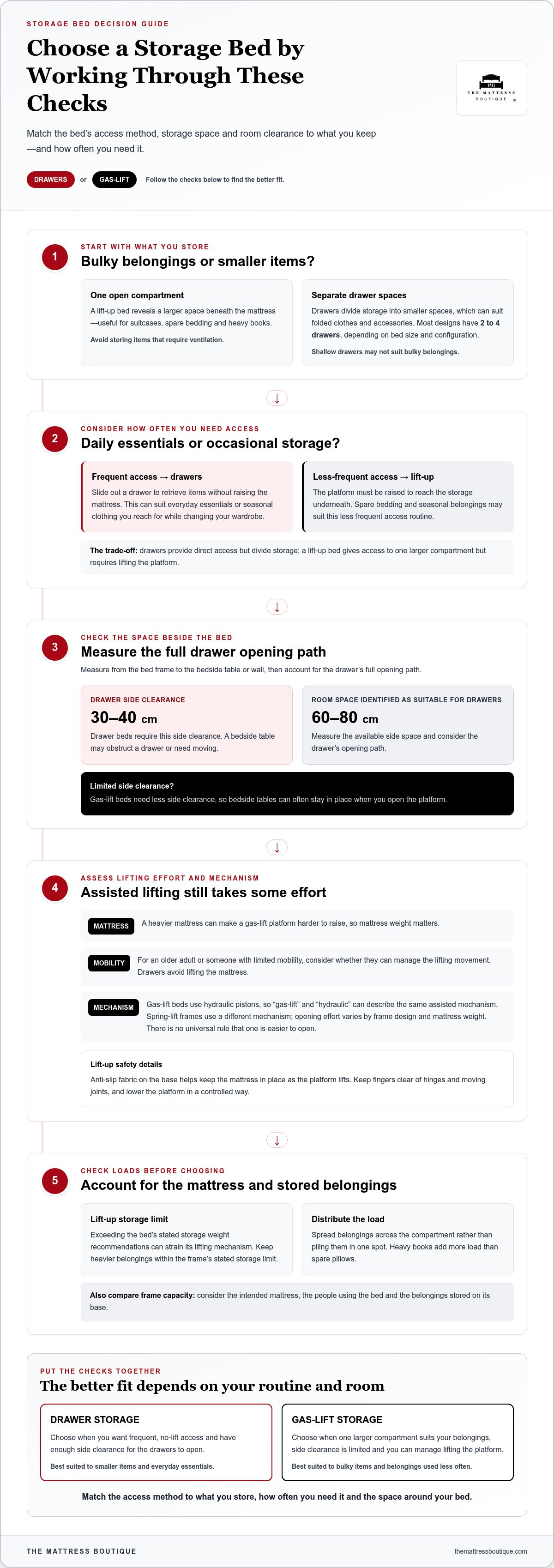
Access frequency can tip the decision. Drawers let you retrieve a frequently used item without lifting the mattress, but they need room to open. Drawer storage beds require 30 to 40 centimetres of side clearance, so a bedside table positioned beside a drawer may obstruct it or need moving.
Rooms with 60 to 80 centimetres of side space are identified as suitable for drawer beds. Measure from the bed frame to the bedside table or wall, then consider the drawer’s full opening path. This makes it easier to judge whether daily access will feel convenient.
Gas-lift beds need less side clearance, so bedside tables can often stay in place when you open the platform. However, accessing the storage still means lifting the mattress base. If you store daily essentials, drawers may be more practical; for spare bedding or seasonal belongings, a larger lift-up compartment may be worth the extra step.
Decision guide: Choose drawers for frequent access and when you have enough side space. Choose gas-lift storage for items used less often and a bedroom with limited side clearance. The best fit comes from matching the access method to your routine, not simply adding storage underneath.
Storage capacity and bulky items
A lift-up bed reveals one large storage compartment beneath the mattress, making it useful for bulky belongings. Suitcases, spare bedding and heavy books can be awkward to fit into shallow drawers. Under-bed drawers divide storage into separate spaces, so they work better for smaller items such as folded clothes. Most drawer designs have two to four drawers, depending on bed size and configuration.
Think about what you intend to store before choosing a frame. A suitcase needs open compartment space, while accessories or neatly folded clothing can be sorted into drawers. Drawers have limited storage volume and aren’t ideal for bulky items. A lift-up design offers a more open area, but avoid storing items that require ventilation there.
Weight matters for both storage and lifting. Exceeding a lift-up bed’s storage weight recommendations can strain its lifting mechanism. For example, a compartment packed with heavy books adds more load than one holding spare pillows. Keep heavier belongings within the frame’s stated storage limit, and distribute them across the compartment rather than piling them in one spot.
Also consider the bed frame’s weight capacity. The mattress and the people using the bed both place demands on the frame, while stored belongings add load to its base. Compare the frame’s stated capacity with your intended mattress and normal use, then keep stored items within the storage recommendation. These are separate considerations: a frame’s overall capacity doesn’t automatically mean its lifting mechanism can handle unlimited storage weight.
To reduce bedroom clutter, group belongings by size and how often you use them. Place occasional-use items, such as a spare duvet or suitcase, in a lift-up compartment. Keep smaller, regularly used items in drawers for easier sorting. This helps match the storage design to your routine, rather than choosing capacity that remains awkward to access.
For bulky belongings, a lift-up bed usually provides more practical storage. For smaller items that benefit from separation, drawers may suit better. Either way, follow the bed frame’s weight recommendations to protect the storage mechanism and keep the compartment useful.
Gas-lift beds versus drawer storage
Compare the two designs by how they use floor space, provide access and handle everyday use. Gas-lift beds reveal a broad storage space beneath the mattress platform. Drawers separate belongings into smaller sections but need clear space beside the frame. Let your room layout and stored items guide the choice.
A lift-up mechanism suits bedrooms where furniture sits close to the bed. The platform rises vertically, so the frame can sit nearer a wall than drawer designs. This can preserve access in a tighter layout. However, opening it means raising the mattress, and you may need to move bedding first. That makes the mechanism less convenient for belongings you use daily.
Drawer frames trade that open compartment for direct, organised access. They need 30 to 40 centimetres of side clearance to open fully, while rooms with 60 to 80 centimetres of side space suit drawer access. Measure from the frame to nearby furniture, including bedside tables. Thick carpet can also affect smooth drawer movement on frames that sit flush to the floor.
Consider how the bed may hold up over time. A weakened gas lift may eventually need replacing, while quality gas struts can last for many years with normal household use and proper maintenance. A lift-up frame can also be harder to move or rearrange after assembly because of its extra structure and mechanism. Drawers avoid that lifting system, but need usable floor clearance.
Prefer a lift-up design if you need a large compartment, have limited side clearance or store bulky items. Prefer drawers if you reach stored belongings often and can keep their opening path clear. Most under-bed drawer designs have two to four drawers, though configurations vary by bed size and design. For help matching a frame to your room and storage needs, explore storage bed frame options.
The Mattress Boutique: King Koil Mattresses
The Mattress Boutique offers King Koil mattresses, along with Slumberland, Dunlopillo and SofzSleep mattresses. If you’re choosing a lift-up bed, mattress weight matters because a heavier mattress can make the platform harder to raise. Consider how your preferred mattress will work with your storage-bed design, and weigh comfort needs against everyday access.
Mattress type can also shape your shortlist. The Mattress Boutique offers pocketed-spring, memory foam, latex and Bonnell-spring mattresses, giving you different constructions to consider as you plan your bedroom setup. Balance your preferred feel with a storage arrangement you can use comfortably.
Contact The Mattress Boutique or visit themattressboutique.com to explore its mattress range.
Choose a Setup That Fits Your Daily Routine
Before deciding, picture a typical week in your bedroom. Note who will access the stored items, what they’ll reach for, and whether lifting a mattress platform fits comfortably into the routine. This practical check can clarify the choice better than focusing on storage space alone. If you’re still asking whether storage beds are hard to lift, consider who will operate the mechanism and how often.
Then consider the mattress as part of the whole setup, not as a separate decision. The Mattress Boutique offers King Koil, Slumberland and Dunlopillo mattresses to consider alongside your storage-bed choice.
For a considered next step, contact The Mattress Boutique to explore mattress options for your bedroom. Choose the arrangement that feels practical for your home, and you can move forward with greater confidence.
Frequently Asked Questions
What Are Gas-Lift Beds?
Gas-lift beds have an upward-opening mattress platform supported by gas struts or hydraulic pistons. This reveals the space beneath the mattress without sliding a drawer from the frame. For instance, you can reach an item near the bed’s centre instead of pulling out separate drawers from the sides. This design can help when side access is tight.
What Exactly Is a Storage Bed?
A storage bed is a bed frame with built-in space for belongings, rather than leaving the area underneath unused. Depending on its construction, storage may come as drawers or as a compartment accessed by raising the mattress base. For example, use drawers for sorted clothing, or an open compartment for awkward-shaped items that don’t fit neatly into shallow spaces.
Are storage beds with gas-lift mechanisms hard to lift?
If you’re asking whether storage beds are hard to lift, gas-lift models are designed to assist the movement, but some effort remains. Use the frame’s intended lifting point and raise the platform steadily, keeping your hands clear of the hinges. If it feels unusually stiff or moves unevenly, stop rather than forcing it, as the load or lifting mechanism may need attention.
How much force does it take to lift a storage bed mattress and frame?
There’s no single force figure that applies to every bed. The effort depends on the combined weight of the mattress and platform, the assistance provided by the lifting mechanism, and how the base is balanced. A practical check is to raise the platform from its intended handle when the bed is correctly assembled. Smooth, controlled movement matters more than a guessed force figure.
Do storage bed lifting mechanisms require physical strength?
Some physical effort is still needed, but a gas-lift mechanism assists in raising the base. The task can feel more demanding if the mattress is heavy or the lifting point is awkward to reach. If you have limited strength or mobility, a drawer-style design avoids raising the platform. Compare the access movement with what you can comfortably manage in your bedroom.
How do mattress weight and size affect how easy a storage bed is to lift?
Mattress weight directly affects the load the lifting system must support, so a heavier mattress can make opening the bed more demanding. Larger formats usually come with larger platforms and mattresses; the total load, not size alone, is the key consideration. Match the mattress weight to the lift system’s stated limit, and account for any bedding left on the bed.