

A stable bed starts with the right preparation, before you tighten the first bolt. Setting up a new bed frame can feel tricky when the instructions are unclear, the hardware looks unfamiliar or there’s little room to unpack. A few practical steps can protect the parts and make assembly easier to follow.
This guide covers how to clear and organise your workspace, identify the frame components and assemble them in a sensible order without forcing pieces into place. You’ll also find final stability checks to help you spot loose connections or uneven support before adding a mattress. The fit matters too: your mattress should sit securely on the frame or base, with suitable support underneath. Whether you’re assembling a storage or divan bed frame, use these steps to prepare the room, build carefully and check that the bed is ready for use.
Key Takeaways
- Before setting up a new bed frame, measure the route into the room and the intended bed position to plan for bulky parts.
- Use the manufacturer’s manual as your guide, and leave the main frame loosely assembled until the rails and joints are aligned.
- Platform, storage and divan frames can require different setup steps, especially when storage mechanisms or moving parts are involved.
- Check that the frame is level and its supports sit firmly on the floor. Tighten connections only as the instructions direct.
- Confirm the mattress matches the frame’s specified size and that the base provides suitable support for its type.
Before Setting Up a New Bed Frame: Prepare the Room and Parts
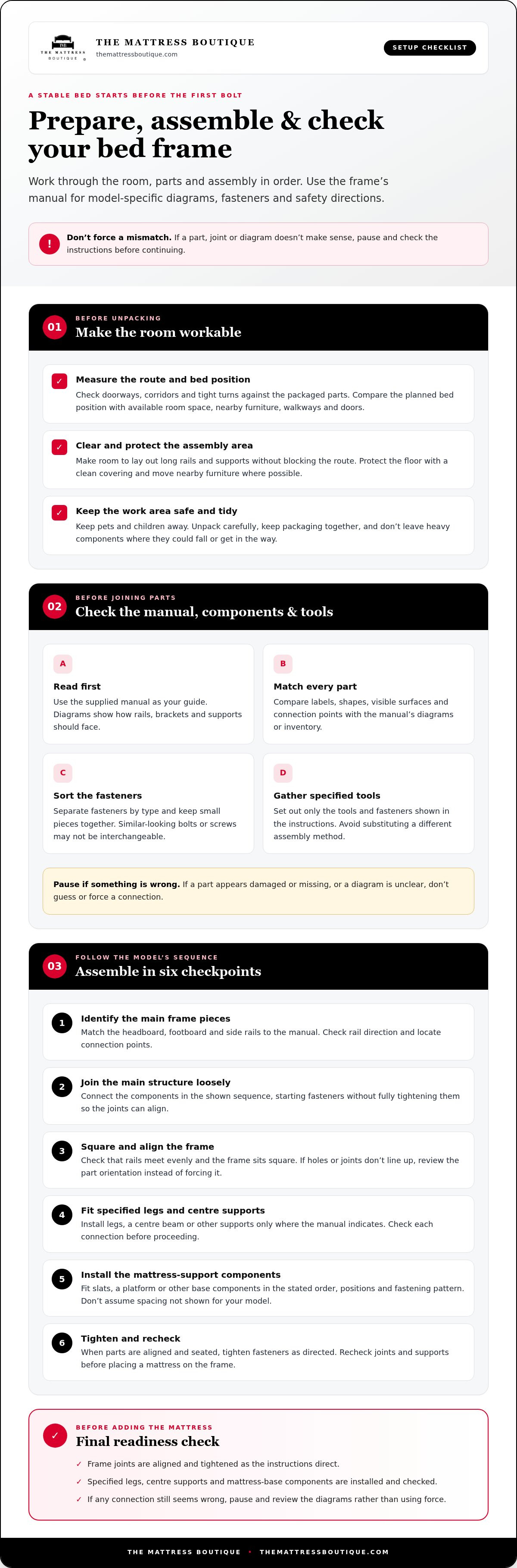
Preparation helps prevent cramped working conditions, misplaced fasteners and avoidable marks on your floor or furniture. Before setting up a new bed frame, make sure you have enough room to handle the components safely and follow the manufacturer’s instructions without interruption.
Start with this checklist:
- Clear floor space and protect the area where you’ll unpack and assemble.
- Keep pets and children away from the work area.
- Measure the route into the room and the planned bed position before opening bulky packages.
- Set aside the manual and gather only the specified tools.
Measure doorways, corridors and tight turns along the route, then compare them with the packaged parts and the available room space. Check the planned bed position against nearby furniture, walkways and doors. This helps you choose a workable assembly area and avoid unpacking a large component before you know where it can be handled.
Make room to assemble the frame safely
Choose a clear area where you can lay out long rails and supports without blocking the route through the room. Protect the floor with a clean covering, and move nearby furniture out of the way where possible. Keep the intended bed position accessible, but leave enough space around the frame to reach its joints during assembly.
Unpack carefully and keep the packaging together so it doesn’t spread across the floor. Don’t lean heavy components against a wall or leave them where they could fall. A tidy workspace makes parts easier to find and reduces the chance of stepping on hardware or scraping a finished surface.
Check the instructions, components, and tools
Read the manual before joining anything. Frame designs differ, and diagrams show how rails, brackets and supports should face. If you’re unfamiliar with the parts, this overview of bed frame types and components explains common terms, but follow the instructions supplied with your frame for assembly.
Lay out the components so their labels and shapes are easy to compare with the manual. Separate fasteners by type and keep small pieces together in a container. Don’t assume similar-looking bolts or screws are interchangeable. Use the locations and quantities shown in the instructions.
- Check visible surfaces and connection points for damage.
- Compare the parts and fasteners with the manual’s diagrams or inventory.
- Set out the specified tools, and avoid substituting a different assembly method.
If a part appears damaged or missing, or a diagram doesn’t make sense, pause before proceeding. Forcing a connection or guessing which fastener fits can damage components and complicate later steps. Once the workspace, parts and tools are ready, assemble the frame in the order specified by the manufacturer.
How to Assemble a Bed Frame in the Right Order
Use the manufacturer’s manual as your primary guide. Designs differ, so the sequence below is a general framework, not a substitute for model-specific diagrams or safety directions. During setting up a new bed frame, pause at each stage to check alignment before moving on. It’s easier to correct a small mismatch before the base and mattress supports are in place.
- Identify the main frame pieces. Match the headboard, footboard and side rails to the labels or diagrams in the manual. Check which way each rail faces and locate the connection points before fastening anything.
- Join the main structure loosely. Connect the head, foot and side components in the sequence shown. Start the specified fasteners without fully tightening them, leaving enough movement to align the joints.
- Square and align the frame. Check that the rails meet evenly and the frame sits square. If holes or joints don’t line up, stop and review the part orientation rather than forcing the pieces together.
- Fit specified legs and centre supports. Install the legs, centre beam or other supports where the manual indicates. Confirm each one meets its connection point correctly before proceeding.
- Install the mattress-support components. Fit slats, a platform or other base components in the stated order, using the specified positions and fasteners. Don’t assume a layout or spacing that isn’t shown for your model.
- Tighten and check the completed assembly. Once all parts are aligned and seated, tighten the fasteners as directed. Recheck the joints and supports before placing a mattress on the frame.
Build and align the main frame
Keep the early connections slightly loose while you assemble the outer structure. This allows small adjustments if a rail is reversed or the frame needs to shift into alignment. For example, if one side rail sits at an angle, compare its orientation with the diagram before tightening. When the corners meet as intended and the frame is square, secure the joints as directed in the manual.
Fit supports and the mattress base
Support layouts vary by frame. One design may require a centre beam or extra legs, while another uses a different arrangement. Fit each support only where the instructions specify, then check that it is seated firmly and connected as shown. Add slats or platform components evenly, following the model’s fastening directions. Don’t place a mattress on the frame until the supports are installed and checked.
Keep the manual nearby for the final tightening sequence. Avoid overtightening or substituting fasteners, since either can affect how the parts fit together. If a connection still seems wrong, pause and review the diagrams rather than using force. If you’re choosing a frame to suit your room and mattress, explore storage bed frames as one option.
How Assembly Changes for Platform, Storage, and Divan Bed Frames
Bed bases don’t all use the same parts. A platform may have a solid mattress-supporting surface or use slats, while storage designs include moving components. A divan can be constructed differently from a frame assembled from separate head, foot and side rails. Use the comparison below to identify what to look for, then follow the instructions for your specific model. When setting up a new bed frame, its design determines which parts need fitting and in what order.
| Frame type | What to look for during assembly | Key instruction |
|---|---|---|
| Platform | A solid surface, slats or a separate support structure | Identify the mattress-supporting surface and any centre supports in the manual. |
| Storage | Storage hardware and moving components | Use the model’s specific installation steps and handle moving parts carefully. |
| Divan | A base structure that may differ from a rail-and-slat frame | Follow the directions for the divan’s actual construction rather than assuming rails are involved. |
Platform and slatted frames
Platform bases vary: the mattress may rest on a solid surface, slats or a support structure fitted within the frame. Use the manual’s diagrams to identify the surface that carries the mattress and any centre beams or legs that support it. Don’t add or remove support parts based on another frame’s layout. For a Sofzsleep mattress on a slatted base, keep the gap between slats under 3 in (7.62 cm).
Check that every support component is positioned and secured as directed before placing the mattress. If the instructions show a particular slat arrangement, follow it rather than spacing the slats by eye. The support surface is part of the frame-and-mattress fit, so check that the assembled base matches both the frame manual and the mattress guidance.
Storage and divan frames
Storage models may include hardware and moving parts that require a model-specific fitting sequence. Follow the supplied instructions for each mechanism. General steps for a fixed rail frame may not apply. Keep hands clear of hinges and other moving parts while fitting and checking components, and don’t operate a mechanism until the relevant parts are installed as directed.
A divan’s construction can differ from a frame made by joining separate rails and adding slats. Identify the base sections and any included components from the manual, then follow its stated method rather than expecting a rail-and-slat structure. The Mattress Boutique offers storage and divan bed frames to suit different bedroom setups.
Check Bed Frame Stability and Fix Common Setup Problems
A frame can look complete but still need a careful final check before use. Work through these checks after assembly, and use the manual whenever it specifies an inspection or tightening method. This review can help you distinguish a simple adjustment from a problem that needs attention.
Final stability check: Confirm the frame is level, joints are aligned, every leg and support sits firmly on the floor, and all mattress-base parts are in their intended positions.
Spot wobbling, noise, or misalignment
If the frame wobbles or makes a noise, don’t tighten parts at random. First check whether the floor is uneven or a leg or support isn’t sitting flat. Then inspect nearby joints and compare the orientation of connected components with the manual. A rail fitted the wrong way around can leave a joint misaligned, while a misplaced support may not meet the floor as intended.
Retighten only as the instructions direct. Overtightening can affect how components fit, and replacement fasteners that aren’t specified may not suit the frame. If a connection won’t align, loosen it only as the manual allows and recheck the component positions before trying again. Don’t use the frame if a structural part remains loose, damaged or incorrectly fitted. Pause and follow the manufacturer’s instructions for the next step.
Complete a final safety check
Once the frame appears correctly assembled, inspect the whole base, not just the corners. Check that all listed legs, centre supports, slats or platform components are present and seated where shown. Apply gentle pressure to different parts of the frame and note any unexpected movement. Don’t jump on the frame or load it abruptly to test it.
If a support shifts or a joint moves, stop and trace the issue to its connection. Check floor contact, alignment and fastening directions again. Movement may point to a part that needs repositioning, but don’t assume tightening harder will solve it. Follow the manual, and keep the mattress off the frame until structural concerns are resolved.
- Check the frame sits level and its joints meet evenly.
- Confirm each leg and support rests firmly on the floor.
- Verify the mattress base is complete and correctly fitted.
- Apply gentle pressure and watch for movement or unusual noise.
- Keep packaging and spare fasteners until the checks are complete.
Hold on to the packaging and any spare fasteners until setup is finished and you’re satisfied with the frame’s condition. If you’re choosing a frame for your room, explore bed frames from The Mattress Boutique.
Match the Mattress to Your Newly Set-Up Bed Frame
Before placing a mattress on the completed frame, compare the size on the mattress label or product information with the frame’s specified mattress dimensions. Matching the stated sizes is more reliable than judging by appearance. A mattress that is too large may not sit properly within the frame, while one that is too small may leave unwanted space around the edges.
Check mattress size and support compatibility
Check both sets of specifications, and make sure the frame is fully assembled before positioning the mattress. Follow the frame manual for the intended mattress size and the mattress maker’s guidance for a suitable base. Requirements differ by mattress design and manufacturer, so don’t assume every mattress works equally well on a solid platform, divan or slatted frame.
Pay particular attention to the support surface. If you’re using a Sofzsleep mattress on a slatted base, the gap between slats must be under 3 in (7.62 cm). For other combinations, follow the relevant product guidance rather than applying one mattress’s support requirement to another. Once the mattress is in place, follow its care instructions, including any directions for handling, rotation or flipping.
Choose a frame and mattress as a coordinated setup
Think of the bed as a matched pair: the frame’s stated dimensions need to suit the mattress size, and the base needs to provide the support that mattress requires. If you’re comparing comfort and materials, The Mattress Boutique offers memory foam, latex, pocketed-spring and Bonnell-spring mattresses, as well as guidance from sleep specialists on size and comfort.
Frame style is another part of the decision. Storage and divan bed frames are options to consider alongside the mattress that will sit on the base. Compare the frame specifications and mattress guidance before choosing, particularly if you’re replacing only one part of your current setup. This helps you assess fit and support before bringing a new mattress into the room.
After setting up a new bed frame, position the mattress carefully and check that it rests evenly on the intended support surface. It should match the frame’s specified dimensions without being forced into place or left unsupported at the edges. If it doesn’t sit as expected, revisit the size details and setup instructions before using the bed.
For a coordinated setup, browse The Mattress Boutique’s range of bed frames and mattresses, including storage and divan designs, alongside mattress options for different sizes and comfort preferences.
Make Your Bed Setup Work for You
With the frame ready, consider how you want your bedroom to feel and function every day. The right combination should suit your available space, preferred mattress comfort and routine. Comparing these needs before choosing can help you select a frame and mattress that work together.
The Mattress Boutique offers storage and divan bed frames alongside mattresses, with sleep specialists available to provide personal guidance on size and comfort. When you’re ready to plan your setup, explore bed frames and mattresses.
Thoughtful choices make setting up a new bed frame part of creating a bedroom that feels right for you. Take it one decision at a time, and enjoy making the space your own.
Frequently Asked Questions
Can I assemble a bed frame by myself?
Yes, a straightforward frame may be manageable alone if its instructions allow solo assembly and you can handle every component safely. The challenge is often holding a long rail in position while attaching it, not turning the fastener. If a part is bulky, heavy or awkward to steady, ask someone to help lift or align it. Don’t attempt a step that feels unsafe, and follow the manual for your specific frame.
How long does it take to set up a new bed frame?
There isn’t one reliable time estimate because the design, number of parts and clarity of the instructions all affect assembly. Setting up a new bed frame may take longer if you need to identify unfamiliar components or correct an alignment issue. Read the manual and organise the parts first, then allow enough time to work carefully and complete the checks. Rushing to meet a generic estimate can lead to missed steps.
Do bed frames come with the tools needed for assembly?
Some frames may include tools, but don’t assume yours will. Check the packaging and manual before you begin, and note whether the instructions specify a particular tool for each fastener. A tool supplied with another frame may not be included or suitable for this one. If a required tool or fastener appears to be missing, pause and review the instructions instead of forcing a connection with a substitute.
Can I assemble a bed frame in one room and move it afterward?
It may be possible, but moving a fully assembled frame can put strain on its joints and supports. If you need to relocate it, check the manual for guidance and get help with lifting bulky sections. Support the frame as you move it, and avoid dragging it, which may damage the floor or shift connections. If the frame has moving storage parts, take extra care to prevent them from swinging or catching.
Does a platform bed frame need a box spring?
Not necessarily. A platform frame may already have a surface designed to support a mattress, but construction varies between models. Before adding a box spring, compare the frame instructions with the mattress maker’s base requirements. An extra layer may change the bed’s overall height or create a setup that differs from the frame’s intended design. Use the product guidance to decide whether another support is appropriate.
Can I put the mattress on the frame immediately after assembly?
Only after the frame is complete and its components have passed the final checks. A mattress shouldn’t be used to hold an unfinished part in place or conceal movement at a joint. Check the mattress instructions too, since unpacking or positioning guidance can vary by product. If the mattress arrives compressed or packaged in a particular way, follow its directions before placing it on the base.
What should I do with the bed-frame packaging after setup?
Keep the manual and any labelled spare hardware somewhere you can find them later, and retain the packaging until you’ve confirmed the frame is complete and correctly assembled. After that, sort cardboard, plastic and other materials according to local recycling and disposal guidance. Don’t leave packaging or small fasteners on the floor while children or pets are nearby, as they can create clutter or become a safety concern.