

The spring label alone won’t tell you how firm or comfortable a mattress will feel. In the bonnell spring vs pocket spring mattress comparison, the key difference is how the coils respond: Bonnell springs are linked, while pocket springs sit in individual fabric pockets and can move more independently.
If mattress listings have left you unsure what those terms mean, you’re not alone. If you share a bed, you may also wonder whether one person’s movement will disturb the other. Spring type can influence how movement travels across the bed, but it doesn’t determine the whole feel. Comfort layers and the mattress’s overall construction matter too.
This guide explains how each spring system works and what you may notice when sleeping on it. Compare movement response and general feel, then consider your sleep position, bed-sharing habits and support preferences. You’ll have a clearer way to compare Bonnell and pocket spring mattresses beyond the label.
Key Takeaways
- Compare how connected and individually wrapped coils respond to pressure to understand the practical difference between spring designs.
- The bonnell spring vs pocket spring mattress decision involves trade-offs in movement response and feel, not a guarantee of comfort or undisturbed sleep.
- Use your sleep priorities, preferred feel and sensitivity to a partner’s movement to narrow down which type may suit your household.
- Look beyond the spring label: the complete construction also shapes how a mattress feels.
- Test options in your preferred sleeping positions and use personal guidance on firmness, materials and size to refine your choice.
Bonnell Spring vs Pocket Spring: Why the Coil Design Matters
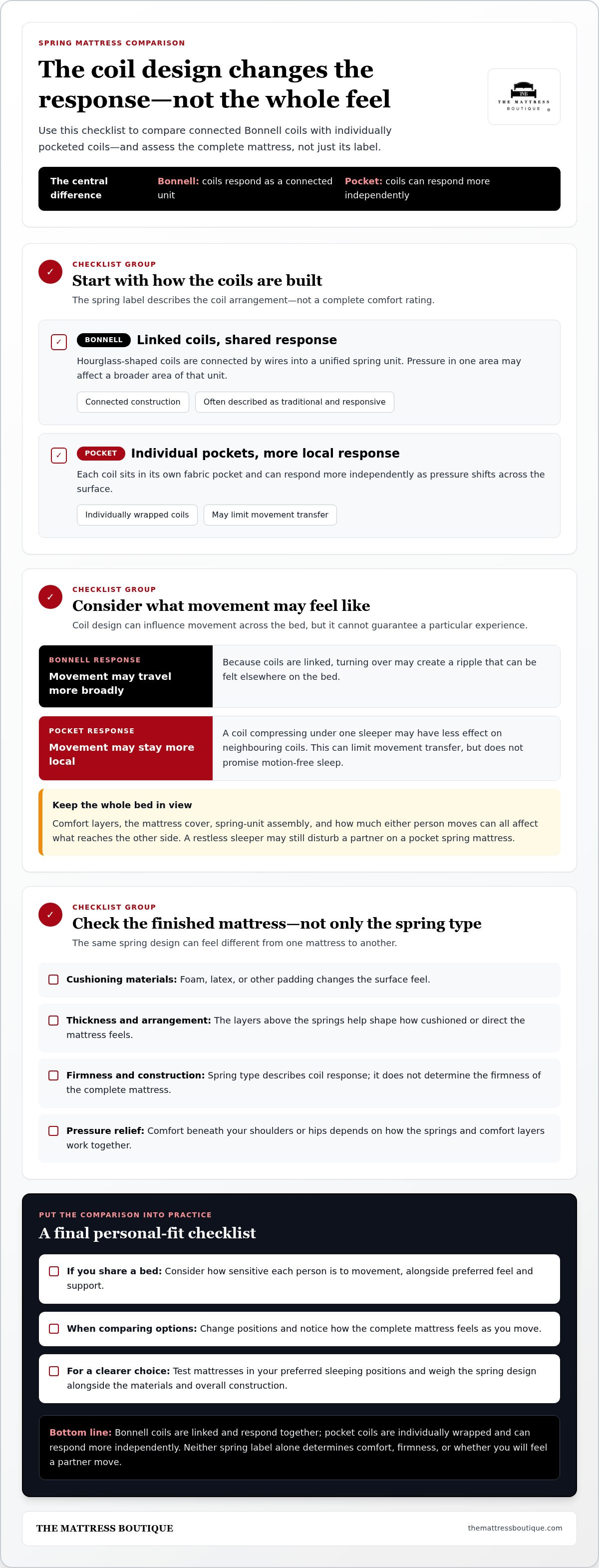
The central difference is whether the coils respond together or individually. In a Bonnell unit, linked coils work as a connected system. In a pocket spring unit, each coil sits in its own fabric pocket and can move more independently. That distinction helps explain how pressure may travel across the mattress, but it doesn’t decide which option will feel better to you.
An innerspring mattress uses metal coils as a key part of its support structure, but the coil design is only one part of the finished mattress. Foam, latex or other cushioning materials, along with their thickness and arrangement, also affect the surface feel. So does the mattress’s overall construction and firmness. Two mattresses with the same spring type can still feel different.
For an overview of different mattress coil types, including Bonnell and pocket springs, see the Mattress coil types reference. Treat the coil label as a clue about construction, not a complete comfort rating.
What is a Bonnell spring mattress?
Bonnell springs are hourglass-shaped coils connected by wires into a unified spring unit. When pressure is applied, the linked structure can respond across a broader area rather than only beneath the exact point of contact. This design is commonly associated with a traditional, responsive feel. It doesn’t guarantee a particular firmness, since the padding and finished mattress design also influence how the bed feels.
What is a pocket spring mattress?
In a pocket spring mattress, each coil is enclosed in an individual fabric pocket. Because the springs aren’t directly linked into one unit in the same way, they can respond more independently as pressure shifts across the surface. That construction may help limit how much movement travels through the mattress, but the final result depends on the complete design and isn’t a promise of motion-free sleep.
In short: Bonnell springs are interconnected coils that respond together; pocket springs are individually wrapped coils that can respond more independently. This is the clearest way to distinguish the two systems, but it doesn’t make either one the right choice for everyone.
- Bonnell: Linked coils respond as a connected unit, contributing to a more unified, responsive feel.
- Pocket: Individually wrapped coils can react more independently to pressure in different areas.
- Both: Cushioning layers, firmness and overall construction help determine the feel of the finished mattress.
Use that comparison as a starting point, then look beyond the spring system. Consider both the coil arrangement and the materials layered around it. The sections that follow explain how these designs may affect movement and pressure, and how to weigh those trade-offs against your sleep preferences.
How Bonnell and Pocket Springs Respond to Movement and Pressure
Coil design can influence how movement and pressure travel across a mattress, but it doesn’t tell the whole story. A connected spring unit may pass some movement through its shared structure, while individually pocketed coils can respond more locally. Think of this as a likely difference in response, not a promise that one mattress will keep a partner from feeling movement.
How much movement reaches the other side of the mattress?
With Bonnell springs, coils are linked, so pressure in one area can affect a broader part of the spring unit. For example, turning over may create a ripple that can be felt elsewhere on the bed. Pocket coils are less directly connected, so a coil compressing under one sleeper may have less effect on neighbouring coils. This can limit movement transfer, but the result varies with the whole mattress and how much either person moves.
Comfort layers, the mattress cover and the way the spring unit is assembled can all influence what reaches the other side. A restless sleeper may still disturb a partner on a pocket spring mattress, and Bonnell models won’t all feel the same. If you share a bed, consider movement response alongside each person’s preferred feel and support.
Does spring type determine firmness and support?
No. Spring type describes how the coil unit responds, while firmness describes the feel of the complete mattress. Padding and upholstery above the springs can make the surface feel more cushioned or more direct, even when two mattresses use the same spring system. Coil response and contouring are also different from pressure relief: how comfortable a mattress feels beneath your shoulders or hips depends on how its springs and comfort layers work together.
Use the table as a guide to what the construction may suggest, not as a guarantee of a particular result. For the bonnell spring vs pocket spring mattress choice, compare the finished mattress rather than relying on the coil label alone.
| Factor | Bonnell springs | Pocket springs |
|---|---|---|
| Structure | Interconnected coils form a shared spring unit. | Each coil sits in an individual fabric pocket. |
| Movement response | Pressure may affect a broader area of the unit. | Coils can respond more independently, which may limit movement transfer. |
| Feel | Often described as traditional and responsive; finished feel varies. | Can respond more locally to pressure; finished feel varies. |
| Shopping consideration | Assess how the whole mattress feels when you move on it. | Test movement response and comfort layers together. |
When comparing options, try changing positions and notice whether movement travels across the surface, as well as how the cushioning feels beneath you. Explore Bonnell and pocket spring mattresses and use The Mattress Boutique’s personal guidance on firmness and materials to compare the complete designs.
Bonnell Spring vs Pocket Spring: Which Trade-Offs Matter Most?
Neither spring system is automatically the better choice. Bonnell and pocket coils offer different responses, but a more elaborate coil design doesn’t guarantee a more comfortable mattress. Comfort depends on how the spring unit works with the padding, upholstery and overall construction. The useful question is which trade-offs matter to you, and whether the complete mattress feels right when you try it.
Think of the points below as tendencies, not fixed promises. A Bonnell mattress isn’t necessarily firm just because its coils are connected, and a pocket spring mattress isn’t automatically plush or motion-free. Mattresses with the same spring type can still feel different, so use these comparisons to guide what you pay attention to rather than deciding by label alone.
Where Bonnell springs may suit a shopper
A Bonnell mattress may appeal if you like a more unified, traditional spring response, where movement in one area can involve more of the spring unit. That familiar connected feel may also suit a guest room or a bed used occasionally. Don’t infer firmness from the hourglass coil shape. Try the finished mattress and assess how its cushioning feels beneath you.
Where pocket springs may suit a shopper
Pocket springs may be worth considering if you share a bed and want a more localized response as pressure changes, or if you prefer the mattress to react more independently beneath different areas. This design may limit movement transfer, but it can’t guarantee that a partner won’t feel you move. Firmness and comfort still depend on the complete mattress.
Use this quick pros-and-cons guide to identify what you’d like to compare:
- Bonnell, possible advantage: The connected unit offers a unified response that may suit shoppers who enjoy a traditional spring feel.
- Bonnell, consideration: Movement may travel through the shared unit. Check whether that response suits you, particularly if you’re sensitive to a partner shifting position.
- Pocket, possible advantage: Individual coils can respond more locally, which may appeal to couples or shoppers who prefer a less connected feel across the bed.
- Pocket, consideration: Independent coils don’t determine surface softness, firmness or comfort on their own. Assess the layers above them, too.
For a guest bed, occasional use may make a familiar, connected feel a reasonable preference, provided the whole mattress feels comfortable to the people using it. For a shared bed, movement sensitivity may lead you to compare pocket spring options, but both sleepers’ comfort preferences still count. These are starting points, not rules.
The bonnell spring vs pocket spring mattress choice is less about selecting the most advanced-sounding construction and more about matching a mattress to your priorities. Compare the spring design, cushioning and overall feel together. A coil description can help you understand what’s inside, but your experience of the complete mattress is the better guide.
How to Choose Between Bonnell and Pocket Springs for Your Sleep
Spring type can help narrow your options, but your daily sleep habits are a better starting point. Use this four-step process to compare Bonnell and pocket spring mattresses around what matters to you, whether that’s a familiar feel, less movement transfer or comfort when you share a bed.
- Identify your priorities. Decide what you want from a mattress before comparing labels. Is a responsive feel most important, or do you want to focus on how much movement crosses the bed? If you sleep alone, prioritise the feel and support you prefer rather than benefits designed for couples.
- Compare the feel. Consider whether you like a more connected spring response or a mattress that reacts more locally beneath you. Keep an open mind: padding and upholstery affect the surface, so a coil description can’t tell you exactly how the finished mattress will feel.
- Assess sharing needs. If you share a bed, discuss how easily each of you wakes when the other moves. Give both sleepers’ comfort preferences equal weight; reducing movement transfer won’t help if one person finds the mattress uncomfortable.
- Test the complete mattress. Lie down in your usual sleeping position and notice the surface feel, support and response as you move. If you’re shopping as a couple, try the mattress together and take turns changing position while the other person pays attention to any disturbance.
Which spring type should couples consider?
Ask each other whether a partner turning over or getting out of bed tends to wake you. If movement is a priority, pocket springs may be worth trying because their coils can respond more independently. That design may reduce movement transfer, but no spring type guarantees that you won’t notice a partner moving. Compare how the whole mattress responds, not just its coil construction.
What should side, back, and stomach sleepers compare?
Try each mattress in the position you usually sleep in. Notice whether the surface feels comfortable around the areas that meet it, and whether the overall support suits your preference. Sleeping position alone can’t determine the right spring type or firmness. A side sleeper isn’t automatically suited to pocket coils, just as a back or stomach sleeper isn’t automatically suited to Bonnell springs.
Keep the decision practical. If you’re comparing a bonnell spring vs pocket spring mattress, treat your sleeping position as one clue, alongside comfort, support preference and whether you share the bed. The most useful comparison is between complete mattresses, tested in the way you actually sleep. The Mattress Boutique’s sleep specialists can offer personal guidance on firmness, materials and size as you weigh your options.
Decision rule: Match the complete mattress to your personal comfort, not the spring label alone.
Explore Bonnell and pocket spring mattresses and compare options with your sleep preferences in mind.
Try the Complete Mattress and Get Personal Spring-Mattress Guidance
Spring descriptions can help you understand a mattress, but they can’t replace trying the finished product. A useful comparison focuses on how the mattress feels beneath you, how easily you can change position, and whether its construction matches your preferences. Compare Bonnell and pocketed-spring options as complete mattresses, including the comfort layers above the coils.
What should you check when testing a spring mattress?
Lie down in the position you usually sleep in and notice the surface feel and support. Shift position as you normally would. If you’re shopping with a partner, take turns moving while the other person stays still and notices how much movement they feel. There’s no need to follow a fixed testing duration; focus on a fair, consistent comparison.
- Try your usual position: Notice whether the mattress feels comfortable and supportive to you, rather than judging it only by how it feels while sitting on the edge.
- Change position: Pay attention to whether turning feels easy and whether the mattress responds in a way you like.
- Compare as a couple: Take turns moving and resting, then discuss whether either of you notices unwanted movement.
- Review the full description: Look at the stated firmness and comfort layers as well as the spring type. These details help explain the feel you’re testing.
Keep your comparison simple. Try one mattress, note what feels comfortable or less comfortable, then repeat the same checks on another. This makes it easier to tell whether a difference comes from the coil response, the cushioning or the overall feel, rather than relying on a label or first impression.
How can a sleep specialist help narrow the choice?
A sleep specialist can help connect your preferences with mattress firmness, materials and size. The Mattress Boutique offers both Bonnell and pocketed-spring mattress categories, so you can compare the two with guidance focused on the complete mattress. If you’re also considering other materials, the complete mattress-selection guide provides a wider starting point for comparing options.
Bring your practical priorities into the discussion. For example, mention whether you share the bed, which position you usually sleep in, and whether you prefer a more connected or more localized response. A specialist can use these preferences to help you compare suitable construction and comfort choices without treating a spring label as a verdict.
The best comparison reflects how you sleep. Explore the mattress options and get personal guidance as you decide which complete mattress feels right for you.
Make Your Next Mattress Comparison Count
Your next step doesn’t have to be choosing a spring type straight from a product description. Use what you’ve learned to create a shortlist, then focus on which complete mattress feels right for your everyday sleep. That practical comparison is more useful than choosing based on a label or assuming one design is automatically better.
If you’re still weighing the bonnell spring vs pocket spring mattress options, The Mattress Boutique carries both categories. A sleep specialist can help you refine your shortlist around firmness, materials and size, so you can compare mattresses with your own preferences in mind.
Explore Bonnell and pocket spring mattresses with personal guidance, then take the next step towards a mattress that feels like a better fit for you.
Frequently Asked Questions
Is a pocket spring mattress always better than a Bonnell spring mattress?
No. Pocket springs can respond more independently, which may help limit movement transfer, while Bonnell springs have a connected response. Neither construction is the right choice for every sleeper. For example, a solo sleeper who likes a unified spring feel may prefer a Bonnell mattress, while someone sharing a bed may want to compare pocket options. In either case, assess the comfort layers and finished mattress, not the spring type alone.
How many pocket springs should a good mattress have?
There’s no single spring-count number that proves a mattress will be comfortable or suit you. Counts can vary with mattress size and coil design, and they don’t tell you how the cushioning feels. Treat the figure as one construction detail. For a more useful comparison, check what the mattress description says about its comfort layers and firmness, then consider whether the complete mattress feels comfortable when you try it.
Can Bonnell springs be comfortable for side sleepers?
Yes, a Bonnell mattress can feel comfortable to a side sleeper, depending on the complete build and personal preference. The spring label alone doesn’t tell you how cushioned the surface will feel. If you usually sleep on your side, lie in that position while testing and notice how the mattress feels beneath your shoulder and hip. Compare the actual surface comfort rather than ruling a mattress in or out by coil type.
Does mattress firmness depend only on its spring system?
No. The spring unit affects how a mattress responds, but the comfort layers and overall construction also shape its firmness and surface feel. Two mattresses with the same spring category can feel different. For example, the padding above the coils may create a more cushioned impression. Check the firmness stated for the specific mattress, then assess how it feels in your usual sleeping position instead of assuming Bonnell means firm or pocket means soft.
What does coil gauge mean in a spring mattress?
Coil gauge describes the thickness of the wire used to make a spring. It’s useful construction information, but it can’t tell you on its own whether a mattress will feel comfortable. Mattress size, spring design and cushioning also influence the finished feel. If a listing includes a gauge figure, consider it alongside the other construction details and your own experience of the mattress, rather than treating it as a stand-alone quality score.
How often should I rotate or flip a spring mattress?
Follow the care instructions for your specific mattress, since the recommended method depends on its design. The Mattress Boutique’s general guidance is to rotate or flip a mattress every 4-6 months, depending on design. Some mattresses are intended to be rotated rather than flipped, so use the method specified for yours. Keeping to the appropriate care routine can help promote more even wear over time.