

The quickest way to make an uncomfortable bed feel better may not be the right way to fix it. A mattress topper vs new mattress decision comes down to one important distinction: a topper can change the surface feel, but it can’t restore support if the mattress underneath is sagging or worn out.
If you’re waking up uncomfortable, it’s understandable to wonder whether a softer layer will help or simply delay a bigger decision. The answer depends on what’s causing the discomfort. A mattress that still feels supportive but needs more cushioning may benefit from a topper. One with visible wear, uneven areas or weakened support is unlikely to improve in a lasting way just because you cover it.
This guide will help you assess your current mattress, understand what a topper can and can’t change, and choose a practical next step without spending on the wrong fix. We’ll compare the signs that point to a comfort adjustment with those that suggest it’s time to replace the mattress, so you can make a more confident decision.
Key Takeaways
- For the mattress topper vs new mattress decision, first work out whether you need a surface comfort change or a solution for worn-out support.
- Remove bedding and any existing comfort layers to check the mattress itself for unevenness or visible deterioration.
- Identify what feels uncomfortable and what you want your sleep surface to feel like before choosing a solution.
- A topper may adjust comfort, but it isn’t a substitute for an intact, supportive mattress.
- If replacement seems more suitable, compare mattress constructions and brands against your comfort and support preferences.
Mattress topper vs new mattress: what problem are you trying to solve?
A topper adjusts the feel of the mattress surface; replacing the mattress changes the complete sleep surface, including its underlying support. A mattress topper is an added comfort layer placed on top of an existing mattress. It can be a useful adjustment when the mattress is still intact but feels too firm or needs more cushioning. It’s unlikely to help if the mattress itself is sagging, uneven or damaged.
In short: a topper is a comfort adjustment for a serviceable mattress; a new mattress is a full replacement when the existing sleep surface no longer provides the feel or support you need. Start by identifying what you want to change, then check whether the mattress beneath the bedding is still in sound condition.
What a mattress topper can change
A topper adds cushioning between you and the mattress. Depending on its construction and thickness, it may make a firm-feeling surface seem softer or add a more cushioned layer where the bed feels too unyielding. This changes the initial feel and how your body meets the surface. The result depends on the topper and the mattress beneath it, so it isn’t a guaranteed fix for every comfort preference.
For example, if a mattress feels evenly supportive but you would prefer a plusher surface, an added layer may be a reasonable comfort adjustment. It can’t repair broken components, level out a sagging support core or return worn materials to their original condition. If the base mattress dips under body weight, you may still feel that unevenness through the topper.
What replacing a mattress can change
Replacing the mattress changes more than the top layer. It gives you a new complete sleep surface and a chance to choose a different construction, firmness and support feel. Latex, memory foam and spring mattresses use different materials and structures, which can create distinct experiences. The right choice depends on your comfort preferences and the support you want from the mattress.
Replacement is more relevant when the mattress has persistent unevenness, visible deterioration or a support problem that an added layer can’t address. It may also suit you if your needs or preferences have changed and you want a different overall feel, rather than extra cushioning on the same base. To learn more about mattress construction and types, see Mattress Wikipedia.
If replacement seems appropriate, The Mattress Boutique offers memory foam, latex, pocketed spring and bonnell spring mattresses, as well as options from SofzSleep. Compare construction, firmness and the feel you want from the surface to narrow down your choices. A mattress selection guide can help you organise those comparisons before deciding which option may suit your sleep needs.
How to tell whether discomfort comes from the surface or the mattress
Start by separating a comfort preference from a support problem. If the mattress feels evenly firm but you’d like a plusher surface, the issue may be cushioning. If you notice a dip, an uneven area or visible damage, the mattress itself may be the cause. A topper can add a layer, but it can’t make a worn or damaged base sound again.
To assess the mattress, remove the sheets, protector and any existing comfort layers so you can see the surface clearly. Look across the bed for dips, raised areas, torn fabric or other signs of deterioration. Then press gently across different areas and compare how they feel. Note whether the surface seems consistently firm or whether particular spots feel noticeably different.
A topper changes the feel above the mattress, not the condition beneath it. Keep this rule in mind when weighing mattress topper vs new mattress. If the mattress has a pronounced dip, damaged construction or broken springs, adding cushioning may change the surface feel, but it won’t correct the underlying problem.
Clues that a topper may be enough
A topper may suit a mattress that remains even and intact but feels firmer than you prefer. The issue is more likely to be surface cushioning if the bed feels consistent across its different areas and you want a softer, plusher feel overall. It can also make sense if you want to adjust comfort without changing the mattress itself. Treat it as a comfort adjustment, not a repair.
Clues that point towards mattress replacement
Visible sagging, uneven support or damaged construction are reasons to consider whether the mattress still meets your needs. A mattress can remain uncomfortable with another layer on top, especially if its support has deteriorated. If discomfort is tied to dips or inconsistent areas rather than a uniformly firm feel, assess the mattress before adding cushioning. The signs it may be time to replace your mattress can help you think through that decision.
One question can help clarify the cause: does the discomfort follow a particular spot on the bed, or do you simply want a softer feel everywhere? A localised dip or uneven patch points to the mattress condition. A consistent preference for more cushioning, with no visible deterioration, is more likely to be a surface-comfort issue. These observations won’t explain every cause, but they give you a more useful starting point than choosing a topper based on feel alone.
If the mattress appears intact, define the change you want before considering an added comfort layer: softer, plusher or simply less firm. If you find deterioration instead, explore a replacement that better suits your needs. The Mattress Boutique offers memory foam, latex and spring constructions, including mattresses from King Koil, Slumberland, Dunlopillo, SofzSleep and MaxCoil. Explore mattress options if your assessment points towards replacement.
Topper vs new mattress: compare comfort, support, lifespan, and value
The key difference is how much of the bed changes. A topper adds a comfort layer to an existing mattress, while replacement gives you a new sleep surface and underlying construction. Comparing the mattress topper vs new mattress options by purpose, support and condition can help you avoid paying for a change that doesn’t address the actual issue.
| Factor | Mattress topper | New mattress |
|---|---|---|
| Purpose | Adjust the surface feel of a mattress that remains in good condition. | Replace the full sleep surface when its condition or feel no longer suits you. |
| Comfort | Adds cushioning or changes how firm the surface feels. | Offers a fresh surface with a different comfort feel. |
| Support impact | Doesn’t restore worn or damaged support beneath it. | Changes the underlying construction and support characteristics. |
| Suitable condition | Even, intact mattress that needs a surface adjustment. | Mattress with deterioration, persistent unevenness or broad comfort mismatch. |
| Useful lifespan and value | Value depends on whether the added comfort suits a serviceable mattress; it doesn’t reset that mattress’s useful life. | Value comes from addressing the whole sleep surface when the current one no longer meets your needs. |
Neither option is automatically the better value. A topper is more relevant if the mattress is still supportive and the change you want is limited to extra cushioning. If the bed has a pronounced dip or its construction is worn, an added layer may leave the main problem untouched. Replacement is a broader decision, but it lets you reassess the materials, firmness and support rather than build on a mattress that no longer works for you.
Which option is better for your sleep preference?
If you like the support your mattress provides but want a plusher surface, a topper may be the more focused adjustment. If your needs have changed, the mattress feels uncomfortable across the bed, or you’re dissatisfied with its support as a whole, assess whether replacement is more suitable. Firmness is personal, so there isn’t one level that suits every sleeper.
How Singapore's humid climate affects the decision
Heat and humidity can affect how comfortable your bed feels, but they don’t automatically point to either a topper or a new mattress. Consider whether discomfort appears connected to warmth or to the mattress’s firmness and support. Bedding layers also matter: sheets, protectors and added cushioning can influence how the surface feels. Review the whole setup before assuming a particular material will feel cool in Singapore’s climate.
For a practical value check, ask whether the proposed change matches the problem and whether the underlying mattress is still suitable. A surface adjustment can be worthwhile when it serves a sound mattress; replacement makes more sense when the full sleep surface needs attention.
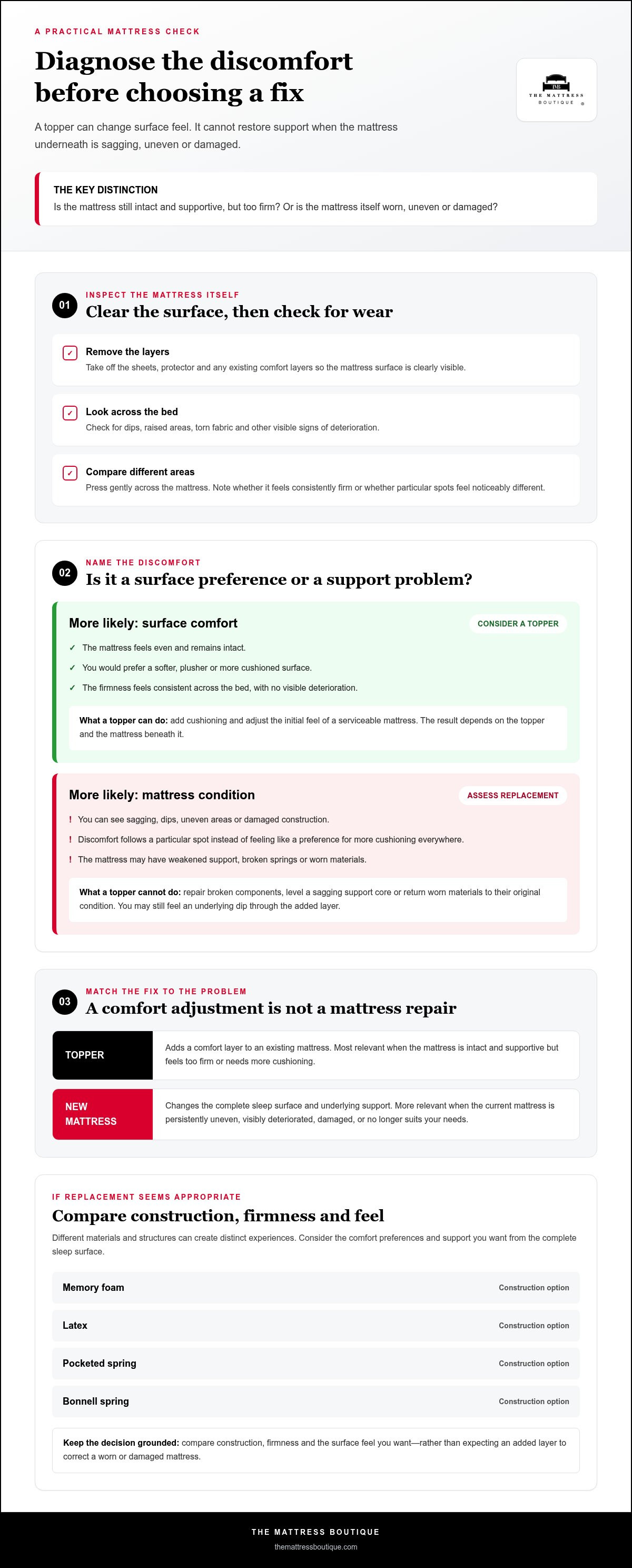
A practical checklist for choosing a topper or new mattress
A simple sequence can keep you from buying a comfort layer when the mattress itself needs attention. For the mattress topper vs new mattress decision, check the bed first, then pinpoint the discomfort and the change you want. Your sleep position and firmness preference can help define that change, but neither dictates one answer for every sleeper.
- Inspect the mattress. Remove bedding and any existing comfort layers. Look for visible dips, uneven areas, damaged fabric or changes across the sleep surface. Check whether the bed feels consistent from one area to another, rather than judging it only by how it feels under the sheets.
- Identify the discomfort. Is the surface simply firmer than you like, or does one area feel lower or less supportive? Consider whether the discomfort is new or persistent, and whether a bed partner notices the same issue. This can help distinguish an overall comfort preference from a problem with a particular part of the mattress.
- Define the change you want. Be specific: do you want more cushioning, a different firmness feel or a new level of support across the bed? Think about your usual sleep position and what feels comfortable to you, without assuming that one firmness level suits everyone.
- Choose the response that matches. An intact, even mattress with a surface that feels too firm may be suitable for a comfort adjustment. Deterioration, a pronounced dip or inadequate support calls for assessing replacement instead.
Assess your current mattress before buying
Check more than the top fabric. Notice whether the surface has changed over time, whether discomfort persists night after night, and whether it affects both sleepers or only one. Also consider other parts of the bed: a pillow that doesn’t suit your sleep position, an unstable bed frame or bulky bedding may contribute to discomfort. Isolate the mattress as much as you can before deciding it’s the cause.
Match the next step to the problem
Decision rule: if the mattress is even and intact, consider adjusting comfort; if its support is damaged or deteriorating, assess replacement. A topper makes sense only if the mattress remains sound and the desired change is at the surface. If the central concern is the mattress’s condition or support, another layer won’t address it. For replacement, compare mattress materials and comfort options to clarify what to look for in a new sleep surface.
Once you’ve assessed the bed, use that diagnosis to guide your next step rather than choosing by habit. If replacement is more suitable, explore mattress options at The Mattress Boutique, including different constructions and mattress brands.
Find a mattress that suits your needs with The Mattress Boutique
Your assessment can help you decide whether you need a surface comfort adjustment or a new mattress. If the mattress is still even and intact but feels firmer than you prefer, a topper may be the type of change to explore. If it’s worn, damaged or no longer provides the support you want, consider replacing the complete sleep surface instead.
For replacement shoppers, The Mattress Boutique offers mattresses from King Koil, Slumberland, Dunlopillo, SofzSleep and MaxCoil, in memory foam, latex, pocketed spring and bonnell spring constructions. These choices give you different categories to compare rather than treating every mattress as if it will feel the same.
Explore mattress options by construction and preference
Construction influences a mattress’s overall feel, but a material name alone can’t determine whether it will suit you. Consider what you want from the surface, how much firmness feels comfortable and whether your current mattress’s support needs have changed. If you’re exploring King Koil, a King Koil mattress buying guide can help organise your research around that brand.
Use your preferences as a starting point, not a fixed prescription. Two people can respond differently to the same construction, and the feel of a mattress depends on more than its category. Compare options with your own comfort priorities in mind, such as whether you prefer a more cushioned or firmer-feeling surface. The aim is to choose a mattress that addresses why you’re considering replacement, not simply to select a familiar material.
Take the next step with confidence
The distinction is straightforward: a topper adjusts the feel above a mattress, while a new mattress changes the complete sleep surface. If your existing mattress is sound and you want a surface-level comfort change, you may not need full replacement. If the mattress itself is no longer meeting your needs, exploring replacement options is a practical next step.
Use what you’ve noticed about the mattress and your comfort preferences to narrow your options. If replacement is the right direction, browse mattress options at The Mattress Boutique and compare the brands and constructions with your needs in mind. A clear assessment can make the choice between a mattress topper vs new mattress feel more manageable.
Make your next sleep decision with confidence
Before choosing, note what you’ve observed: where the bed feels uncomfortable, whether that feeling is consistent and what change you’re hoping for. This gives you a practical reference point as you consider the mattress topper vs new mattress question, instead of making a choice based on a single difficult night. If the mattress itself appears worn or uneven, focus on finding a replacement that addresses the whole sleep surface. If it remains in good condition, consider whether a surface comfort adjustment is all you need.
A clear idea of your comfort preferences can make it easier to compare mattress options and choose what feels right for your needs. The Mattress Boutique offers mattresses from established brands and across different constructions, giving replacement shoppers options to explore.
Explore mattresses at The Mattress Boutique and take the next step towards a bed that better suits your preferences. A thoughtful choice starts with knowing what you want to change.
Frequently Asked Questions
Is a mattress topper worth it if my mattress is still in good condition?
It may be worthwhile if your mattress is even and supportive but doesn’t feel cushioned enough. For example, if you’re generally comfortable on the bed but would prefer a softer first impression, a topper could be a more targeted change than replacing the entire mattress. For the mattress topper vs new mattress choice, consider whether extra surface comfort would meet your needs without changing the feel of the whole bed.
Can a mattress topper fix a sagging or uneven mattress?
No, a topper can’t correct sagging or restore damaged support. It sits above the mattress, so a dip in the base can remain noticeable underneath it. Before adding a layer, remove the bedding and inspect the mattress across its full surface. If a low area is visible when the bed is unoccupied, or feels different from nearby areas when you lie down, consider the mattress condition rather than treating it as a cushioning issue.
How much longer will a topper make my mattress last?
A topper doesn’t reset a mattress’s age or guarantee that it will last longer. It may change how the surface feels, but it won’t stop worn support materials from deteriorating or fix structural damage. If you’re trying to get more use from an older bed, base your decision on its current condition, not on the added layer. A sound, comfortable mattress and a worn one need different responses, even if both have a topper.
What happens if I put a topper on an old mattress?
The result depends on the mattress’s condition. If it’s old but still level and supportive, an added layer may change the surface feel to better suit your preference. If it has a dip or uneven support, those problems can still affect how the bed feels. Check whether the mattress stays level and comfortable across its surface before adding another layer, and don’t treat age alone as proof that a topper will help.
Is a mattress topper cooler than a new mattress in Singapore's humid climate?
Not necessarily. A topper doesn’t automatically feel cooler than a replacement mattress, and comfort in Singapore’s humid conditions can depend on the room, bedding and how many layers are on the bed. If you feel too warm, consider whether a thick protector, heavy sheets or extra cushioning could be contributing. Compare the overall sleep setup before assuming that changing only the mattress or adding a topper will solve the problem.
Can a mattress topper change how firm my bed feels?
Yes, a topper can make the surface feel softer or more cushioned, depending on its construction and the mattress underneath. For example, it may suit someone who finds an otherwise even bed too firm. But adding a soft layer won’t reliably make an overly soft or sagging mattress feel supportive. Consider whether you want a different surface sensation or a different level of support throughout the bed.
Should I replace my mattress if I still feel uncomfortable with a topper?
Consider replacement if discomfort continues and the mattress feels uneven, worn or unsupportive, especially if the topper hasn’t addressed the issue you hoped it would. First check whether another part of the setup, such as your pillow or bed frame, could be contributing. If those aren’t the concern and the mattress itself remains uncomfortable, reassessing the full sleep surface is a sensible next step rather than adding more layers.