

Could a mattress feel comfortable in the middle but leave you sinking when you sit on the side? That difference comes down to more than firmness. Understanding edge support in mattresses explained in practical terms can help you judge how a bed may feel in everyday use and compare options more confidently.
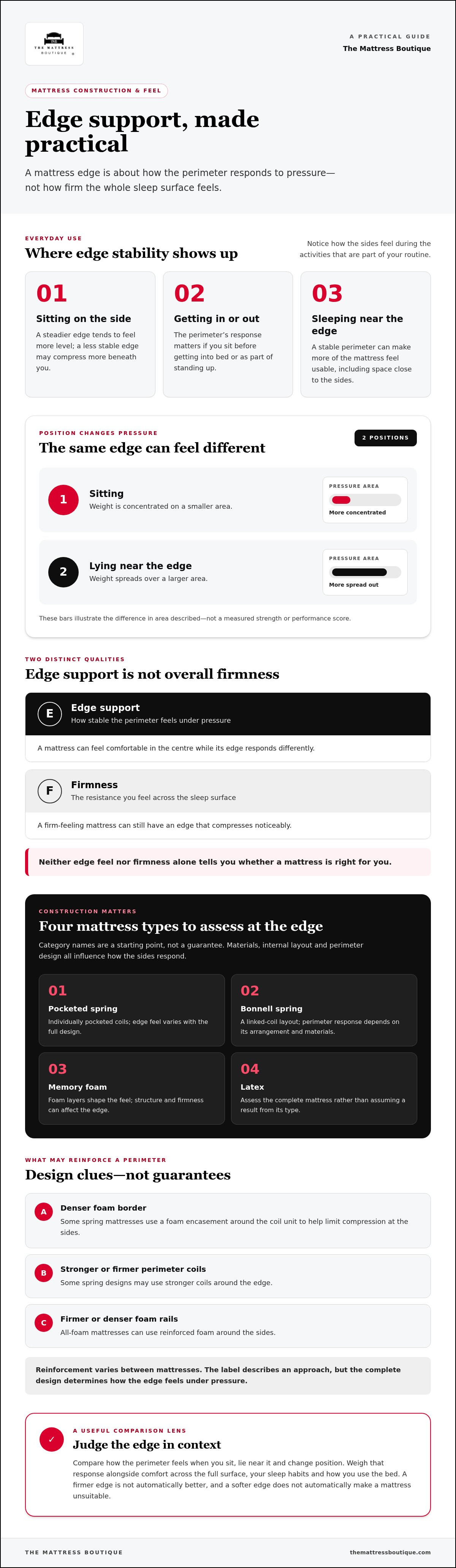
Edge support describes how well a mattress’s perimeter holds its shape under weight. Spring mattresses may use firmer coils or a supportive foam border, while all-foam designs can have reinforced foam around the sides. These features can affect how steady the edge feels when you sit down, get up or sleep close to it, but they don’t tell the whole story about comfort.
This guide explains how edge support is built, how it differs from overall firmness, and who may value it most. You’ll also find a repeatable way to assess mattress edges and practical points to weigh when comparing pocketed spring, Bonnell spring, memory foam and latex mattresses.
Key Takeaways
- Learn what edge support means in everyday use, from sitting on the side of the bed to using more of the sleep surface.
- See how materials and perimeter design can influence edge stability, without assuming every mattress is built the same way.
- Understand why edge support and firmness are separate qualities when comparing mattresses.
- Use a simple, repeatable test to compare how different mattress edges feel when you sit, lie down and change position.
- Weigh edge stability alongside your comfort preferences, sleeping habits and daily use of the bed.
What Is Mattress Edge Support, and What Does It Do?
Mattress edge support is the stability around the perimeter when weight presses against it. It affects how secure the sides feel when you sit down, get into bed or sleep near the edge. A stable perimeter can make more of the mattress feel usable. If the edge compresses noticeably, you may feel as though you’re tipping towards the side.
Edge support is the mattress’s resistance to compression at its perimeter, not a measure of support across the whole sleep surface. The distinction matters: the centre can feel comfortable and supportive while the edges respond differently. Firmness describes the overall feel under your body, and comfort is personal. Neither term alone tells you how steady the sides will feel.
Construction helps explain why edges vary. Mattresses use different materials and internal components, so their perimeters can respond differently under pressure. A general overview of mattress construction and types provides useful background, but edge feel is best judged as part of the complete mattress. Consider it alongside the feel you prefer across the sleeping surface.
What does mattress edge support feel like?
A steady edge tends to feel more level when you sit, with less of a sense that the side is giving way beneath you. A softer or less stable perimeter may compress more under the same seated pressure. Sitting concentrates weight on a smaller area, while lying near the edge spreads it over a larger area. The same mattress can therefore feel different depending on your position. Neither feel is automatically right for everyone.
Who may notice edge support most?
If you regularly sit on the side of the bed to get dressed or prepare for the day, the perimeter’s response is part of your everyday experience. You may also pay closer attention to edge stability if sitting before getting into bed or standing up is part of your routine.
Couples may value a perimeter that feels usable because both sleepers can make practical use of the mattress surface, including space closer to the sides. Your sleep position, comfort preferences and habits all affect whether that matters to you. The phrase edge support in mattresses explained is a useful reminder to assess this feature separately rather than treating it as a shortcut for overall quality.
When comparing pocketed spring, Bonnell spring, memory foam and latex mattresses, consider how each feels at the edge as well as in the middle. A firmer perimeter won’t suit every sleeper, and a softer edge won’t automatically make a mattress unsuitable. Focus on how the sides respond to the activities you actually do, then weigh that against comfort across the full surface.
How Is Mattress Edge Support Built Into the Perimeter?
Edge performance depends on the mattress as a whole: its materials, internal layout and perimeter construction. The sides aren’t always made or reinforced in the same way as the central sleep surface. Some designs use denser foam around the perimeter, while others may use stronger or firmer coils along the sides. These are possible approaches, not features found in every mattress.
Layers work together. A comfort layer can compress under body weight, while the components beneath it influence how pressure is distributed. At the edge, the balance between these layers and any perimeter reinforcement affects whether the mattress feels steady or gives way more noticeably. A label naming one material or construction method can’t tell you exactly how the sides will feel.
Construction labels alone can’t guarantee a particular edge feel, because the full design determines how the perimeter responds to pressure. Keep this in mind as you compare pocketed spring, Bonnell spring, memory foam and latex mattresses. The type gives you a starting point, but it doesn’t replace assessing the mattress itself.
Foam encasement and reinforced perimeter designs
Some spring mattresses have a denser foam border around the coil unit, forming an encasement that may help limit compression at the sides. Other designs may use stronger coils around the perimeter. All-foam mattresses can use firmer or denser foam rails to reinforce the edges. These approaches differ, and foam encasement isn’t automatically better than another design. How the materials work together matters.
Reinforcement can vary from one mattress to another, even within a broad category. A description such as “reinforced perimeter” indicates the design intent, but doesn’t necessarily tell you how firm or secure the edge will feel under your weight. Assess the mattress in practice rather than relying on the label alone.
How spring and foam mattresses can differ at the edge
Pocketed spring mattresses use individually pocketed coils, while Bonnell spring mattresses use a different linked-coil layout. Either type may feel different near the perimeter depending on its coil arrangement, surrounding materials and any added reinforcement. Foam mattresses rely on foam layers, and their edge feel can vary with the structure and firmness of those layers. Category names describe broad construction, not a guaranteed result.
Compare the complete feel rather than assuming one mattress type will always have stronger edges. You can consider mattress types and materials alongside your comfort preferences. Then assess each design’s edge stability directly.
Does Stronger Edge Support Mean a Firmer or Better Mattress?
No. Edge support and firmness describe different parts of the mattress experience. Firmness is the resistance you feel across the sleeping surface as you lie down. Edge support is how stable the perimeter feels under pressure. A mattress can feel plush in the middle yet steady at the sides, or feel firm across its surface while the edge compresses noticeably.
To understand edge support in mattresses explained, consider it separately from both firmness and overall support. Overall support describes how the mattress works beneath your body across the sleep surface. It isn’t a single quality rating, and a strong edge doesn’t automatically mean better pressure comfort or spinal alignment. Those depend on how the complete mattress suits your body and preferred sleeping position.
| Term | What it describes | What to notice |
|---|---|---|
| Edge support | Stability around the perimeter | How much the side compresses when you sit or lie close to it |
| Firmness | The perceived resistance of the sleep surface | How soft or firm the mattress feels beneath you |
| Overall support | How the mattress supports your body across the surface | Whether the feel suits your position and comfort needs |
Edge support versus firmness
Assess both qualities independently. A softer-feeling mattress may still have a steady perimeter when you sit, while a firmer-feeling mattress may give more at the sides. One quality can’t reliably predict the other. Notice how the centre feels in your usual sleeping position, then assess the edge separately if you use it regularly.
When edge support matters less than other comfort needs
Your preferred surface feel and sleeping position should remain central to your choice. If you rarely sit on the edge or sleep near the perimeter, edge stability may have less influence on your day-to-day comfort. Prioritise how the mattress feels where you actually sleep, and treat edge support as an additional consideration rather than a deciding score.
There’s no universal winner among pocketed spring, Bonnell spring, memory foam or latex mattresses. Each category includes different designs and feels, and the right fit depends on your preferences and how you use the bed. Edge support is one useful part of the comparison, not proof that a mattress is better overall. A balanced choice accounts for perimeter stability, comfort across the surface and the feel you want while sleeping.
How to Test Mattress Edge Support Before You Choose
A quick, consistent test can help you compare mattress edges more clearly than a label can. Try the same movements on each mattress and focus on how stable you feel, not just whether the surface seems soft or firm. This practical check makes edge support in mattresses explained easier to apply to your own needs.
A simple sit-and-lie test
Start with how you’ll use the bed. Sit on the perimeter as you normally would to get dressed or prepare to lie down. Then lie near the side in a familiar sleeping position. Repeat on both sides if possible, using similar positions each time. This makes it easier to compare edge feel without relying on a brief first impression.
- Sit on the edge. Notice whether the side sinks enough to make you feel unstable or feels steady beneath you. Sit as you naturally would rather than perching unusually far forward.
- Lie near the perimeter. Settle into your usual position close to the side. Notice whether you feel supported and comfortable or aware of the edge giving way.
- Change position. Roll or shift as you would at home. Notice whether the edge feels secure as your weight moves and whether repositioning feels easy.
- Repeat and compare. Test more than once, repeating the same actions on each mattress. If possible, try both sides to compare how the perimeter feels in different spots.
What to notice during the test
Pay attention to excessive sinking, a sensation of rolling outward or difficulty changing position near the side. Separate those observations from whether the surface feels too firm or creates pressure elsewhere. If you share the bed, consider how each person uses the perimeter. Your usual positions and habits may differ.
Sit, lie near the edge, change position, then repeat the same checks on both sides and across the mattresses you’re comparing. Keep the sequence consistent. Trying a mattress can reveal immediate differences, but it can’t fully reproduce how it feels through regular use at home. Treat the test as a practical comparison, not a prediction of every night’s experience.
As you explore pocketed spring, Bonnell spring, memory foam or latex mattresses, assess edge stability alongside comfort across the surface. You can explore mattress options with these checks in mind, then compare how each feels for the people who’ll share the bed.
Choosing a Mattress With Edge Support That Fits Your Needs
The right level of edge stability depends on how you use your bed, but it shouldn’t outweigh comfort across the surface. Consider your usual sleep position, how the mattress feels beneath you, and whether you sit or sleep close to its sides. Aim for a balance that suits your routines, rather than choosing the mattress with the firmest-feeling edge by default.
Match edge support to how you use your bed
If you often sit on the perimeter to get ready or use the full width of the mattress, a stable-feeling edge may be a useful priority. Couples can consider whether either sleeper tends to settle near a side, or whether both prefer to use more of the available sleeping space. These habits can make perimeter stability more noticeable day to day.
Balance that need with how the mattress feels in the middle. A reassuring edge won’t make up for a surface that doesn’t feel comfortable in your usual sleeping position. Likewise, a mattress that feels right across the centre may suit you if you rarely sit or sleep near the perimeter. Treat edge support as one part of the decision, not a standalone measure of quality.
Explore mattress constructions without relying on labels alone
Pocketed spring, Bonnell spring, memory foam and latex describe broad mattress construction categories. They help organise your options, but the category name alone doesn’t determine how the edge will feel. Individual designs use different combinations of materials and layers, so assess each mattress on its own rather than assuming one type will always provide a particular level of perimeter stability.
The Mattress Boutique offers mattresses featuring SofzSleep alongside various other quality construction types. Comparing the diverse collection can help you consider materials and overall feel while keeping edge stability in view. Don’t choose on a brand or construction label alone; consider how the mattress feels across the sleep surface and at the perimeter.
- Prioritise edge stability if sitting on the side or sleeping close to the perimeter is part of your regular routine.
- Keep comfort central by considering how the mattress feels in your preferred sleeping position.
- Compare complete designs rather than treating a material or category label as a promise of edge performance.
- Account for everyone sharing the bed, including their preferred positions and how they use the available surface.
For a broader decision framework, the guide “The Complete Guide to Choosing a Mattress in Singapore (2026 Edition)” can help you consider mattress selection beyond this one feature. Bring your priorities together: comfort, sleep habits and how you use the bed. A suitable choice is one that meets those needs as a whole, with edge support weighted according to how much it matters in daily life.
Take Your Mattress Priorities Into Your Next Choice
Before comparing mattresses, decide what you want your bed to do in daily life. Is sitting at the side part of your routine? Do you and your partner use the full width, or mainly sleep near the centre? Keeping these habits in mind helps you judge edge support as one part of a comfortable fit, rather than a feature to pursue at any cost.
With edge support in mattresses explained, you can make your next step more intentional: look for a mattress that suits the way you sleep and use your bed, then weigh that comfort against how the perimeter feels. The right choice is personal, and a clear sense of your priorities makes comparisons more useful.
Explore mattresses at The Mattress Boutique to compare options against your comfort preferences and everyday needs. Consider how each one feels across the sleep surface and at the edge, then choose the fit that best matches your priorities.
Frequently Asked Questions
What does edge support mean in a mattress?
Edge support describes how the mattress perimeter responds when weight is placed near its sides. In simple terms, edge support in mattresses explained means looking at how well the edges resist sinking compared with the centre. It can matter if you use the side as a sitting spot or sleep close to it. A mattress may feel different at the perimeter than it does beneath you in the middle.
Is edge support important in a mattress?
It matters most if you regularly sit at the bed’s side, share the mattress or tend to sleep near its perimeter. For example, someone who gets dressed while seated on the bed may appreciate a side that feels steady under their weight. If you sleep centrally and rarely sit on the edge, other comfort preferences may deserve more attention. Consider how everyone in your household uses the bed.
Does a firm mattress have better edge support?
No. Firmness describes the feel of the sleep surface, while edge support depends on how the perimeter responds to pressure. A firm mattress can still compress at the side, and a softer-feeling mattress can have a more stable edge. Assess the surface feel and perimeter separately. Don’t assume that choosing a firmer mattress will solve concerns about sinking at the sides.
How can I test edge support on a mattress?
Sit on the side as you normally would, then lie near the perimeter and shift position. Notice whether the edge feels steady or whether you feel drawn towards the side. For a fair comparison, repeat the same movements on each mattress and, if possible, test both sides. Pressing the edge with your hand alone may not reflect how it feels under your body weight.
Can mattress edge support wear out over time?
Yes, the materials around a mattress perimeter can change with repeated use, just as other parts of the mattress can. If an edge that once felt stable begins to sink noticeably, compare it with the centre and check whether the change is consistent. Unevenness may have more than one cause, so consider the bed’s overall condition too. There’s no single timeline that applies to every mattress.
Do memory foam mattresses have good edge support?
They can, but the material category alone doesn’t determine how stable the sides feel. Memory foam mattress designs vary in their layers and perimeter construction. Some may use firmer foam around the edges, while others may feel softer at the sides. If you’re considering memory foam, notice how the specific mattress responds when you sit near its edge and lie close to the perimeter.
Is edge support the same as mattress support?
No. Mattress support refers to how the mattress supports you across the sleeping surface, while edge support focuses on the perimeter. The centre may feel comfortable beneath your usual sleeping position even if the sides compress when you sit down. Each quality answers a different question, so consider both when comparing mattresses, alongside whether the overall feel suits your comfort preferences.