

The mattress foundation vs box spring choice comes down to the support your mattress needs: a foundation provides a firm, stable surface, while a traditional box spring has coils that add some bounce. They aren’t the same, even though the terms are sometimes used interchangeably. Foam, latex and hybrid mattresses generally suit a firm foundation, while a box spring may work with a traditional innerspring mattress designed for that support.
It’s easy to focus on the mattress and overlook the base, but the wrong support can affect how the bed feels and how well it holds up. This guide explains the difference, how each option changes bed height, and which base fits different mattress types. You’ll also learn when a mattress needs a foundation or box spring, so you can make a practical choice based on mattress compatibility, stability and the height you want for getting in and out of bed.
Key Takeaways
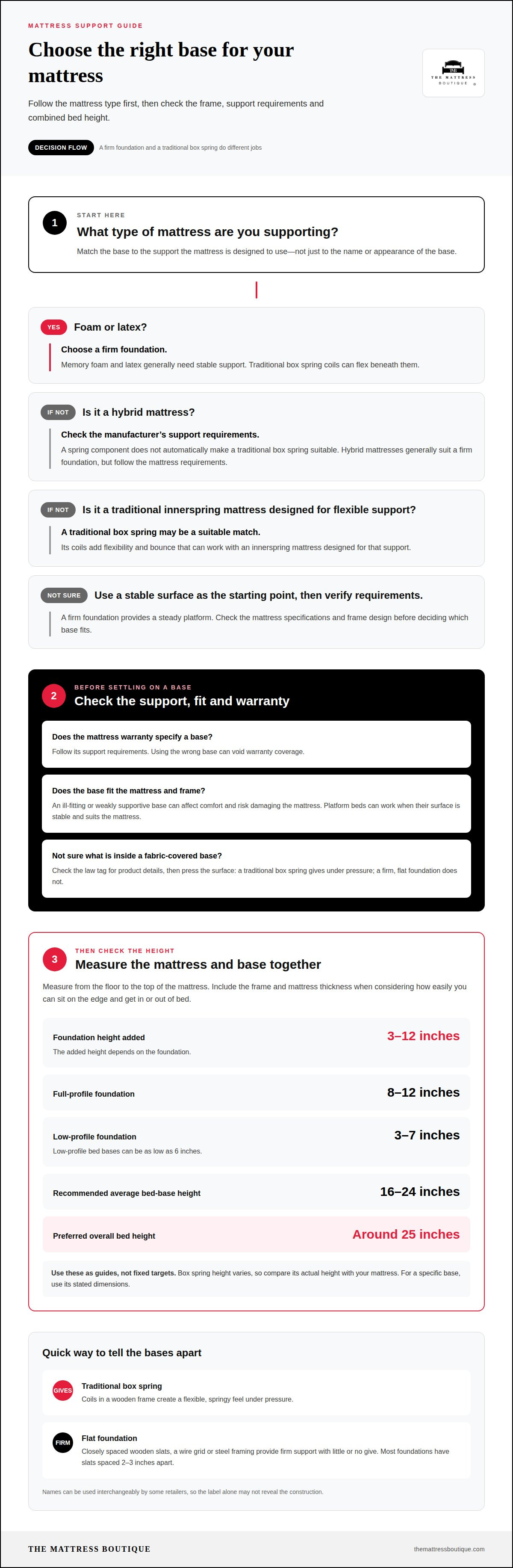
- Learn how to tell a coil-based box spring from a firm, flat foundation by looking at its construction and response to pressure.
- Use the combined mattress and base height to choose a bed that feels practical to get into and out of.
- Match the support surface to your mattress type and frame requirements to help avoid fit and support problems.
- See how The Mattress Boutique’s mattress range can help you narrow down a setup that suits your bed.
Is a foundation the same as a box spring?
No. A traditional box spring uses coils to add flexibility, while a foundation provides a firm, stable platform. The difference is how each supports the mattress.
Box Spring Construction and Support
A traditional box spring combines a wooden frame with coils and widely spaced wooden slats, or may have no supportive slats. Its spring system gives under pressure, adding bounce beneath the mattress. This flexible support was designed for traditional innerspring mattresses, whose coils can work with the base’s movement.
Terminology can be confusing: some retailers use “box spring” to describe a flat foundation. The name alone doesn’t tell you what’s inside. Press the surface to check: a box spring gives under pressure, while a firm, flat support surface does not.
Foundation Construction and Support
A mattress foundation is a firm support platform, commonly built with closely spaced wooden slats, a wire grid or steel framing. Most foundations have slats spaced between two and three inches apart. Unlike coils in a traditional box spring, these structures are designed to stay firm under weight and provide a stable surface.
That steady support suits mattresses that need a surface that won’t yield under weight. Compatibility still matters: the foundation must fit the mattress and meet its support requirements. A base that is too small or otherwise ill-fitting can affect comfort and risk damaging the mattress.
| Support option | Construction | Feel under pressure | Typical match |
|---|---|---|---|
| Traditional box spring | Coils with widely spaced or absent supportive slats | Flexible and springy | Traditional innerspring mattress |
| Flat foundation | Close wooden slats, wire grid or steel framing | Firm, with little or no give | Modern mattress requiring stable support |
A fabric-covered base may conceal its construction, so appearance alone won’t distinguish the two. Check the law tag for product details, then press the surface to see whether it gives. A flat foundation supports the mattress without coil bounce, while a traditional box spring flexes under pressure.
Match the base’s support style to the mattress: choose a firm foundation for a stable platform, or a box spring if a traditional innerspring mattress is designed for flexible support.
Bed base height
Measure the mattress and base together: their combined height affects how easily you get into bed. A box spring may flex under pressure, while a foundation provides firm support. The mattress and frame requirements determine which one fits.
Foundation and Box Spring Height
A foundation can add 3-12 inches to a bed. Full-profile foundations are typically 8-12 inches thick, while low-profile foundations are 3-7 inches tall. Low-profile bed bases can be as low as 6 inches. Box spring height varies, so compare its actual height with your mattress rather than assuming both support types raise the bed equally.
Measure from the floor to the top of the mattress before choosing. The recommended average bed-base height is 16-24 inches, while around 25 inches is a preferred overall bed height. These are guides, not fixed targets: consider your comfort and how easily you can sit on the edge, then account for the bed frame and mattress thickness.
For a Big Fig foundation or base, use the specific product’s stated dimensions in the same calculation rather than assuming a standard height. A solid wood frame or heavier mattress doesn’t change the measurement method, but the base must still meet the mattress and frame’s support requirements.
Foam Mattress Base Choice
Memory foam and latex mattresses generally need a firm foundation, not a traditional box spring. Box spring coils can flex, while foam and latex need stable support. A hybrid mattress also needs a base that meets its manufacturer’s requirements; a spring component doesn’t automatically make a box spring suitable.
Can you use a box spring with memory foam or latex? A traditional box spring is generally not the recommended match, so choose a firm foundation instead. To protect warranty coverage, read the mattress warranty’s support requirements. Manufacturers may specify a particular foundation or box spring, and using the wrong base can void the warranty.
Choose a base by comparing three things: the mattress’s support requirements, the bed frame’s design, and the combined height you want. This helps balance stability with everyday comfort.
Mattress compatibility
The right base depends on the mattress type and its support requirements. A stable, correctly sized surface helps the mattress perform as intended.
Mattress-Type Compatibility
Foam, latex and hybrid mattresses generally suit a firm foundation rather than a traditional box spring. A box spring’s coils add movement, which may change the mattress feel and make it seem softer. A wooden foundation provides a steady surface without changing the mattress’s firmness or comfort feel.
Traditional innerspring mattresses are the clearest match for a box spring: their coils can work with the base’s added bounce and shock absorption. If you prefer a more responsive feel, that flexibility may matter. Match the support to the mattress, not just its profile or label.
Base Stability
Stability matters for every mattress type. A well-constructed foundation can promote airflow and help protect against early sagging. If the base has dips or weak support, replacing it may help prevent uneven support from affecting the mattress. A box spring’s coils can also break down over time, creating a dent beneath the mattress.
Platform beds can provide a flat support surface, but their construction still needs to suit the mattress. A stable, evenly supportive platform differs from a flexible box spring. Check that the base fits the mattress, since an ill-fitting foundation can damage it or make sleeping uncomfortable.
Use this practical comparison when choosing a base:
- Foam or latex: Prefer a firm foundation that won’t yield under body pressure.
- Hybrid: Choose a stable base compatible with the mattress requirements.
- Traditional innerspring: A box spring may suit the mattress if its design calls for added bounce.
- Platform bed: Confirm that its support surface is stable and correctly sized.
A solid floor can provide even, consistent support, but it reduces airflow around and beneath the mattress. In humid conditions, limited circulation can allow mould or mildew to collect underneath. A raised, compatible base can provide both support and airflow, while an unsuitable base can damage the mattress and frame over time.
When a mattress needs a box spring or foundation
A mattress needs a suitable support base, not simply a surface that raises it. In most setups, use a foundation with a bed frame that keeps the mattress off the floor, or choose a lifestyle adjustable base.
The deciding factors are the mattress design, the bed frame and the support each requires. A traditional innerspring mattress may suit a box spring because its coils can benefit from added bounce and shock absorption. Foam and latex mattresses generally need a firm, flat foundation. If a frame requires a box spring but the mattress needs stable support, use a flat foundation without innersprings.
Consider these situations before choosing:
- Standard bed frame: Pair a suitable foundation with a frame that supports the mattress above the floor.
- Adjustable setup: A lifestyle adjustable base can provide support without a separate flat foundation.
- Traditional innerspring: A box spring may fit when the mattress and frame are designed for its flexible support.
- Heavier sleepers: Consider a foundation if you weigh more than 250 pounds, as it provides a stable support surface.
Placing a mattress directly on the floor provides even support, but reduces airflow around and beneath it. In Singapore’s humid conditions, limited circulation can allow mould or mildew to collect underneath. A sturdy raised base leaves space for airflow; a flat foundation with closely spaced slats is one option if it suits the mattress.
Before deciding, match the base to the mattress and frame, then consider room humidity and how the bed will be used for sleeping. The right choice is the support system that meets those needs, not automatically a box spring or foundation. For help exploring suitable mattresses, browse mattress options.
The Mattress Boutique
The Mattress Boutique helps you match your mattress choice to the support your bed needs. If you’re replacing a mattress or planning a new setup, consider its construction, your bed frame and your preferred base height before deciding.
Various modern mattress types offer options to consider as you narrow down the right fit. Compare the mattress type and its support requirements rather than choosing a base by name alone. This helps you make a more informed decision about a stable, comfortable bed setup.
For personal guidance on mattress options and support needs, contact The Mattress Boutique.
Choose a Setup That Works for Your Next Mattress
When changing your bed, consider the complete setup, not just the mattress. The mattress foundation vs box spring decision is one part of the process; your frame, preferred bed height and mattress support requirements also affect the fit. A well-matched combination can help create a bed that suits your room and everyday routine.
The Mattress Boutique offers King Koil, Slumberland and Dunlopillo mattresses to consider as you plan your setup. Focus on the mattress you want and the support it needs, then choose a compatible base and frame. If you’re weighing options or planning a replacement, contact The Mattress Boutique for guidance on what matters.
Contact The Mattress Boutique to discuss your mattress options and move towards a setup that suits you.
Frequently Asked Questions
Can Box Springs Ruin A Mattress?
Yes, a box spring can contribute to mattress damage if it’s worn out or incompatible with the mattress. For example, weakened coils may create uneven support beneath the sleeping surface. If you notice a dip, inspect whether the mattress or base is causing it, then compare the base with the mattress manufacturer’s support requirements before continuing to use that pairing.
Does a foundation need a bed frame?
No, a foundation doesn’t always need a separate bed frame. It can sit on a suitable, level surface, while a frame raises the bed and supports the foundation. If you use a frame, make sure the foundation sits securely in its intended position. Choose based on your preferred setup and the mattress’s support requirements.
Is foundation the same thing as a boxspring?
No. A mattress foundation vs box spring comparison is about construction and support, not just the name. A foundation is designed to provide firm support, while a traditional box spring contains coils that flex under pressure. Because retailers sometimes use “box spring” to describe a flat foundation, check the actual structure and mattress compatibility rather than relying on the label.
When might a box spring still make sense?
A box spring may suit a traditional innerspring mattress designed for flexible support. Its coils add bounce and can absorb some movement from the mattress. It may also fit a bed setup that calls for this type of base. The key is compatibility: a box spring isn’t automatically right for every mattress or frame.
Why are box springs no longer used?
Box springs are still used in some setups, but flat foundations became the preferred mattress support option about 20 years before the source page was published. A mattress foundation vs box spring decision often reflects the mattress design: firm foundations suit modern mattresses needing stable support, while box springs may suit traditional innerspring models that benefit from added flexibility.
What is the difference between a mattress foundation and a box spring?
A foundation provides firm, steady support, while a traditional box spring has coils that give under pressure. This difference can affect how the mattress feels and whether the base suits its design. Before choosing, review the mattress maker’s support instructions and the bed frame’s requirements. Matching both helps you select a base for the complete setup.