

Is the mattress that feels like a soft hug in the showroom actually the reason you're waking up at 3 AM drenched in sweat? Selecting the right surface is about more than just a five-minute test in a store; it's about how the material responds to your body heat and movement over eight hours. When weighing a latex vs memory foam mattress, you're likely looking for that perfect balance of pressure relief without the frustration of feeling "stuck" or overheating in a humid climate.
We understand that a mattress is a significant investment in your physical well-being and daily productivity. You want a bed that maintains its structural integrity for a decade or more, rather than one that starts to sag after just a few seasons. It's common to feel torn between the deep contouring of memory foam and the breathable, buoyant support of natural latex, especially if you're sensitive to dust mites or struggle with back pain.
This guide provides a clear, logical comparison of these two materials to help you choose the best fit for your comfort and health. We'll explore the technical differences in heat retention, spinal support, and durability, including why some materials last 12 to 15 years while others may lose their shape much sooner. By the end, you'll have the specialist knowledge needed to secure a cool, supportive sleep surface that stands the test of time.
Key Takeaways
- Contrast the body-contouring pressure relief of memory foam with the buoyant, active support of latex to determine your ideal feel.
- Identify which material structure offers the best thermal regulation to prevent waking up hot in humid, tropical climates.
- Learn how to evaluate a latex vs memory foam mattress based on your specific sleep position and spinal alignment requirements.
- Discover the natural hypoallergenic properties of latex that help maintain a cleaner, dust-mite-resistant sleep environment for allergy sufferers.
- Explore the "best of both worlds" approach offered by hybrid mattress designs from trusted specialists like King Koil, Dunlopillo, and SofzSleep.
Latex vs Memory Foam Mattress: Understanding the Core Differences
Choosing between a latex vs memory foam mattress isn't just a matter of picking a price point; it's about selecting the foundation for your physical recovery. The material you sleep on is the single most important factor in maintaining proper spinal alignment and ensuring you wake up without stiffness. While both materials offer pressure relief, they achieve it through entirely different mechanical properties. Memory foam is a viscoelastic material that uses your body heat and weight to soften and contour to your specific shape. In contrast, latex is a highly resilient, elastic material made from rubber tree sap or synthetic polymers that provides an immediate "lift" rather than a "sink."
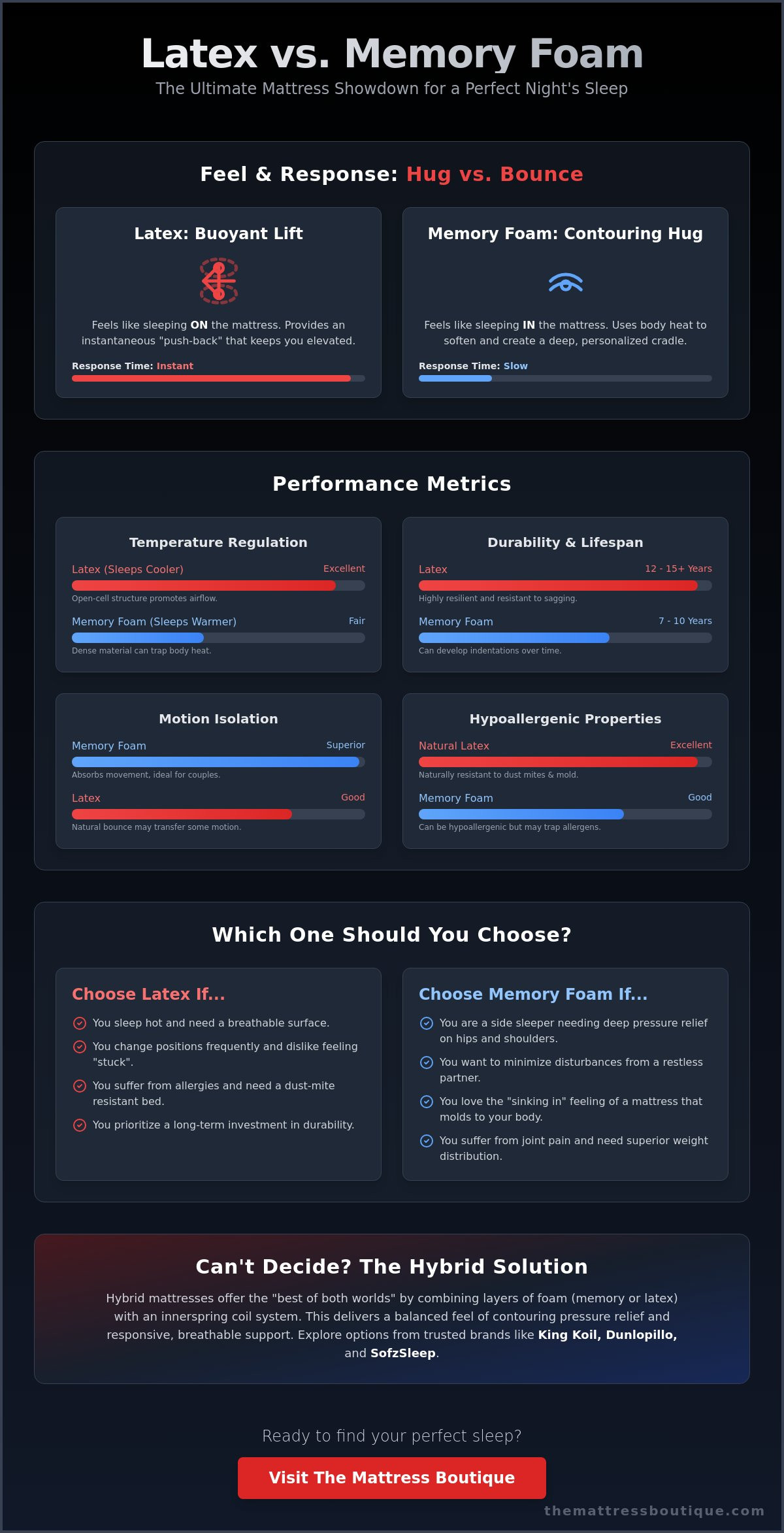
The "feel" factor often dictates which material a sleeper prefers. Memory foam provides a "sinking hug" that many find comforting for side sleeping, as it isolates movement and cradles the joints. Latex offers a "buoyant lift" that keeps you on top of the bed rather than in it. This distinction is vital for those who prioritize ease of movement or find the sensation of being enveloped by their mattress claustrophobic. Understanding these basics is the first step toward a better night's sleep.
The Origins of Comfort: Natural vs Synthetic
The story of these materials begins in very different places. Natural latex is harvested from the Hevea brasiliensis tree. This sap is processed using either the Dunlop method, which creates a denser, firmer feel, or the Talalay method, which results in a lighter, more airy foam. Because rubber trees are renewable and actively absorb carbon dioxide, natural latex often has a lower environmental footprint than petroleum-based alternatives. Memory foam, however, evolved from NASA research designed to improve seat cushioning for pilots. Modern versions use polyurethane to create a durable, body-conforming surface. For a broader Mattress construction overview, understanding how these layers interact is key to predicting long-term performance.
Response Time and Pressure Relief
One of the most noticeable differences is how quickly the bed reacts to your movement. Memory foam is famous for its slow response time; it takes a few seconds to "reset" when you roll over. Viscoelasticity is the specific property that allows foam to mold to unique body shapes while absorbing the energy of your movement. This makes it excellent for motion isolation if you have a restless partner. Latex offers a different experience. It provides an instantaneous push-back that prevents that common feeling of being "stuck" in the bed. If you change positions frequently during the night, the buoyant response of latex ensures you don't have to fight against the material to get comfortable.
The Mechanical Feel: Sinking Support vs Buoyant Response
The sensation of lying on a latex vs memory foam mattress is often described as a choice between "sleeping in" the bed versus "sleeping on" it. This mechanical difference dictates how your body weight is distributed and how much effort it takes to change positions during the night. While memory foam absorbs energy to create a personalized cradle, latex pushes back with a resilient force that keeps your spine in a more neutral, elevated position. Understanding which of these responses suits your body type is essential for long-term comfort.
The Memory Foam "Hug"
If you are a side sleeper, you likely experience significant pressure buildup in your shoulders and hips. Memory foam is engineered to solve this by distributing weight across a wider surface area. It uses your body heat to soften, allowing your heavier points to sink deeper while the foam fills the gaps around your waist. This creates a highly aligned environment that reduces the need for tossing and turning throughout the night. For those who find this contouring essential, our guide on the Best Mattress for Side Sleepers in Singapore dives deeper into specific model recommendations for that "weightless" feel.
The Latex "Bounce"
Latex provides an entirely different sensation characterized by its buoyancy. It doesn't rely on heat to mold to your shape; instead, it responds purely to pressure. This instantaneous response makes it the preferred choice for back and stomach sleepers who need a firmer surface to prevent their midsection from bowing into the mattress. According to the Sleep Foundation's detailed comparison, latex is also superior for those with mobility issues, as the material helps "propel" you when you try to sit up or roll over. The firmness is typically determined by the density of the latex layers, allowing for a range of feels from plush to extra firm without losing that signature lift.
Motion Isolation and Edge Support
Couples often prioritize motion isolation to ensure one person's movement doesn't wake the other. Memory foam is the undisputed leader here. Its ability to absorb energy means that a partner rolling over on the left side of the bed won't be felt on the right. Latex has a slight bounce that may transfer a bit more energy, though it remains significantly quieter than traditional spring beds. However, latex often wins on edge support. Because it is naturally more resilient, the perimeter of the bed doesn't compress as easily when you sit on the edge. If you're unsure which mechanical feel suits your lifestyle, you can explore our full collection of premium mattresses to compare these sensations in person.
Performance in Tropical Climates: The Heat and Durability Factor
In a tropical climate, your choice of a latex vs memory foam mattress determines whether you wake up feeling refreshed or sticky and overheated. Traditional memory foam is often criticized for heat retention because its dense, viscoelastic structure restricts airflow. However, modern sleep technology has introduced gel-infused foams and phase-change materials that actively pull heat away from the body. Natural latex possesses an inherent open-cell structure. This allows for constant ventilation, making it naturally cooler without the need for additional chemical cooling agents.
Beating the Heat
Ambient temperature significantly impacts how your mattress feels throughout the night. Memory foam is temperature-sensitive; it becomes softer in a warm room and firmer in a cold one. This can be a challenge in environments where air conditioning use varies. To mitigate this, many high-end models incorporate specialized cooling covers. Materials like Tencel or Bamboo are frequently paired with these mattresses to enhance breathability at the surface level. For a deeper look at specific technologies designed for our weather, you can consult our Cooling Mattress Guide. These small adjustments in material composition make a massive difference in your nightly comfort.
Longevity and Value for Money
Durability is where these two materials diverge most significantly. High-quality natural latex is incredibly resilient and resistant to sagging, often maintaining its original shape for up to two decades. Memory foam, while providing excellent pressure relief, is more susceptible to "body impressions" over time. In humid environments, polyurethane foams can undergo faster oxidation, leading to a gradual breakdown of the material's cellular structure. This usually results in a functional lifespan of about 7 to 10 years for a standard foam bed. While latex has a higher upfront cost, its cost-per-year is often lower due to its 15-20 year lifespan. Investing in a more durable material often proves to be the more economical choice for those looking for a long-term sleep solution that won't need replacing every few years.
When you consider the structural integrity of these materials, latex typically outlasts memory foam by 5 to 7 years. This resilience means your spine receives the same level of support in year ten as it did on night one. If you're looking for a mattress that holds up against both the heat and the passage of time, the material's density and origin are the most reliable indicators of value.
Choosing Your Match: Sleep Positions and Common Concerns
Finding the right latex vs memory foam mattress often comes down to your primary sleep position and personal health priorities. While we have discussed the mechanical feel, how these materials interact with your body weight and respiratory health is equally critical. A back sleeper requires different structural resistance than a side sleeper, and someone with chronic allergies will find one material significantly more accommodating than the other. Your body mass also influences how deep you sink, which can change the perceived firmness of the bed.
The Best Choice for Pain Relief
When addressing back or joint pain, it is vital to distinguish between "support" and "comfort." Support refers to the mattress's ability to keep your spine in a neutral alignment, while comfort describes the surface softness that prevents pressure points. Latex is often the superior choice for spinal alignment because its resilient nature prevents the heavier midsection of the body from dipping too low. Conversely, memory foam is excellent for localized pain relief, especially for side sleepers who need the mattress to "give" around the shoulders and hips to prevent numbness.
Many modern designs don't rely on a single material to do all the work. High-quality pocketed spring mattresses often use latex or memory foam as a comfort layer to provide the best of both worlds. This combination ensures the deep support of individual coils while offering the specific surface feel of foam or latex. If you are unsure which firmness level suits your body mass index (BMI), we recommend consulting a specialist who can match the material density to your specific requirements. Heavier individuals generally benefit from the higher density and "push-back" of latex to avoid the feeling of "bottoming out" against the core layers.
Hygiene and Health
For sleepers with sensitive respiratory systems or skin allergies, material origin is a major factor. Natural latex is the gold standard for hygiene. It is naturally hypoallergenic and inherently resistant to dust mites, mould, and mildew. This makes it an ideal choice for households in humid climates where these allergens thrive. Memory foam, while often treated to be antimicrobial, is a synthetic product that may undergo "off-gassing." This is the temporary "new mattress smell" caused by volatile organic compounds (VOCs) escaping the foam after it is unboxed. While modern certified foams have low emissions, those with extreme chemical sensitivities often prefer the neutral profile of natural latex.
Regardless of the material you choose, preserving its integrity is essential for long-term health. Using a high-quality waterproof protector prevents moisture and skin oils from seeping into the core layers, which can accelerate material breakdown. If you are ready to see how these materials feel in person, you can visit our showroom to test our curated collection and find your perfect match.
Finding Your Perfect Fit at The Mattress Boutique
Deciding between a latex vs memory foam mattress is much easier when you can experience the materials side-by-side. Our role as a knowledgeable curator is to simplify this path for you. We've assembled a selection of the world's most reliable brands, ensuring that every option in our showroom meets high standards for structural integrity and physical well-being. Whether you seek the contouring of foam or the resilience of latex, our experts help you understand these technical variations without the pressure of a high-stakes sales pitch.
You don't always have to choose just one material. Many of our most popular models are hybrid solutions. These designs often feature a core of pocketed springs for deep support, topped with layers of both latex and memory foam. This allows you to enjoy the motion isolation of foam alongside the breathable, buoyant response of latex. It's a pragmatic approach to comfort that addresses diverse needs in a single, durable investment.
Premium Brands We Trust
We focus on brands that have demonstrated long-term reliability and specialized focus. King Koil mattresses are a standout choice for those prioritizing chiropractor-tested support and spinal alignment. If your interest lies in the heritage of latex, Dunlopillo remains a global leader in latex innovation, offering unparalleled comfort. For sleepers who prefer a natural sleep environment, SofzSleep specializes in premium latex that emphasizes both health and economic efficiency through long-lasting materials.
The Showroom Testing Checklist
To ensure you make an informed decision, we recommend a methodical approach to testing. Reading about a latex vs memory foam mattress is helpful, but the "Lie-Down Test" provides the final confirmation your body needs. Use this checklist during your visit:
- Spend at least 15 minutes in your primary sleeping position to let the materials react to your body heat and weight.
- Check for a "spinal neutral" position. There should be no significant gaps between your lower back and the mattress surface.
- Evaluate the ease of turning. If it takes too much effort to roll over, the material might be too soft for your specific mobility needs.
- Assess the edge support by sitting on the perimeter of the bed to see how well it holds your weight without excessive compression.
Visit The Mattress Boutique today to test the best latex and memory foam mattresses in person! Our team is here to help you find a mattress that fits your body and your budget, ensuring you leave with a sleep solution that improves your everyday life.
Securing Your Decade of Better Sleep
Choosing the right foundation for your rest is a decision that impacts your physical health and daily energy for years to come. We've explored how the deep contouring of foam and the buoyant resilience of latex serve different sleep biomechanics and climate needs. Whether you prioritize the hypoallergenic properties of natural materials or the motion isolation of viscoelastic foam, your final choice in the latex vs memory foam mattress debate should align with your unique comfort profile.
As an authorized retailer for King Koil, Dunlopillo, and Slumberland, we take pride in offering the region's widest selection of premium mattresses and storage beds. Our expert sleep consultants are available in-store to guide you through the technical nuances of each brand, ensuring your investment provides lasting value. We're committed to helping you find a solution that balances structural integrity with everyday physical well-being.
Explore our full range of Latex and Memory Foam Mattresses at The Mattress Boutique and take the first step toward a cooler, more supportive night. You're just one visit away from the restful sleep you've been searching for.
Frequently Asked Questions
Is latex mattress better than memory foam for back pain?
Both materials can alleviate back pain, but they do so in different ways. Latex provides a firmer, buoyant support that keeps your spine aligned, which is often better for back and stomach sleepers. Memory foam offers deep pressure relief by cradling your joints, making it a strong choice for those with hip or shoulder pain. The best option depends on your specific sleep biomechanics and where you feel the most tension.
Does memory foam get too hot in a tropical climate?
Traditional memory foam can feel warm, but modern cooling technologies have greatly improved its performance. High-quality foam mattresses now feature gel infusions or open-cell structures to help heat escape. While natural latex is inherently more breathable due to its pin-hole ventilation, these innovations make memory foam a viable option even in our humid climate. Using a breathable mattress protector also helps maintain a neutral temperature throughout the night.
How long does a latex mattress last compared to memory foam?
Natural latex is known for its exceptional durability, often lasting 15 years or more. When comparing a latex vs memory foam mattress, you'll find that foam typically needs replacement after 7 to 10 years as it loses its ability to bounce back. Latex maintains its shape and resilience much longer under consistent weight. This longevity makes it a reliable investment for those who don't want to shop for a new bed every few seasons.
Can you be allergic to a latex mattress?
It is possible to be allergic to latex, but reactions to the material inside a mattress are extremely rare. The intensive washing process used during manufacturing removes the vast majority of allergenic proteins. Most people with latex sensitivities only react to direct skin contact with items like gloves or balloons. If you have a known severe allergy, it's always best to consult your doctor or test a sample before making a purchase.
Which is more expensive, latex or memory foam?
Natural latex mattresses generally have a higher upfront cost than memory foam models. This price difference is due to the labor-intensive process of harvesting and refining natural rubber sap. However, you should consider the long-term value rather than just the initial price. Because latex lasts significantly longer, its cost-per-year is often lower than a foam mattress that may need to be replaced twice in the same timeframe.
Do latex mattresses smell like rubber?
New natural latex may have a faint, slightly sweet scent when first unboxed, but it doesn't smell like harsh industrial rubber. This natural aroma is usually compared to vanilla and typically disappears within a few days. It's different from the chemical off-gassing smell sometimes associated with synthetic foams. Most users find the natural scent quite mild and it shouldn't interfere with your sleep quality or comfort.
Is memory foam or latex better for side sleepers?
Memory foam is generally considered the better choice for side sleepers because of its superior contouring. It allows your shoulders and hips to sink in just enough to keep your spine in a straight, neutral line. This prevents the pressure buildup that often leads to morning stiffness or pins and needles. While latex can work for side sleepers, it often requires a softer density to provide the same level of cushioning.
What is a hybrid mattress and does it use both materials?
A hybrid mattress is a multi-layer bed that combines a pocketed spring system with comfort layers like latex or foam. This design is an excellent middle ground if you're struggling to choose a latex vs memory foam mattress because it provides the bounce of coils with the pressure relief of specialty materials. It's a versatile solution that suits many different body types and is particularly popular for couples with different firmness preferences.