

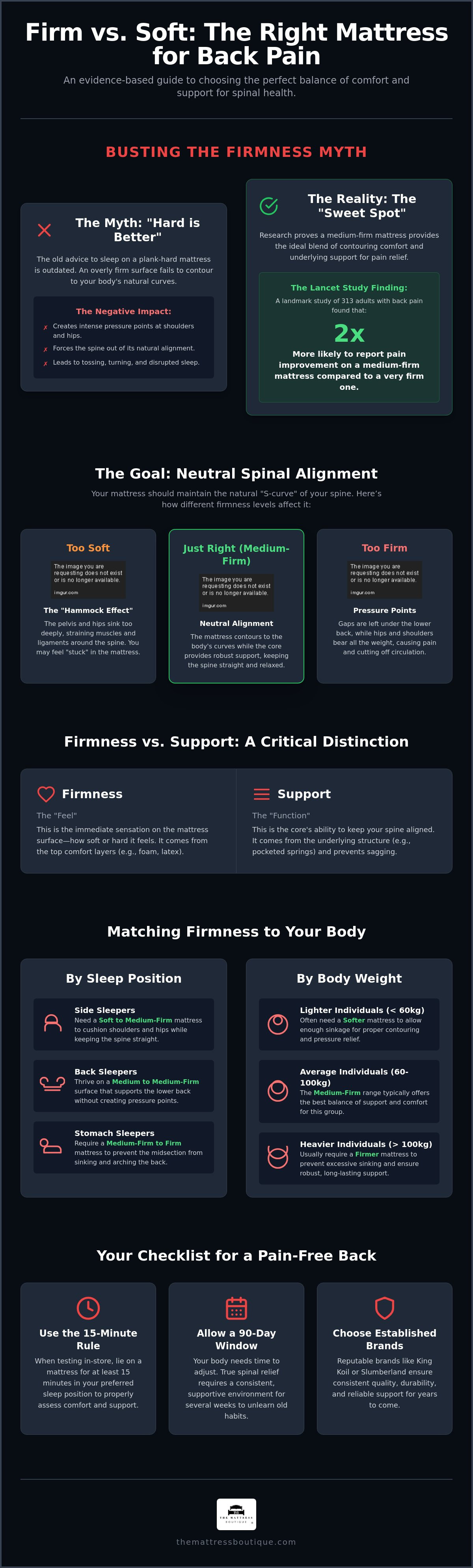
That old advice about sleeping on a floor-firm mattress to fix your spine is actually one of the most persistent myths in the sleep industry. While it sounds logical that a hard surface provides more support, research from The Lancet involving over 300 adults found that those on medium-firm beds were twice as likely to report pain improvements compared to those on very firm ones. If you are struggling to decide is a firm or soft mattress better for back pain, you aren't alone; with 39% of adults experiencing back issues, the pressure to choose the right bed is immense.
We understand the frustration of waking up with stiffness and the fear of wasting money on a mattress that doesn't deliver. You deserve a clear, evidence-based path to better sleep that isn't clouded by sales jargon or outdated medical rules. This 2026 guide promises to reveal the perfect balance of comfort and structural integrity needed to alleviate your pain for good. We will break down the medium-firm consensus, explain how materials like pocketed springs or latex impact your recovery, and help you find a solution that keeps your spine in a neutral, healthy position all night long.
Key Takeaways
- Modern research suggests that a medium-firm surface, rather than an excessively hard one, provides the optimal balance for spinal alignment and long-term pain relief.
- Understanding the distinction between surface comfort and core support is essential for choosing a bed that keeps your spine in a neutral position throughout the night.
- Discover how your unique sleep position and body weight determine whether is a firm or soft mattress better for back pain in your specific case.
- Learn how different materials, such as responsive latex or pocketed springs, provide targeted pressure relief to accommodate specific physical needs.
- Find out why testing your choice with the 15-minute rule and selecting established brands like King Koil or Slumberland ensures consistent support and durability.
The Firmness Myth: Why "Hard" Isn’t Always Better for Your Back
For decades, the standard advice for back sufferers was to sleep on a surface as hard as a dining table. This "plank-hard" approach was thought to keep the spine straight by force. However, 2026 sleep science has largely dismantled this idea. When you lie on a mattress that is too firm, it fails to contour to your body. Instead of cradling your natural curves, it creates intense pressure points at your shoulders and hips. This often leads to tossing and turning as your body tries to find a position that doesn't cut off circulation.
The real question isn't just about surface feel; it's about whether is a firm or soft mattress better for back pain in relation to spinal alignment. A mattress that is too soft presents the opposite problem. It creates a "hammock effect" where your heaviest part, the pelvis, sinks too deep into the comfort layers. This misalignment strains the ligaments and muscles surrounding your spine, leading to that all-too-familiar morning stiffness. Finding the middle ground is the key to waking up refreshed.
What the Lancet Study Taught Us About Back Pain
One of the most influential pieces of evidence in this debate comes from a landmark study published in The Lancet. This 2003 clinical trial followed 313 adults with chronic low back pain. The results were clear: participants who used medium-firm mattresses were twice as likely to report significant pain reduction compared to those using very firm mattresses. It proved that your spine needs a surface that yields slightly to its shape while remaining supportive underneath.
Experts now suggest a 90-day window as the critical timeframe for assessing back health on a new surface. It takes your muscles and spinal discs several weeks to unlearn old compensation patterns. This is especially true for chronic low back pain, which involves long-term structural issues. Temporary muscular soreness might resolve quickly, but true spinal relief requires a consistent, supportive environment over several months.
The Problem with "Cloud-Like" Soft Mattresses
While a plush, cloud-like mattress feels luxurious in a showroom, it often lacks the structural integrity needed for long-term health. When the core layers are too yielding, your spine loses its neutral position. This excessive sinking causes the pelvis to drop, which puts immediate strain on the lumbar discs. If you've ever felt like you're "stuck" in your bed, your mattress is likely too soft to provide the necessary push-back.
Stomach sleepers are at the highest risk here. If the mattress is too soft, the midsection sinks, forcing the back into an unnatural arch. This hyperextension is a primary cause of waking up with a sore lower back. For these sleepers, the answer to whether is a firm or soft mattress better for back pain is almost always a lean toward the firmer side of the medium-firm spectrum. Without that resistance, the core of your body simply cannot stay aligned.
Firmness vs. Support: The Critical Distinction for Sleep Health
Many people use the terms "firmness" and "support" interchangeably. They shouldn't. These words refer to completely different aspects of your sleep experience. Firmness describes the immediate sensation you feel when you first lie down. It's the "softness" or "hardness" of the top comfort layers. Support is the job of the mattress core. It's the ability of the underlying structure to keep your spine in a neutral position, regardless of how plush the surface feels. You can find a mattress that feels like a soft cloud but still provides the structural strength of an extra-firm orthopedic bed.
This distinction is vital when asking is a firm or soft mattress better for back pain. You might prefer a plush surface for pressure relief, but your back still requires robust support from the base layers. High-quality mattresses often combine these features by using thick comfort layers of memory foam or latex over a resilient pocketed spring system. The base layer acts as the foundation, absorbing weight and preventing the mattress from sagging over time. Sagging is the leading cause of back pain in older mattresses, as it forces the spine into an unnatural curve that strains the surrounding muscles.
Spinal Alignment 101: Keeping the Natural Curve
Proper spinal alignment means maintaining the natural "S-curve" of your back while you sleep. A mattress should fill the small gap in your lumbar region without pushing back so hard that it creates tension. Responsive materials are essential here. They adjust to your movements, ensuring that as you roll from your side to your back, the support remains consistent. Following expert guidance on mattress selection can help you identify models that prioritize this neutral posture and reduce nighttime discomfort.
Zonal Support: Engineering for Different Body Parts
Engineering has advanced to the point where a single mattress can offer different levels of resistance across its surface. This is known as zonal support. Your shoulders are wider and lighter; they require a softer zone to sink in. Your hips are heavier and need a firmer zone to stay elevated. When considering is a firm or soft mattress better for back pain, zonal support offers a sophisticated answer that simple firmness ratings cannot match. King Koil mattresses are particularly well-regarded for this technology. Their systems are often endorsed by chiropractors because they mimic the body's natural weight distribution, providing targeted relief where you need it most.
If you're unsure which setup fits your body type, you can browse our collection of orthopedic designs that balance these two critical factors for a better night's rest.
Matching Firmness to Your Sleep Position and Body Weight
One person's "firm" is another person's "soft." A sleeper weighing 50kg will naturally stay on top of the comfort layers, while someone weighing 100kg will sink much deeper into the support core. When you are trying to determine is a firm or soft mattress better for back pain, you must first consider your own physical build. Your weight dictates how much pressure you apply to the materials, which directly affects how well those materials can keep your spine aligned. Without enough resistance, a heavier person's spine will bow; without enough give, a lighter person will experience painful pressure points.
A practical way to check this in person is the "Hand Test." While lying on your back, try to slide your hand under the small of your back. If your hand slides through too easily, the mattress is likely too firm, leaving a gap that strains your lumbar muscles. If you can't get your hand under at all, the mattress is too soft, and your torso is sinking too far. For couples with different weights, this balance becomes even more critical. In these cases, high-quality pocketed spring mattresses from brands like Slumberland or King Koil are often the best solution because they respond to each sleeper's weight independently.
Firmness Recommendations by Sleep Style
Your primary sleeping posture determines where your body needs the most cushioning. Side sleepers generally thrive on a 4-6 firmness score. This range provides enough "sink" to accommodate the shoulders and hips, preventing the spine from curving sideways. Back sleepers usually find their "sweet spot" at a 6-8 firmness level, which offers the necessary lumbar stability. Stomach sleepers require the most resistance, typically a 7-9 surface. A firmer bed prevents the pelvis from dipping, which is the primary cause of neck and lower back strain for those who sleep on their fronts.
How Body Weight Changes Your Firmness Perception
Body mass significantly alters how you perceive mattress density. Lightweight sleepers (under 60kg) often find that a standard "medium" mattress feels quite firm because they don't have the mass to compress the foam layers. Conversely, heavyweight sleepers (over 90kg) need high-density foams or thicker coils to avoid "bottoming out" against the base. This is supported by research on mattresses for back pain, which indicates that medium-firm options provide the most consistent relief across a broad range of body types. If you fall into a higher weight category, looking for mattresses with reinforced edge support and higher coil counts will ensure the bed doesn't lose its shape over time. Ultimately, the answer to whether is a firm or soft mattress better for back pain depends on finding the specific density that keeps your unique frame in a neutral, relaxed state.
Materials That Matter: Pocketed Springs, Latex, and Memory Foam
Once you understand your ideal firmness level, the next step is choosing the right materials. The physical composition of your bed determines how it responds to your weight and temperature throughout the night. When asking is a firm or soft mattress better for back pain, the answer often lies in how a material balances "push-back" with "contouring." For instance, natural latex provides an immediate upward response that keeps you on top of the surface, while memory foam offers a deep cradle that distributes weight across a larger area. Hybrid mattresses have become the dominant choice in 2026 because they combine these comfort layers with a supportive core, offering a balanced solution for most back sufferers.
In Singapore’s humid climate, breathability is a factor that many people overlook when addressing back health. If a mattress traps heat, it leads to restless tossing and turning. This constant movement often forces your body into awkward positions that pull your spine out of alignment, resulting in a painful morning. This is why pocketed spring mattresses are considered the gold standard for both support and airflow. Because each coil is individually encased, they move independently to provide targeted support to your lumbar region while allowing air to circulate freely through the mattress core.
Natural Latex: The Responsive Choice for Back Support
Latex is an excellent option for sleepers who dislike the "sinking" sensation of traditional foam. It is naturally buoyant and provides a responsive feel that makes it easy to change positions without straining your back muscles. Brands like SofzSleep specialize in high-quality natural latex that maintains its supportive shape for 10 years or more. This durability is crucial; a material that doesn't sag ensures your spine remains in a neutral position for the entire lifespan of the mattress. It's a reliable choice for those who need consistent, firm support without sacrificing a touch of surface softness.
Memory Foam and Pressure Point Relief
Memory foam is famous for its visco-elastic properties, which allow it to contour exactly to the shape of your body. This is particularly helpful for side sleepers who experience sharp pain in their shoulders or hips. However, to avoid the sinking that leads to spinal misalignment, it's vital to choose high-density memory foam. Low-density foams may feel comfortable initially but often lack the structural integrity to support your lower back over an eight-hour sleep cycle. To combat heat retention, look for modern variations like gel-infused or open-cell foams that are engineered to pull heat away from the body.
Choosing the right material is a personal journey, so we invite you to explore our material-specific collections to find the technology that best suits your recovery needs.
Selecting the Right Brand and Testing Your Choice in 2026
Choosing a mattress isn't just about picking a firmness level; it's about investing in a manufacturing process that guarantees long-term spinal health. Reputable brands like King Koil and Slumberland are often the preferred choices because they use standardized testing to ensure their support levels remain consistent for years. When you are trying to determine is a firm or soft mattress better for back pain, these manufacturers provide a level of reliability that budget brands simply cannot match. Their research into pocketed spring tension and foam density means that a "medium-firm" rating is backed by clinical data rather than just a marketing label.
A mattress is only as effective as the foundation it rests upon. In many Singaporean homes, using storage bed frames is a practical way to provide a solid, flat base that prevents the core layers from sagging. A rigid foundation ensures that the zonal support systems we discussed earlier can function as intended. It's also important to prepare for the "Adjustment Period." Your back muscles have likely spent years compensating for a poor mattress. When you switch to a supportive surface, your body may feel some minor discomfort for the first 14 days as it recalibrates to a neutral alignment. This is a normal part of the healing process.
The King Koil Advantage for Back Pain
King Koil stands out in the 2026 market due to its long-standing endorsement by the International Chiropractors Association (ICA). This partnership ensures that their mattress designs prioritize spinal neutral above all else. One specific technical benefit is their Excellent Edge™ foam encasement. This feature provides a firm seating edge and expands the usable sleeping surface, preventing that "rolling off" sensation that can cause you to tense your back muscles during the night. For a deeper look at how these models perform over time, you can read our King Koil mattress review Singapore to see if it fits your specific pain points.
Expert In-Store Testing Tips
To truly know is a firm or soft mattress better for back pain for your body, you must utilize the "15-minute rule." Lie on the mattress in your actual sleeping position for at least 15 minutes; don't just sit on the edge. Wear comfortable, loose clothing to ensure you can move naturally. If possible, bring your own pillow to the showroom to replicate your home sleep environment as closely as possible. Finally, consult with a sleep specialist who understands the specific spatial requirements of HDB and Condo layouts. They can help you find a model that balances orthopedic support with the practical dimensions of your bedroom.
Step into a Pain-Free Morning
Finding relief from chronic stiffness starts with moving past the idea that a mattress must be hard to be helpful. We've explored how a medium-firm surface provides the ideal balance for spinal alignment, ensuring your body is supported without creating painful pressure points. When you evaluate whether is a firm or soft mattress better for back pain, remember that your unique weight and sleeping posture are the ultimate deciding factors. A bed that keeps your spine in its natural S-curve is the only one that will truly solve your morning aches.
At The Mattress Boutique, we specialize in helping you navigate these technical choices with ease. As an authorized retailer for premium brands like King Koil, Dunlopillo, and Slumberland, we offer the widest selection of chiropractor-tested mattresses in Singapore. Our expert sleep consultants are ready to guide your in-store trials, ensuring you find a material and density that fits your lifestyle. Find your perfect back-support mattress at The Mattress Boutique today. You don't have to settle for another night of restless sleep; the right support system is waiting to transform your recovery.
Frequently Asked Questions
Is a firm mattress better for lower back pain?
A medium-firm mattress is typically superior to a very firm one for lower back pain. While firm beds were once the standard recommendation, modern clinical data shows that extreme hardness creates pressure points that prevent the spine from resting naturally. A medium-firm surface provides the necessary resistance to keep your spine neutral while yielding just enough to accommodate your body's shape.
Can a mattress that is too soft cause back and neck pain?
Yes, a mattress that is too soft often leads to the "hammock effect," which strains the neck and back. When your midsection sinks too deep, your spine is forced into an unnatural arch. This hyperextension puts pressure on your lumbar discs and can lead to chronic stiffness. Stomach sleepers are particularly vulnerable to this type of misalignment.
How do I know if my current mattress is causing my back pain?
If your pain is most severe immediately after waking and improves after you've been moving for an hour, your mattress is likely the culprit. You should also check for visible dips or sagging in the surface. If your bed is older than seven years, the internal support structures may have lost their integrity, making it harder to determine is a firm or soft mattress better for back pain in your current setup.
What is the best mattress for a side sleeper with back pain?
The best choice for a side sleeper is a medium-soft to medium-firm mattress that prioritizes pressure relief. You need a surface that allows your shoulders and hips to sink in slightly so your spine stays straight. A hybrid mattress with a plush latex or memory foam comfort layer over a supportive pocketed spring core usually provides the best results for this sleep position.
How long does it take for a back to adjust to a new firm mattress?
It typically takes between 14 and 30 days for your body to fully adjust to a new supportive surface. Your muscles have likely spent months or years compensating for a lack of support. As they begin to relax into a neutral alignment, you might experience some temporary soreness. This is a normal part of the adjustment period as your spine recalibrates.
Do I need a new bed frame if I buy a mattress for back pain?
You only need a new bed frame if your current one is sagging or uneven. A mattress for back pain requires a completely flat, solid foundation to work effectively. Storage bed frames or divan bed frames are excellent choices because they offer a consistent surface that prevents the mattress from dipping, which helps maintain the structural integrity of the support system.
Is memory foam or latex better for spinal alignment?
Both materials offer excellent spinal alignment, but they feel different to the sleeper. Latex is highly responsive and keeps you "on top" of the bed, which is great for those who move frequently. Memory foam contours more deeply to your shape, which is ideal for isolating pressure points. The most important factor for alignment is the density of the material rather than the material type itself.
What firmness level is recommended by chiropractors?
Chiropractors almost universally recommend a medium-firm mattress for general back health. This specific density level is widely recognized for balancing comfort with orthopedic support. Brands like King Koil are specifically designed with this in mind and hold endorsements from the International Chiropractors Association, ensuring the bed meets rigorous standards for spinal neutral positioning.