

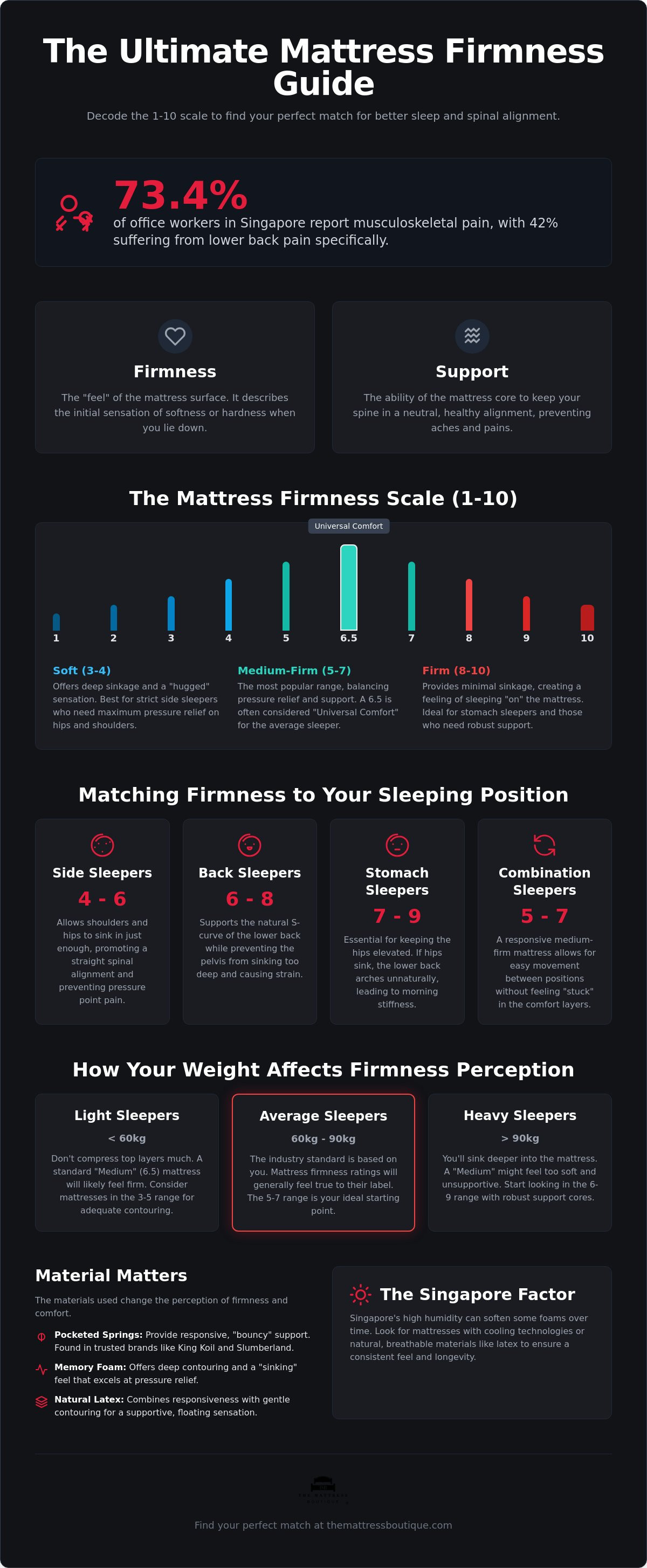
Did you know that 73.4% of office workers in Singapore report musculoskeletal pain, with 42% specifically struggling with lower back pain? Much of this daily discomfort often stems from sleeping on a surface that fails to support the body's unique requirements. You've likely experienced the frustration of waking up with a stiff neck or sore shoulders, wondering why the bed that felt so soft in the showroom isn't delivering the rest you expected.
It's easy to feel overwhelmed by the technical jargon surrounding sleep products. You might find yourself confused by the difference between a mattress's "firmness" and its actual "support." This mattress firmness guide is designed to remove that uncertainty. We'll help you master the standard 1 to 10 scale and discover the ideal support level for your specific body type and sleeping position. You'll gain the confidence to choose between materials like latex, memory foam, and pocketed springs, ensuring your next investment leads to improved sleep quality and proper spinal alignment. We will break down how to navigate various brands like King Koil and Slumberland to find a solution that fits your lifestyle perfectly.
Key Takeaways
- Learn how to navigate the 1–10 industry scale to differentiate between a mattress that feels soft and one that provides actual spinal support.
- Discover why side sleepers typically thrive in the 4–6 range, while back sleepers often need a firmer 6–8 level to maintain their spine's natural curve.
- Use this mattress firmness guide to understand how materials like pocketed springs and natural latex change your perception of comfort and responsiveness.
- Find out how Singapore's unique humidity affects foam longevity and why specific cooling technologies are essential for maintaining a consistent firm feel.
- Identify which trusted brands, such as King Koil or Slumberland, offer the specific technical construction and spring systems required for your body type.
Understanding the Mattress Firmness Scale (1–10)
Firmness isn't a measure of quality. It's a measure of how the surface feels against your body when you first lie down. Most manufacturers use a standard 1 to 10 scale to help shoppers find their preference. While a 1 would feel like a literal cloud and a 10 like a sidewalk, almost all mattresses on the market fall between 3 and 9. This mattress firmness guide helps you decode these numbers so you don't end up with a bed that's too soft to support your back or too hard to let you sleep.
The scale is generally broken down into three main categories:
- Soft (3–4): These offer deep sinkage and a "hugged" sensation, ideal for those who like to feel enveloped by their bed.
- Medium-Firm (5–7): This is the most popular range. A rating of 6.5 is often cited as the "Universal Comfort" level because it balances pressure relief with enough push-back for the average sleeper.
- Firm (8–10): These provide minimal sinkage. You'll feel like you're floating on top of the mattress rather than sinking into it.
Don't confuse firmness with support. Support refers to the mattress's ability to keep your spine in a neutral alignment. You can have a soft mattress that offers excellent support because of its internal core. By understanding mattress construction and materials, you can see how high-quality pocketed springs or dense latex provide the structural integrity required for health, regardless of how plush the top layer feels.
The Distinction Between Feel and Structure
The top layers of foam or fiber determine the firmness, while the base layers provide the structure. Pressure relief is the ability of those top layers to cradle heavy joints like shoulders and hips to prevent pain. If a mattress is too firm for your body type, you'll feel your weight concentrated on your bones rather than being distributed evenly. This leads to tossing and turning as your body struggles to find a comfortable position.
The Subjectivity of the Scale
Your body weight significantly influences how you perceive this mattress firmness guide. A 50kg sleeper barely compresses the comfort layers, making a medium mattress feel quite firm. In contrast, a 100kg sleeper will sink deeper into the core, making that same mattress feel much softer. Your Body Mass Index (BMI) is a better indicator of your needs than a showroom tag. This is why we recommend testing mattresses in-store for at least 15 minutes. It takes that long for your muscles to relax and for the materials to respond to your specific body heat and weight.
Matching Firmness to Your Sleeping Position and Weight
Your preferred sleeping position is the most significant factor in determining where you fall on the mattress firmness guide. While we previously discussed the 1 to 10 scale, applying those numbers to your specific posture is where the science of sleep becomes practical. Finding the intersection of comfort and health requires looking at how your body interacts with the surface throughout the night.
Side sleepers usually require a firmness level between 4 and 6. This range allows the shoulders and hips to sink just enough to keep the spine straight. Without this specific "give," these protruding joints bear the brunt of your body weight. This often leads to numbness or a pins-and-needles sensation. Back sleepers find their sweet spot between 6 and 8. This level of tension supports the natural S-curve of the lower back while preventing the pelvis from dipping too low.
For stomach sleepers, a firmer surface is essential. We recommend a 7 to 9 rating to keep the hips elevated. If the hips sink, it arches the lower back into an unnatural position, which is a primary cause of morning stiffness. If you switch positions throughout the night, you're a combination sleeper. You'll likely benefit from a responsive medium-firm mattress (5 to 7) that allows for easy movement without feeling stuck in the comfort layers.
Weight Categories and Sinkage Levels
Your weight determines how much pressure you apply to the mattress materials. Light sleepers (under 60kg) often find standard mattresses too hard because they don't have enough mass to compress the foam or springs. In these cases, a "Soft" 3 or 4 might actually feel like a Medium. Average sleepers (60kg to 90kg) can usually rely on the standard scale ratings. However, heavy sleepers (over 90kg) need to be cautious. A mattress that feels firm to a lighter person might feel quite soft to you. You'll need deeper comfort layers and a robust support core to prevent "bottoming out" against the base. If you aren't sure which category you fit into, you can start by exploring our range of supportive mattresses to see how different constructions handle weight.
Spinal Alignment and Pressure Relief
You can check your own alignment using the "hand test." While lying on your back, try to slide your hand under the small of your back. If there's a large gap, the mattress is too firm. If it's impossible to slide your hand in at all, the mattress is likely too soft. Many modern designs now incorporate 7-zone support. This technical feature uses different tension levels across the mattress length to provide firmer support for the torso and softer cushioning for the head and legs. This ensures your posture remains correct regardless of whether the top layer feels plush or firm. Remember, "Orthopaedic" doesn't mean a bed should feel like a rock; it simply means the mattress is engineered to support the musculoskeletal system effectively.
How Mattress Materials Influence Firmness Perception
While the 1 to 10 scale gives you a numerical value, the specific materials inside your bed dictate the physical sensation of that firmness. Two mattresses can both be rated a 7 in our mattress firmness guide, yet feel completely different because of their construction. Understanding the technical aspects of these materials allows you to choose a feel that matches your personal comfort preferences.
Pocketed spring mattresses offer dynamic support. Each spring is wrapped in its own fabric sleeve, allowing it to move independently. This adapts to your body contours much more precisely than traditional systems. Latex mattresses are known for being naturally bouncy and responsive. They push back against your weight immediately, making them highly durable and easy to move on. Memory foam provides a unique cradling effect. It uses your body heat to soften and mold to your shape, which offers superior pressure relief but can feel like you're sinking "into" the bed rather than lying "on" it. For guest rooms or entry-level needs, Bonnell springs remain a common choice. These use an interconnected wire system that provides a traditional, firmer feel with a more uniform surface tension.
Hybrids: The Best of Both Worlds
Hybrid mattresses are often considered a medium-firm masterpiece. By combining the structural integrity of pocketed springs with a thick comfort layer of latex or memory foam, they bridge the gap between support and plushness. This combination makes them the top choice for couples who have different firmness preferences. One partner gets the pressure relief they need, while the other gets the stable support they require. If you're looking for a deeper dive into these options, check out The Complete Guide to Choosing a Mattress in Singapore for more detailed construction insights.
Response Time and Ease of Movement
Response time refers to how quickly the mattress surface returns to its original shape. Latex has a fast response time. It adjusts to your movements instantly. Memory foam has a slow response time, which creates that classic "sinking" feeling. This distinction is vital for combination sleepers who toss and turn throughout the night. A slow-responding foam might make you feel stuck when trying to change positions. Additionally, pay attention to edge support. High-quality pocketed spring and hybrid models often feature reinforced perimeters. This is critical for those who sit on the side of the bed to put on shoes or for sleepers who tend to migrate toward the edge during the night.
The Singapore Factor: Humidity, Heat, and Bed Frames
Singapore's average annual relative humidity of 84% is more than just a weather statistic; it's a critical factor in how your bed feels over time. High humidity can gradually affect the structural integrity of certain foam materials, often causing them to feel slightly softer as they absorb moisture. While a standard mattress firmness guide might list a product as a "7," that rating can shift if the materials aren't suited for a tropical climate. This is why we emphasize the technical construction of mattresses designed specifically for our local environment.
Density often correlates with firmness, but high-density materials can also trap body heat. If you prefer a firm mattress, look for "Cooling" technologies like gel-infused memory foam or phase-change fabrics. These prevent the heat-trapping effect common in denser foams, ensuring you stay comfortable throughout the night. Latex mattresses are an excellent alternative here because they are naturally more breathable and responsive than traditional memory foam, maintaining their firm feel without sacrificing airflow.
Breathability and Firmness
Dense, firm mattresses typically have fewer air pockets than softer, plush models. This lack of internal space makes ventilation essential. Without proper airflow, moisture can build up, leading to a "soggy" feel that ruins the intended support level. High-quality latex and pocketed spring systems are inherently better at circulating air. Using a cooling mattress protector can also help. It acts as a breathable barrier that protects the foam layers from humidity without altering the surface tension you've chosen.
HDB and Condo Space Planning
The type of bed frame you choose significantly impacts the final firmness of your sleep system. If you place a mattress on a slatted base, the slats provide a small amount of "give," which can make a firm mattress feel slightly more forgiving. However, many Singaporean homeowners prefer storage bed frames or solid-base divans to maximize space in HDB flats and condos. These solid surfaces provide zero flex, which reinforces the mattress’s internal support and makes the overall feel firmer. If you’re optimizing your room, The Ultimate Guide to Storage Bed Frames in Singapore offers excellent advice on matching frames to your specific needs.
Mattress height also plays a role in room aesthetics and perceived comfort. A very thick, high-profile mattress might look impressive in a large master suite, but it can overwhelm a smaller condo bedroom. When selecting your support level, consider how the total height of the bed frame and mattress will affect your ease of getting in and out of bed. For the best results, we suggest you browse our full collection of mattresses and frames to see how different combinations interact to provide the perfect sleep surface.
Choosing Your Match at The Mattress Boutique
How do you turn all this technical information into a purchase you won't regret? Selecting the right brand is the final step in applying this mattress firmness guide to your daily life. While every manufacturer uses the 1 to 10 scale, each brand has a distinct "signature feel" based on their proprietary engineering. King Koil is often the first choice for sleepers who prioritize spinal health. Their models are chiropractor-tested and offer a wide range of firmness levels, from cloud-like plushness to the rigid support required for chronic back issues.
Slumberland provides a different experience, focusing on hospitality-grade comfort. They utilize advanced spring technology that excels at motion isolation and long-term durability. If you've ever slept in a luxury hotel and wanted that same feel at home, this is often the brand that delivers it. For those who prefer the natural, responsive bounce of latex, Dunlopillo remains the gold standard. Their mattresses are highly breathable and naturally hypoallergenic, making them perfect for the Singaporean climate. We also carry MaxCoil and SofzSleep, which offer specialized options for specific support needs, ensuring that every body type finds a matching surface tension.
Why Shop at The Mattress Boutique?
One of the biggest hurdles in mattress shopping is the inability to compare different brands in a single environment. Most showrooms only feature one manufacturer, which makes it impossible to judge how a "Firm" rating from one brand compares to another. We solve this by hosting a wide selection of leading names in one location. You can test a King Koil and a Slumberland side-by-side to feel the nuances in their support systems. Our consultants don't just sell beds; they act as knowledgeable curators who understand the specific needs of Singaporean sleepers. For a deeper look at one of our most popular brands, you can read our King Koil Mattress Singapore: The Ultimate Buying Guide.
Our Testing Process
We encourage every visitor to take the "Rest Test." A quick sit on the edge of the bed or a five-second lie-down isn't enough to judge how a mattress will feel after eight hours. We want you to lie down in your primary sleeping position for at least 15 minutes. This allows the comfort layers to respond to your body heat and weight, giving you a true sense of the pressure relief. It's also the best way for couples to find a compromise. If you and your partner have different firmness preferences, we can guide you toward specific hybrid models or pocketed spring systems that balance both needs without sacrificing support. Before finalizing your choice, keep this checklist in mind:
- Weight: Does the firmness level account for your specific BMI?
- Position: Are your shoulders and hips properly aligned with your spine?
- Material: Does the breathability of the latex or spring system suit your cooling needs?
- Budget: Is the investment aligned with the technical quality and expected lifespan of the mattress?
Take the Next Step Toward Restorative Sleep
Finding the right balance between comfort and support doesn't have to be a guessing game. By using this mattress firmness guide, you now understand how your body weight and sleeping position interact with different materials. You also know how Singapore's unique climate influences the longevity and feel of your bed. The final step is to transition from theory to practice by experiencing these technical differences in person. It's the only way to be certain that your choice delivers the pressure relief you need.
As an authorized retailer for trusted brands like King Koil, Slumberland, and Dunlopillo, we provide a professional environment where you can compare the industry's best side-by-side. Our expert sleep consultants are ready to assist with personalized HDB or condo bedroom planning. We'll ensure your new mattress fits your lifestyle and your space perfectly. Whether you need a robust pocketed spring mattress or a space-saving storage bed frame, we have the specialized options to help you achieve perfect spinal alignment. Visit The Mattress Boutique to find your perfect firmness today! You deserve to wake up feeling recharged and pain-free every single morning.
Frequently Asked Questions
Is a firm mattress always better for back pain?
No, a firm mattress isn't a universal cure for back pain. While it offers strong structural support, a bed that's too hard can leave gaps under your lower back, forcing muscles to work through the night. The best choice balances your specific weight with spinal alignment. Most people find that a medium-firm surface provides the most reliable relief for common aches.
What is the best mattress firmness for side sleepers with shoulder pain?
Side sleepers typically thrive on a medium-soft to medium surface, ranging from 4 to 6 on the scale. This flexibility allows your shoulder and hip to sink into the mattress, which keeps your spine straight. If the bed is too firm, it pushes against these joints. This pressure can cause numbness or sharp pain during the night.
Can I make a mattress firmer or softer after buying it?
You can modify the surface feel by using a mattress topper. A plush latex or memory foam topper adds softness to a bed that feels too rigid. If you need more firmness, it's often more difficult; however, adding a solid bunkie board or switching to a non-slatted bed frame can provide a more stable foundation that reinforces the mattress's internal support.
Does mattress firmness change as the bed gets older?
Yes, most mattresses become softer over time as the internal foams and springs begin to fatigue. As noted in this mattress firmness guide, Singapore's humid climate can accelerate this softening if materials aren't high-quality. Regular rotation every six months helps maintain a consistent feel and prevents sagging in specific areas where you sleep every night.
What firmness do most luxury hotels in Singapore use?
Most luxury hotels in Singapore use a medium-firm mattress, usually rated around a 6 or 7. This level is designed to satisfy the widest range of guests by balancing plush comfort with reliable support. This mattress firmness guide notes that these brands often include a thick pillow-top layer to provide that signature high-end hospitality feel while maintaining a supportive core.
How do I know if my current mattress is too soft for me?
If you wake up with lower back pain or feel like you're sinking into a hammock, your mattress is likely too soft. A lack of resistance causes your hips to dip below your shoulders, which strains your spine. You should feel supported across your entire body rather than feeling stuck in a deep crater when you try to move or change positions.
Is there a difference between "Firm" and "Extra Firm"?
The difference lies in the level of sinkage and the density of the support core. A "Firm" mattress is usually an 8 on the scale, providing a solid feel with a touch of padding. "Extra Firm" is a 9 or 10, offering almost zero compression. These are typically reserved for very heavy sleepers or specific orthopaedic needs where maximum resistance is required.
What is the best firmness for a couple with different weights?
A medium-firm mattress (6-7) is usually the best compromise for couples with different weights. It provides enough push-back for the heavier partner while remaining soft enough for the lighter person's pressure points. Pocketed spring systems are excellent for couples because they adapt to each person's weight independently and prevent you from feeling your partner's movements when they shift during the night.