

What if the best shared mattress isn’t a compromise halfway between soft and firm? Learning how to choose a mattress with a partner starts with identifying what each of you needs for comfortable, supported sleep, then comparing options against those priorities. That matters when one person prefers a softer feel, while the other wants firmer support, or when movement, different sleep schedules, and warmth affect the night.
It’s easy to focus on mattress labels and miss the differences that matter most. Compare how each option feels to both of you in your usual sleeping positions, whether you notice pressure or a lack of support, and how much movement you feel when your partner shifts. Your bed frame and bedroom layout also affect what will work in practice.
This guide will help you agree on priorities before shopping, compare pocketed spring, memory foam, latex, and Bonnell spring mattresses using couple-specific criteria, and make a considered choice together. You’ll learn what to do when comfort preferences don’t match, how to weigh movement and temperature concerns, and why firmness alone doesn’t settle the decision. The Mattress Boutique offers established brands and a range of mattress types for couples to compare.
Key Takeaways
- To decide how to choose a mattress with a partner, assess each person’s support needs separately before agreeing on shared priorities.
- Consider how side, back, or stomach sleeping affects the comfort and support each of you prefers.
- Compare mattress constructions by how they feel and how much movement they may transfer, rather than expecting one type to suit every couple.
- Test shortlisted mattresses together: lie in your usual positions, check support, and notice how movement feels to both of you.
- Use shared criteria to compare options available at The Mattress Boutique to find the ideal match for both sleepers.
Why choosing a mattress with a partner takes more than finding a comfortable feel
A mattress that feels comfortable to one person in a showroom may not feel right to the person beside them. You each bring different sleep positions, body shapes, temperature preferences, and responses to movement. The goal isn’t to average your preferences or let one person’s first impression decide. It’s to find a shared option that gives both sleepers suitable support and a comfortable surface.
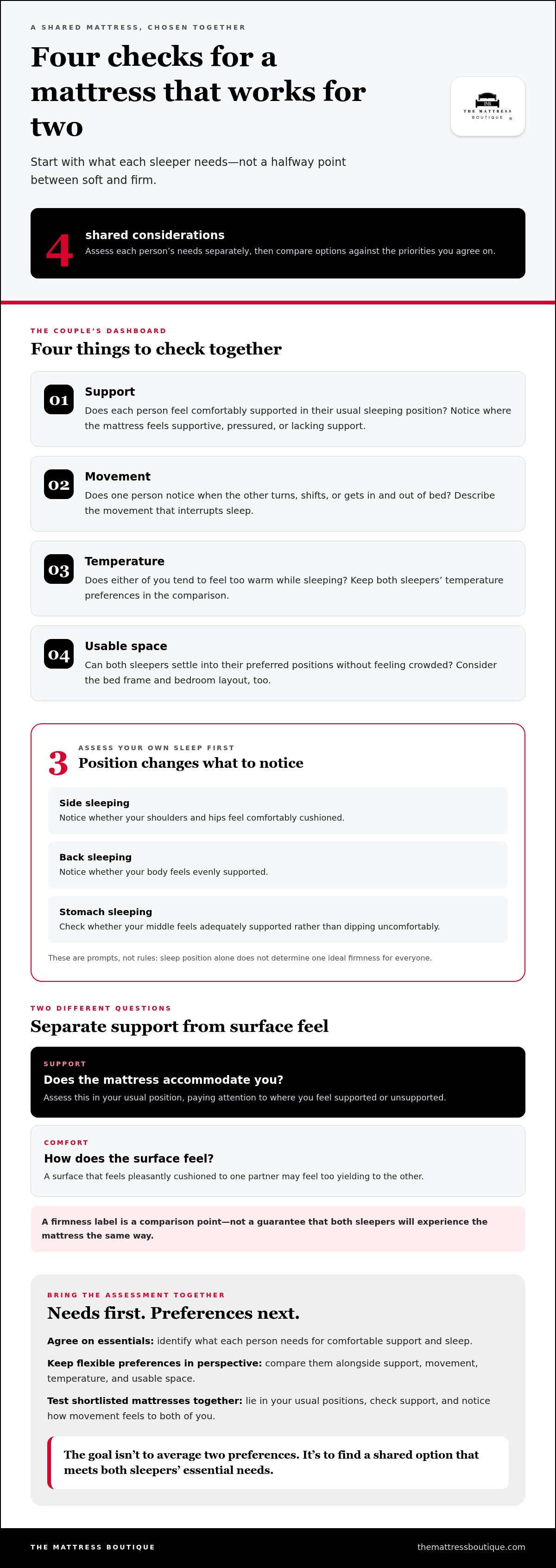
Shared comfort means choosing a mattress that meets both sleepers’ essential needs, not simply picking a firmness halfway between two preferences. A medium feel, for example, isn’t automatically the right compromise if one person needs more cushioning or the other finds the surface too soft. Start by discussing four practical considerations:
- Support: Does each person feel comfortably supported in their usual sleeping position?
- Motion: Does one person notice when the other turns, shifts, or gets out of bed?
- Temperature: Does either of you tend to feel too warm while sleeping?
- Usable space: Can both sleepers settle into their preferred positions without feeling crowded?
Make a short list of essentials and flexible preferences before comparing mattresses. If movement wakes one partner easily, that may be a priority. If the other simply prefers a particular surface feel, weigh that alongside support rather than treating it as a fixed requirement. You can also learn about mattress types and construction to understand how materials and design can affect the feel of different options.
Which sleep differences should couples discuss first?
Start by describing your own sleep, not by choosing a mattress together. Each person should note their usual position, preferred surface feel, and any discomfort they commonly notice. Then compare how sensitive you are to a partner’s movement, warmth, and getting in or out of bed. Be specific: “I wake when the bed moves” is more useful than “I’m a light sleeper.” Clear examples give you practical points to assess.
Next, separate needs from nice-to-haves. One sleeper might need a surface that feels comfortable while lying on their side, while the other prefers a certain degree of firmness but is open to alternatives. Neither preference should automatically override the other. Agreeing on essentials before comparing mattresses helps prevent a quick showroom favourite from becoming the whole decision.
Why does one mattress need to work for two bodies?
The same mattress can feel different to two people because each sleeper’s body and preferred position affect how they experience its surface. Support and surface comfort are related, but they aren’t identical: support concerns how well the mattress accommodates each sleeper, while comfort describes how the surface feels. A mattress that feels pleasantly cushioned to one partner may feel too yielding to the other.
That’s why how to choose a mattress with a partner is best treated as a joint assessment, not a vote for the most persuasive preference. Both sleepers should be able to explain what feels comfortable and what doesn’t. Keep the four shared considerations in view and look for a choice that addresses each person’s essential needs, even if neither gets every minor preference exactly as imagined.
Matching Mattress Support for Two Different Sleepers
Before agreeing on a shared firmness, work out what support feels like for each of you individually. A mattress can feel comfortable at first touch yet leave one sleeper feeling poorly supported in their usual position. Treat support as the first filter: identify what each person needs, then compare surface feels that could meet those needs for both.
Firmness isn’t a fixed experience; the same mattress can feel softer or firmer depending on a sleeper’s body and how they lie on it. A firmness label is a comparison point, not a guarantee that you’ll both experience the mattress in the same way.
How should sleep position shape a shared mattress choice?
Consider your usual position separately. Side sleepers can pay attention to whether their shoulders and hips feel comfortably cushioned. Back sleepers can notice whether their body feels evenly supported, while stomach sleepers can check whether their middle feels adequately supported rather than dipping uncomfortably. These are prompts, not rules: position alone doesn’t determine one ideal firmness for everyone.
Each partner should assess their own comfort before comparing reactions. Lie as you normally sleep and notice where the surface feels comfortable, pressured, or unsupported. Then describe what you felt in specific terms. “My shoulder feels pressed” gives you more to compare than “this is too hard,” especially if your partner sleeps in a different position.
What if one partner prefers a softer mattress?
Compare the softer preference with the sleeper’s actual support and pressure-comfort needs. A softer feel may be a preference, while pressure at the shoulders or hips may point to a need for more cushioning. Likewise, someone who likes a firm surface should still consider whether it feels comfortable in their usual position. Agree on must-haves first, then look for a shared feel that accommodates them as closely as possible.
If one mattress seems unable to suit both sleepers, you can also compare separate mattresses or a split-feel setup. Consider how each arrangement would fit your bedroom, bed frame, and preference for sharing one continuous sleep surface. For many couples, assessing suitable mattresses together is the simplest place to start.
A practical decision rule keeps the discussion fair: resolve support concerns first, then compare comfort preferences. If either person feels unsupported in their usual position, don’t dismiss that concern just because the other likes the surface feel. Once both support needs are addressed, discuss which shared comfort level feels acceptable and what each person is willing to be flexible about. This is the heart of how to choose a mattress with a partner: evaluate both sleepers before settling on one choice.
As you compare, note each person’s position, support concerns, and preferred feel beside the mattress types you’re considering. Use mattress options as a starting point, and let your shared criteria guide the comparison instead of relying on one person’s first impression.
Which mattress types can help couples manage movement and temperature?
A mattress’s construction can influence how movement feels across the bed, but material alone can’t predict exactly how two people will sleep. Motion transfer is the movement one partner feels when the other shifts position or gets in and out of bed. Some constructions may reduce how much movement is felt; none should be assumed to remove it entirely.
Compare overall feel and construction together. Pocketed spring, memory foam, latex, and Bonnell spring mattresses offer different qualities to consider, but the specific design and materials matter. Use the table as a starting point for discussion, not a ranking of which type is best for every couple.
| Mattress type | Construction | Movement considerations | Feel to compare | Questions for both sleepers |
|---|---|---|---|---|
| Pocketed spring | Individual springs sit in separate fabric pockets. | Because springs respond individually, movement in one area may be less noticeable elsewhere, depending on the mattress design. | Notice how the spring support and surface feel work together. | Can you feel your partner shifting? Does the surface feel comfortable in your usual position? |
| Memory foam | Foam forms the mattress’s comfort and support layers. | Foam may absorb some movement, though the result varies with the mattress’s construction. | Check how closely the surface conforms and whether both of you like that sensation. | Does the feel suit both sleepers, and does either person feel restricted when turning? |
| Latex | Latex forms some or all of the mattress layers. | Movement response depends on the mattress design and materials. | Compare its response and surface feel with the other options. | Does it feel comfortable to both of you when changing positions? |
| Bonnell spring | Springs are connected within the support structure. | Movement may travel through the connected spring system; assess the specific mattress rather than assuming how noticeable it will be. | Pay attention to the spring feel and how it responds to each sleeper. | Does one partner’s movement disturb the other during a simple test? |
How do mattress constructions differ when one partner moves?
Pocketed springs move individually, while Bonnell springs are connected, so their structures offer different starting points for comparing movement. Memory foam and latex also have distinct surface responses. The specific materials and design affect the experience, so test how each option responds when one person shifts while the other lies still.
How can couples account for different temperature preferences?
Ask whether either of you regularly feels too warm or too cool during sleep. Compare the mattress surface and your bedding as parts of one setup, and note whether a cover or layer changes either person’s comfort. Don’t assume a material will sleep cooler or warmer without product-specific evidence. When deciding how to choose a mattress with a partner, weigh temperature alongside movement and feel, then compare the options together.
During a comparison, take turns moving while the other person stays still, then discuss what each of you noticed. A movement that barely registers for one sleeper may interrupt the other. Use the table’s questions to make the comparison consistent, and treat temperature as a separate check rather than assuming one construction will solve every comfort concern.
How to test a mattress together before making your choice
A joint mattress test works best when you follow the same steps for each option. This helps you compare what you both notice rather than relying on a quick first impression. Before you begin, keep your agreed must-haves in mind, such as feeling supported in your usual positions or being less aware of a partner’s movement.
What should couples do during an in-store mattress test?
Try each mattress together, then assess your own comfort independently. Lie in your usual sleeping position long enough to notice pressure and support, rather than judging by a brief sit or touch. Take turns shifting while the other person stays still. Record your impressions separately first, so one person’s reaction doesn’t steer the other’s.
Use this sequence for each mattress you’re considering:
- 1. Share priorities. Review your must-haves and flexible preferences before testing. This gives both sleepers the same criteria.
- 2. Test support. Lie in your usual positions. Notice whether any area feels uncomfortable or unsupported, and whether the surface feel works for you.
- 3. Check movement. While one partner lies still, the other can turn, change position, and get in or out of bed. Switch roles and discuss whether the movement was disruptive.
- 4. Compare finalists. Lie near the edge as well as in your usual spot. Note whether the usable surface feels comfortable for both, then compare your observations across the shortlisted options.
For each finalist, record support, pressure comfort, movement, and temperature impressions. A note such as “comfortable on my side, but I noticed movement when you got up” is more useful later than a single rating. A showroom can help you compare surface feel, but it can’t fully recreate your bedroom conditions, so treat temperature impressions as one clue rather than a definitive test.
How should couples make the final decision?
Compare your notes against the must-haves you agreed on, not just which mattress felt best at first. If one option meets both people’s essential support needs but differs from a preferred surface feel, discuss whether that preference is flexible. Then check its dimensions against your bed frame and bedroom layout, including whether there’s enough room to move around the bed comfortably.
Choose the option that best addresses both sleepers’ essentials, even if your preferences aren’t identical. If you want to consider factors beyond the shared test, the complete mattress choosing guide can help broaden your comparison. A repeatable process makes how to choose a mattress with a partner easier to approach as a shared decision.
Use the same testing steps to compare each option against your shared priorities and keep your notes together for the final decision.
How The Mattress Boutique can help you compare mattresses as a couple
Once you’ve identified what each sleeper needs, use those priorities to compare mattress types and brands side by side. The Mattress Boutique offers mattresses from King Koil, Slumberland, Dunlopillo, SofzSleep, and MaxCoil, alongside pocketed spring, memory foam, latex, and Bonnell spring options. That range gives couples different constructions to consider without assuming one brand or material suits everyone.
How can a broad mattress range help couples compare options?
Keep your agreed criteria visible as you compare. For each option, consider its construction, how its support and surface feel to each of you, and how movement feels when one partner shifts. Note where your reactions differ, then revisit your must-haves. This keeps both partners’ essential comfort needs in view instead of letting a brand name or first impression make the decision.
A simple shared comparison can help you stay focused:
- Construction: Identify whether you’re comparing pocketed spring, memory foam, latex, or Bonnell spring mattresses.
- Support and comfort: Record how each sleeper feels in their usual position, including any areas of pressure or discomfort.
- Movement: Note whether one person’s turns or getting in and out of bed are noticeable to the other.
- Shared fit: Consider whether the mattress addresses both partners’ non-negotiable needs, even if your preferred surface feel differs.
These notes make it easier to compare mattresses across brands on the qualities that matter to you, rather than trying to identify a universal “best” choice for couples. If you’re considering King Koil, the King Koil mattress buying guide offers a focused next step for learning about that brand as part of your comparison.
What are the next steps after agreeing on priorities?
Shortlist the mattresses that address both sleepers’ essential support and comfort needs. Then compare those finalists using the same criteria, so you’re weighing them consistently. Keep practical fit in the discussion too: a mattress should suit your bed frame and leave the sleeping space comfortable for both of you. If an option meets one person’s preference but misses the other’s must-have, keep comparing.
Knowing how to choose a mattress with a partner means making each person’s needs part of the decision from the start. You don’t have to share identical preferences; you do need a choice that both of you can feel good about. Compare the available constructions and brands with your notes in hand, and use your shared priorities to guide the final choice.
For a side-by-side comparison, review mattresses at The Mattress Boutique using the criteria you’ve agreed on together.
Make your next mattress decision a shared one
A good choice doesn’t require identical preferences. It requires a decision both of you understand and can feel comfortable with. Before settling on an option, check that each person has had a fair chance to explain what matters most and that neither of you is agreeing simply to end the discussion. That pause can help you make a more considered choice.
Use how to choose a mattress with a partner as a shared process, not a search for a perfect match in every detail. You’re aiming for a practical fit for your sleep and your bedroom, with both partners’ essential needs taken seriously. Keep your agreed priorities close as you compare.
Explore mattresses at The Mattress Boutique and compare options together using your shared priorities.
Frequently Asked Questions
What type of mattress is best for couples with different sleep preferences?
No single mattress type suits every couple, so start with what each sleeper needs rather than choosing by material name. If one partner is easily disturbed by movement and the other prioritises a particular surface feel, compare each option against both needs. The best fit is the mattress that meets your shared essentials, not necessarily the one with the most appealing label or quickest first impression.
Is a pocketed spring mattress good for couples?
It can be a useful option to compare. Pocketed springs move individually, which may help limit how much movement travels across the mattress, but they won’t necessarily prevent a partner from feeling every shift. The effect depends on the mattress’s full construction. Lie still while your partner turns or gets up, then switch roles and compare what you notice.
Can couples choose different firmness levels on each side of a mattress?
Some mattress setups are designed to provide different feels on each side, but that feature shouldn’t be assumed for every model. Couples can also consider two separate mattresses if different firmness preferences are difficult to reconcile, while weighing the effect on the bed setup and shared sleep surface. Compare the practical options against your bedroom, bed frame, and comfort priorities before deciding.
How can I stop feeling my partner move at night?
You may be able to reduce disturbances, but no mattress can be guaranteed to make movement unnoticeable. Compare mattresses with movement sensitivity in mind, and consider whether the disturbance happens when your partner turns, gets in, or leaves the bed. Notice whether the bed frame or overall setup also shifts. If disturbances continue to affect your sleep, discuss other bedroom or sleep-routine changes together.
Should couples choose a queen or king mattress?
Choose a size that gives both sleepers enough room while fitting the bedroom and bed frame. Before deciding, measure the frame and the space around it, including pathways needed to move comfortably through the room. Think about how you each sleep: if you tend to spread out or shift positions, extra width may matter. A larger mattress is only practical if the room can accommodate it.
How do you test a mattress together in a showroom?
Bring a short list of each person’s priorities and test the same mattress together. Lie in your usual positions, then take turns moving while the other stays still. Check how it feels when turning, sitting up, and lying near the edge. Each person should make their own notes before discussing them, so one partner’s immediate reaction doesn’t shape the other’s assessment.
Does mattress material affect how hot couples feel at night?
It can contribute to the overall feel, but material alone doesn’t reliably predict whether you’ll sleep warm or cool. Mattress design, surface layers, bedding, and the bedroom environment all play a part. In Singapore’s warm conditions, note whether either of you regularly feels hot, then compare the mattress with the bedding you expect to use. Base your choice on how both sleepers feel, not a material label alone.