

Did you know your mattress might be aging twice as fast as the warranty suggests simply because of where you live? It is a common dilemma for many homeowners who find themselves asking how long should a mattress last in singapore when their once-comfortable bed begins to sag or cause morning back stiffness. While a label might promise ten years of support, our local climate often forces a different timeline.
You likely expect your bed to remain a sanctuary for a decade, yet you might already be dealing with increased allergy symptoms or visible dips in the foam. It is frustrating to feel your sleep quality declining despite owning a relatively new mattress. We believe that understanding the structural integrity of your bed shouldn't be a guessing game, especially when your physical well-being is at stake.
This guide reveals the real lifespan of mattresses in Singapore’s high humidity, which frequently stays between 70% and 85%, and teaches you how to spot critical signs of material fatigue. We will walk you through how materials like latex and pocketed springs react to tropical weather, providing a clear checklist for when to upgrade to ensure your long-term health and comfort.
Key Takeaways
- Understand why the standard warranty often differs from how long should a mattress last in singapore due to the impact of our local 85% humidity on material breakdown.
- Discover why materials like natural latex and pocketed springs offer the best durability and airflow for the tropical climate.
- Learn to identify the five critical physical signs, such as the "hammock effect," that indicate your mattress is no longer supporting your spine.
- Gain practical tips for extending your mattress life, including the importance of breathable bed frames and dehumidification strategies.
- Find out how specific technologies in brands like King Koil and Slumberland help prevent sagging and maintain comfort for years longer.
The Reality of Mattress Lifespan in Singapore’s Tropical Climate
Most people assume a mattress should last ten years because that is what the warranty card says. In reality, the question of how long should a mattress last in singapore is more complex than a simple date on a receipt. Our local environment is a high-stress zone for bedding materials. While the frame might remain intact for a decade, the internal components often surrender to the tropical elements much sooner.
Chronological Age vs. Functional Age
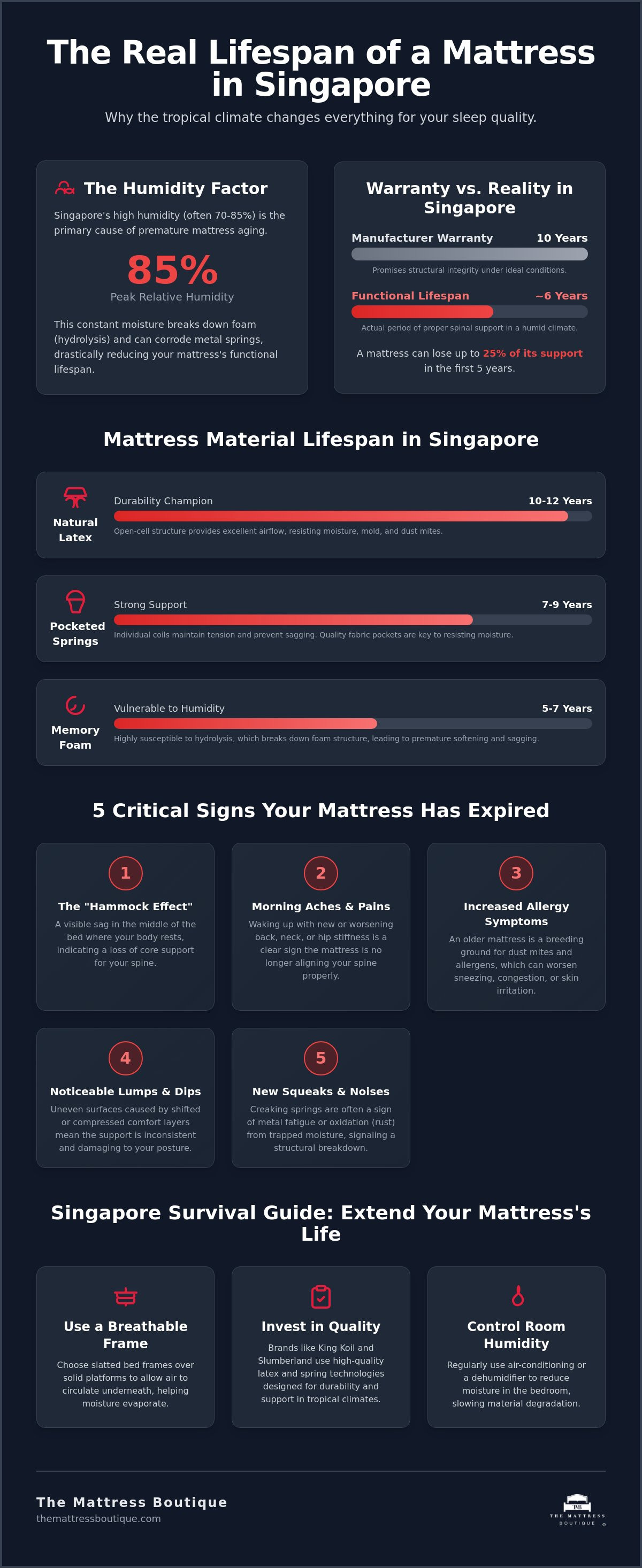
There is a distinct difference between the age of your mattress and its ability to actually do its job. We define functional life as the period where the mattress maintains its original spinal alignment properties. In Singapore's high humidity, a mattress can lose up to 25% of its structural support within just the first five years. Waiting for the ten-year mark can be detrimental to your spinal health, as your body compensates for the lack of support long before the bed visibly collapses. Understanding Mattress lifespan and materials helps you realize that "functional" support is what truly matters for a restorative night's rest.
The Impact of Heat and Humidity
Singapore’s average relative humidity often exceeds 80%, creating a challenging environment for foam and metal alike. High humidity triggers a chemical process called hydrolysis, where moisture in the air breaks down the cellular structure of polyfoams and memory foams. This leads to premature softening, making the mattress feel mushy rather than supportive. Metal components aren't immune either; moisture trapped within the layers can lead to the oxidation of springs, causing them to lose their tension or develop squeaks.
Your sleep habits and living space also play a role. The average person loses about 200ml to 500ml of moisture every night through perspiration. In our warm climate, this moisture is absorbed directly into the mattress layers. In many HDB or Condo bedrooms, space is at a premium. This often means the bed is pushed against a corner or placed in a spot with limited airflow, preventing the mattress from breathing out the trapped moisture. If you don't use air-conditioning regularly to dehumidify the room, the degradation process accelerates. When considering how long should a mattress last in singapore, you must account for these environmental stressors that aren't present in cooler, drier countries.
Comparing Longevity by Material: Which Lasts Longest in SG?
The core materials of your bed determine its fate in the tropics. While the general guideline is 7 to 10 years for most beds, the reality of how long should a mattress last in singapore depends heavily on how those materials handle 85% humidity. Some components are engineered to breathe, while others trap moisture and heat, leading to a much shorter functional life.
Natural Latex: The 10-12 Year Performer
Natural latex stands as the clear durability champion for the Singaporean climate. Unlike synthetic foams that can feel like a sponge for humidity, natural latex features an inherently resilient "open-cell" structure. This design allows for constant air circulation, which prevents the material from trapping body heat and sagging prematurely. It is also naturally resistant to mold, mildew, and dust mites; three major concerns for local homeowners. For those comparing top-tier options, our Dunlopillo vs Slumberland guide highlights how these heritage brands utilize high-quality latex to ensure a decade of consistent support.
Pocketed Springs and Foam Resilience
Pocketed spring mattresses offer significant structural advantages over traditional Bonnell springs. Each coil is encased in its own fabric pocket, allowing them to maintain individual tension and respond to pressure independently. This design prevents the "domino effect" of sagging that often plagues cheaper spring systems. In our environment, the quality of the fabric pocket is just as vital as the steel spring, as it must resist moisture to prevent the metal from oxidizing.
The comfort layers sitting on top of these springs are where many mattresses fail. Low-density foams are highly susceptible to hydrolysis. This chemical breakdown occurs when moisture from the air reacts with the foam's polymers, causing it to crumble or lose its "push-back" feel. To ensure your bed lasts, we recommend choosing high-density materials that can withstand the daily stress of heat and weight. If you want to see how different materials feel in person, you can explore our range of durable mattresses at our showroom.
Memory Foam and Hybrids
Memory foam is popular for pressure relief, but it carries specific risks in a tropical setting. These foams are temperature-sensitive; they soften as they get warmer. In a room that isn't constantly air-conditioned, memory foam can become overly soft, leading to excessive "sinkage" and spinal misalignment. Hybrid mattresses attempt to solve this by combining the support of pocketed springs with thinner layers of foam or latex. This balance often extends the functional life of the bed by providing a sturdy foundation that resists the sagging common in all-foam models. When asking how long should a mattress last in singapore, a well-constructed hybrid or full latex model will almost always outlast a budget foam alternative.
5 Critical Signs Your Mattress Has Expired
Identifying exactly when a bed has reached its limit isn't always as simple as checking a calendar. While we have explored how long should a mattress last in singapore based on material science, your body and the bed's physical state provide the most reliable evidence. If you notice any of the following five signs, your mattress has likely shifted from a sleep sanctuary to a health liability.
Physical Discomfort and Spinal Alignment
The most telling sign is how you feel at 7:00 AM. If you wake up with persistent lower back stiffness that fades after an hour of moving around, your mattress is no longer providing neutral spinal alignment. Even a subtle sag of just 2cm can force your spine into an unnatural curve throughout the night. Your muscles then work overtime to protect your joints, leading to morning fatigue rather than recovery. This is why heritage brands like King Koil utilize chiropractor-tested support systems; they understand that structural integrity is the foundation of physical health. When the "push-back" feel of the springs or foam vanishes, the functional life of the bed has ended.
The Hygiene Factor: Dust Mites and Moisture
In our humid environment, an old mattress becomes a massive filter for environmental pollutants. Over an eight-year period, a mattress can absorb a significant amount of dead skin cells and moisture from perspiration. This organic debris creates a thriving ecosystem for dust mites, which are the leading trigger for asthma, eczema, and sinus issues in Singapore. If you find your allergy symptoms flaring up only when you are in bed, the internal layers are likely saturated. You can learn more about selecting hygienic, breathable materials in our complete guide to choosing a mattress in Singapore.
Structural Failure and the "Taco" Test
Beyond hygiene and pain, look for these three mechanical red flags:
- The Hammock Effect: This is visible sagging in the middle of the bed. If you and your partner find yourselves rolling toward the center involuntarily, the core support has collapsed.
- Increased Motion Transfer: If you suddenly feel every toss and turn your partner makes, the pocketed springs have lost their individual tension and are now vibrating as a single unit.
- The "Taco" Test: Sit on the very edge of the bed as if you are putting on shoes. If the edge collapses completely and you feel like you are sliding off, the perimeter "Edge Guard" or foam encasement has failed. A mattress that cannot support you at the edges is a mattress that has lost its structural footprint.
Your bed's primary job is to provide a consistent, clean, and supportive surface. When these five signs appear, the question of how long should a mattress last in singapore becomes secondary to the immediate need for a replacement that protects your sleep health.
Singapore Survival Guide: How to Extend Your Mattress Life
While the tropical climate presents unique challenges, you aren't powerless against the elements. Extending how long should a mattress last in singapore requires a proactive approach that focuses on moisture management and structural care. By making a few small adjustments to your bedroom environment and maintenance routine, you can ensure your investment provides peak support for its full functional life.
Bed Frame Impact: Storage Beds and Ventilation
Storage bed frames are incredibly popular in space-constrained HDB flats and condominiums, but they can inadvertently shorten your mattress's lifespan if not managed correctly. Because these frames often feature a solid base, they can trap heat and moisture between the mattress and the storage compartment. This lack of airflow creates a breeding ground for mold and accelerates the softening of foam layers. If you use a storage bed or a solid divan base, it's vital to choose a design with built-in ventilation slats or breathable fabric covers. For those looking to balance spatial efficiency with mattress health, our ultimate guide to storage beds in Singapore offers technical insights into choosing models that promote better airflow.
Environmental Control
Controlling the humidity in your master bedroom is the single most effective way to preserve internal materials. Using a dehumidifier can lower the relative humidity from a typical 85% down to a safer 50% to 60%; a change that can add up to two years to the life of a memory foam or hybrid mattress. We also recommend a "Sunday Airing" routine. Once a week, strip the bed completely and leave the mattress bare for several hours with the windows open or the air-conditioning running. This allows trapped perspiration to evaporate before you put on fresh linens.
Protectors and Rotation Schedules
A high-quality waterproof mattress protector is non-negotiable in the tropics. It acts as a primary barrier against the 200ml to 500ml of moisture the average person loses each night, preventing it from reaching the core layers. Modern protectors are designed to be "breathable," meaning they block liquids while allowing air to circulate. Additionally, while most modern mattresses are "non-flip," they still require rotation. Rotating your mattress 180 degrees every three to six months ensures that weight is distributed evenly over time. This simple habit prevents localized sagging in the areas where your hips and shoulders rest, maintaining the bed's original spinal alignment properties for much longer.
Taking these steps ensures your bed remains a healthy place to rest, regardless of the weather outside. If you are ready to upgrade to a system built for the long haul, you can browse our collection of premium mattresses and breathable bed frames to find the perfect fit for your home.
Investing in Longevity: Durable Brands for the Long Haul
When you are deciding how long should a mattress last in singapore, the initial engineering of the bed is your most reliable defense against our challenging environment. While proper maintenance helps, the quality of the base materials determines the bed's ultimate baseline. Investing in a heritage brand isn't just about the name; it's about choosing components specifically tested to withstand years of tropical heat and humidity without losing their structural integrity.
The King Koil and Slumberland Advantage
Heritage brands have spent decades refining their construction methods for the local market. King Koil, for instance, utilizes high-tensile steel in its pocketed springs. This ensures the coils maintain their "push-back" force even after years of supporting your body weight. You can explore how these technical features translate into better sleep in our King Koil review for 2026. Similarly, Slumberland’s "Linear Pocketed Spring" system provides a high coil count that distributes weight with extreme precision, reducing the mechanical stress on individual springs and preventing early sagging.
Another critical feature to look for is "Edge Guard" technology. This is a reinforced perimeter of foam or steel that surrounds the spring system. It prevents the edges from collapsing when you sit on the side of the bed; a common failure point we discussed in the "Taco Test." By reinforcing the perimeter, these brands ensure the mattress maintains its full usable surface area for its entire functional life.
Evaluating the Warranty
It is important to look closely at what a mattress warranty actually covers after the first five years. Most 10-year or 15-year warranties in Singapore are pro-rated. This means that as the mattress gets older, the manufacturer covers a smaller percentage of the replacement cost. We recommend focusing on the "non-pro-rated" period, as this reflects the brand's true confidence in the product's durability. A warranty usually covers manufacturing defects like broken springs or deep indentations, but it won't cover the natural softening of foam caused by humidity. This is why material choice, such as high-density foam or natural latex, is more important than the warranty length itself.
Making the Final Decision
Choosing a new bed is ultimately a calculation of value over time. While a budget mattress might save you money today, it may need replacing every three years if the materials succumb to hydrolysis or structural fatigue. A premium mattress that lasts eight to ten years often proves to be more economical on a cost-per-night basis. Most importantly, it protects your spinal health and daily energy levels throughout that decade.
We invite you to experience the durability of these premium brands in person. Testing a mattress in a showroom allows you to feel the tension of the springs and the resilience of the comfort layers for yourself. If you are still unsure about how long should a mattress last in singapore or which model fits your home, visit The Mattress Boutique for a personalized consultation. Our specialists can help you navigate the technical specifications to find a sleep system built for the long haul.
Securing Your Future Sleep Quality
Understanding how long should a mattress last in singapore is the first step toward reclaiming your morning energy. We've seen how our local 85% humidity can accelerate the breakdown of lower-quality foams through hydrolysis, making material choice more critical than a warranty date. By prioritizing resilient natural latex or high-tensile pocketed springs, you invest in a functional lifespan that actually supports your spine for the years ahead.
If your current bed shows signs of sagging or is triggering allergy flare-ups, it's time to consult with a specialist who understands the local environment. As an authorized retailer for King Koil, Dunlopillo, and Slumberland, we provide expert guidance tailored to the Singaporean lifestyle. We also offer a comprehensive range of durable storage bed frames designed to maximize your space without compromising on essential ventilation. Find your perfect, long-lasting mattress at The Mattress Boutique today. Your journey to better sleep health starts with a single, well-informed choice.
Frequently Asked Questions
How long does a King Koil mattress typically last in Singapore?
A King Koil mattress typically lasts between 8 to 10 years in Singapore when properly maintained. These mattresses are engineered with high-tensile steel and premium foams that resist the early softening often seen in budget alternatives. While the structural integrity remains strong, you should monitor the comfort layers for signs of material fatigue. Consistent use of a protector and proper ventilation will help you reach the upper end of this lifespan.
Can I make my mattress last longer if I use a mattress topper?
Using a mattress topper can extend the functional life of your bed by acting as a sacrificial comfort layer. It absorbs the initial pressure and body heat that would otherwise accelerate the breakdown of the mattress's primary foam layers. However, a topper cannot fix a mattress that has already suffered structural failure or core sagging. It is a preventative measure, not a cure for an expired bed.
Is a 10-year warranty a guarantee that the mattress will last 10 years?
A 10-year warranty is not a guarantee of a decade of perfect comfort; it primarily covers manufacturing defects like broken springs or major structural flaws. The question of how long should a mattress last in singapore often comes down to "functional life," which is how long the bed remains supportive. Factors like local humidity and daily wear aren't covered by warranties, so you may need a replacement before the warranty expires.
Why does my mattress feel softer than when I first bought it?
Your mattress feels softer because the internal cell structure of the foam is breaking down due to a process called hydrolysis. In Singapore’s high humidity, moisture in the air reacts with polyfoams, causing them to lose their original "push-back" resilience. This softening is often most noticeable in the areas where you sleep every night. Once the foam loses its density, it can no longer provide the spinal alignment you need for healthy sleep.
Does sleeping with the air-con on help a mattress last longer?
Sleeping with the air-con on is highly beneficial for mattress longevity because it significantly reduces the relative humidity in the room. Lower humidity levels slow down the oxidation of metal springs and prevent moisture from being trapped within the foam layers. By keeping the environment dry, you reduce the risk of mold growth and hydrolysis, which are the leading causes of premature mattress failure in our tropical climate.
What happens if I don’t replace my mattress after 10 years?
Keeping a mattress beyond its functional life usually leads to chronic lower back pain and increased allergy flare-ups. Over ten years, a mattress accumulates a significant amount of dead skin and moisture, which fuels dust mite populations. Structurally, the core support will have weakened, forcing your muscles to work throughout the night to maintain spinal alignment. This results in waking up feeling fatigued rather than refreshed.
How often should I rotate my pocketed spring mattress?
You should rotate your pocketed spring mattress every 3 to 6 months to ensure even wear across the surface. This 180-degree turn prevents localized sagging in the areas where your hips and shoulders apply the most pressure. Since most modern pocketed spring models are "non-flip," rotation is the most effective way to maintain a level sleeping surface. It helps the springs and foam layers settle uniformly over time.
Are storage beds bad for mattress longevity?
Storage beds are not inherently bad for longevity, but they do require you to be more mindful of ventilation. Because the base is often solid, moisture from perspiration can get trapped between the mattress and the frame. To prevent this, ensure your storage bed has a breathable cover or ventilation slats. Regularly airing out the mattress by stripping the sheets on a sunny day will help mitigate any moisture buildup issues.