

What if the secret to more comfortable mornings isn't just a higher price tag, but the specific way your mattress handles Singapore's humidity? When you're looking at dunlopillo vs slumberland, it's easy to feel overwhelmed by technical jargon like Talalay latex or PPS spring systems. You likely want a bed that's designed to hold up well over time and, more importantly, one that helps you stay cool throughout the night.
We've done the background work to simplify this decision for you. This comparison provides a clear look at how Dunlopillo's latex expertise compares to Slumberland's spring-based approach. You'll gain more confidence to choose a mattress designed with longevity and comfort in mind. We'll break down the core cooling technologies and structural differences that are designed to support your investment over many years. By the end of this guide, you'll have a clearer sense of which brand aligns with your goals for a cooler, more supportive night's rest.
Key Takeaways
- Discover the core differences between Dunlopillo's latex approach and Slumberland's PPS spring systems to find a balance of pressure relief and support that suits you.
- Navigate the dunlopillo vs slumberland comparison by understanding how each brand uses specific cooling technologies to manage Singapore’s heat and humidity.
- Learn why a mattress's structural support matters over the long term, and what to look for in a mattress designed to remain supportive for many years.
- Identify which brand may suit your sleeper profile, moving beyond the common misconception that firmness is the only factor in back comfort.
- Gain practical insights on how to effectively test these heritage brands in person to make a confident, well-informed purchase for your home.
Table of Contents
-
The Battle of the Heritage Brands: Dunlopillo vs Slumberland
-
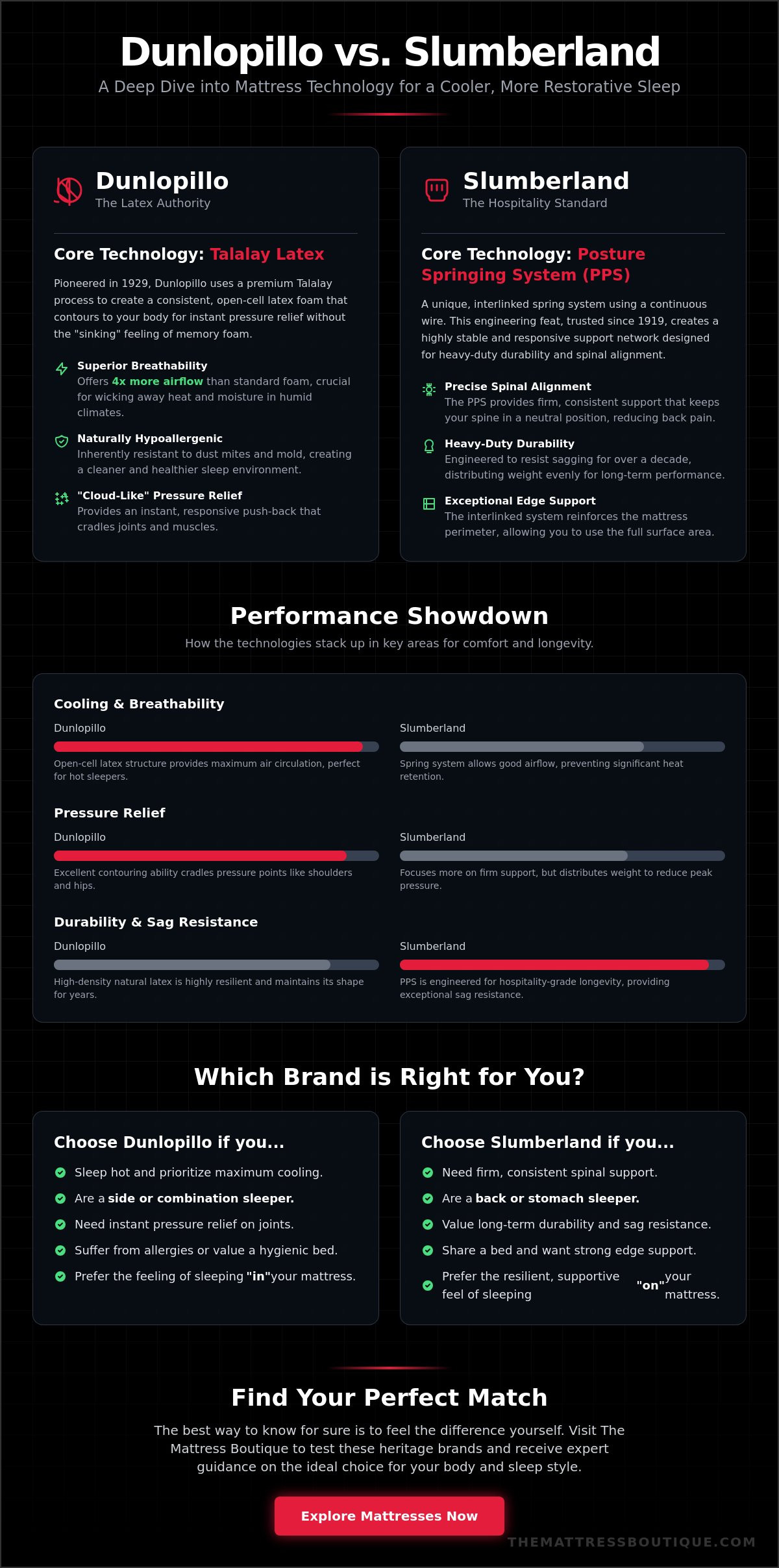
Core Technology: Dunlopillo Latex vs Slumberland PPS Springs
-
Comparing Performance: Cooling, Motion Isolation, and Durability
The Battle of the Heritage Brands: Dunlopillo vs Slumberland
Choosing a mattress is a significant decision. It can affect your comfort, your energy levels, and your overall wellbeing over time. In the debate of dunlopillo vs slumberland, we find two titans that have defined the industry for over a hundred years. These aren't just manufacturers; they're heritage brands that have spent decades refining specific technologies aimed at improving sleep quality. While both offer premium comfort, they approach support from entirely different engineering philosophies. Our goal is to look past the marketing and consider how their core technologies may perform in the heat and humidity of a local bedroom.
Dunlopillo: A Long History in Latex
Dunlopillo changed the sleep industry forever in 1929 when they created the first latex foam. Understanding the Dunlopillo heritage helps explain why they remain the global benchmark for latex quality. Today, they continue to develop the Talalay process, a method designed to produce a more consistent and breathable foam compared to some standard latex. heir focus is on natural materials that are designed to resist dust mites and mold, though individuals with latex sensitivities should verify suitability before purchase. This can be a helpful consideration in tropical climates. The open-cell structure of their latex is designed to allow air to circulate more freely. If you're looking for a softer, more cushioned feel that offers immediate pressure relief without the "sinking" sensation some people associate with memory foam, Dunlopillo is a brand worth considering.
Slumberland: A Hospitality-Inspired Heritage
Slumberland has been part of the bedding industry since 1919 [VERIFY: confirm founding date against current brand materials]. They have a history of supplying hotels, which is often described as "hospitality-grade" sleep. Their signature technology is the Posture Springing System (PPS), an engineering approach that uses a continuous wire to create a responsive support network. Unlike some traditional springs that can feel bouncy, PPS is designed for durability and support intended to help with spinal positioning.Slumberland mattresses are often chosen by those who prefer a firmer, more resilient surface designed to hold up well over years of use. They aim to bring a hotel-style feel into the home, with a focus on structural support and long-term comfort.
When comparing dunlopillo vs slumberland, the choice often comes down to how your body reacts to different support materials. We'll look at how Dunlopillo's latex approach compares with Slumberland's spring technology across three areas: heat regulation, motion isolation, and durability. Whether you're a side sleeper looking for pressure relief or a back sleeper looking for firmer support, understanding these heritage foundations is a useful first step toward finding what works for you.
Core Technology: Dunlopillo Latex vs Slumberland PPS Springs
The mechanical difference between these two brands can affect your daily comfort. When evaluating dunlopillo vs slumberland, you're considering a material that contours through elasticity versus a system that supports through tension. This difference can affect whether you feel like you're sleeping "in" the mattress or "on" it, which may matter for both comfort and temperature regulation.
Dunlopillo’s Latex Layers
Dunlopillo's Talalay latex is designed to offer notably more breathability than some standard foams [VERIFY: "4x more breathability than standard foam" — this specific multiplier claim could not be verified against independent sources and should be confirmed or removed before publishing]. This level of airflow may be helpful for local sleepers who tend to feel warm at night. Unlike memory foam, which relies on body heat to soften and can result in a slower sink feel, latex tends to respond more immediately. It pushes back against your weight, which some people find offers more immediate pressure relief. For those living in humid climates, the natural structure of latex can be an advantage. It's naturally resistant to dust mites, though individuals with latex sensitivities should verify suitability before purchase, which may make it a consideration for some sensitive sleepers. You get a softer, cushioned feel along with materials chosen with hygiene in mind.
Slumberland’s Posture Springing System (PPS)
Slumberland takes a different engineering approach with their Posture Springing System. While many brands use independent pocketed springs, PPS uses a unique interlinking design where springs are connected to distribute weight across a broader surface. This is designed to create a stable sleep surface with good weight distribution. It's also designed to provide strong edge support, meaning you may be able to use more of the width of the bed without feeling like the sides are giving way. This system is designed to help reduce partner disturbance because movement tends to stay more localized within the spring unit. If you're a back sleeper or someone who prefers a more buoyant, responsive feel, this spring architecture is designed to offer support that some sleepers find helpful.
Deciding between these technologies often comes down to your personal physiology. Recent research on mattress types and sleep quality suggests that the right support system can significantly reduce chronic back pain and improve sleep efficiency. Whether you're drawn to the adaptive contouring of latex or the interlinked support of PPS, the aim is generally a surface that helps support a comfortable sleeping position. If you're ready to see how these materials feel in person, you can explore a curated range of both brands to find your perfect fit.
Comparing Performance: Cooling, Motion Isolation, and Durability
The choice between **dunlopillo vs slumberland **often comes down to how a mattress handles the practical realities of your bedroom. In Singapore, where humidity and high temperatures are common, cooling technology is often an important consideration. Beyond temperature, it's also worth looking at how well a mattress isolates movement and how it tends to perform over time. A mattress that feels comfortable in the showroom ideally should also perform well after several years of regular use.
Cooling Approaches: Coolsilk vs TempSmart
Both brands have developed sophisticated methods to combat the tropical heat, but they use different scientific approaches. Slumberland utilizes TempSmart technology, which features NASA-inspired Phase Change Material (PCM). This fabric acts like a thermal regulator; it absorbs excess body heat when you're too warm and releases it if your temperature drops. It's an active system designed to keep you in a "Goldilocks" zone of comfort.
Dunlopillo, on the other hand, often uses Coolsilk, which incorporates silk-infused fibers into the mattress cover. This is designed to provide a cool-to-the-touch feel and focuses on moisture-wicking. While TempSmart is more about active heat management, Coolsilk offers a breathable surface designed to help reduce the sticky feeling sometimes associated with synthetic fabrics. If you tend to sleep hot and are looking for active temperature management, Slumberland's technology may be worth exploring.
Motion Isolation for Couples
If you share a bed with a partner who moves around at night, motion isolation may be an important consideration. Dunlopillo's latex is designed to be effective at absorbing energy. It's designed to dampen vibrations at the source, which may mean you're less likely to feel your partner turning over on the other side of the bed. Slumberland addresses this through their pocketed versions of the Posture Springing System. By housing springs in individual fabric pockets, the design aims to help reduce the movement of one spring affecting the next. Generally, latex tends to provide a more "still" feel that some people find reduces motion transfer, while pocketed springs offer a more responsive, buoyant feel. Light sleepers may find that the dense, energy-absorbing properties of a Dunlopillo latex mattress provide a more undisturbed rest, though individual experiences vary.
Durability is the final piece of the puzzle. It's a concept that involves both the core support and the comfort layers. Dunlopillo mattresses typically come with a 15-year guarantee, reflecting the natural resilience of latex which resists sagging for a very long time. Slumberland mattresses usually carry an 8-year guarantee. However, Slumberland offers models with varying spring counts, ranging from 800 up to 4,000. Higher spring counts often correlate with finer point-elasticity, meaning the mattress may contour more closely to your body shape. This may help reduce pressure on individual springs, which can be a factor in how the mattress maintains its shape and support over its lifespan. When comparing dunlopillo vs slumberland for longevity, you're weighing the durability characteristics of solid latex against the engineered design of high-density spring units.
Which Brand Should You Choose? sleeper Profiles
Selecting a mattress isn't about finding the most expensive model; it's about matching a brand's engineering to your specific body type and preferences. In the** dunlopillo vs slumberland **comparison, your sleeping position and comfort preferences are important factors. Many people believe that a very firm bed is the only option for back discomfort, but this isn't necessarily the case for everyone. A mattress that supports more neutral spinal positioning may be a helpful goal regardless of brand. If the surface is too firm, pressure points may develop; if it's too soft, your spine may curve more than is comfortable.
For Those Managing Ongoing Back Discomfort
If you're looking for a firmer, more structured feel to help keep your spine in a straighter position, some people find Slumberland a good option to explore. Their interlinked Posture Springing System is designed to provide a stable, resilient base that's designed to help reduce excessive sinking. This may be a good fit for back sleepers who prefer a consistent level of resistance. However, if your discomfort tends to be in the lower back, you might find Dunlopillo worth considering. Latex is designed to help fill the lumbar gap, providing gentle contouring intended to support the natural curve of your spine without sacrificing firmness. For those who want more variety in this category, King Koil mattresses represent another strong alternative with spring systems designed with spinal alignment principles in mind that balance comfort with structural support. If back discomfort is persistent or significant, consider speaking with a healthcare professional as part of your overall approach
The Side Sleeper and the Hot Sleeper
Side sleepers face a different set of considerations. Their shoulders and hips create areas of higher pressure that some people find uncomfortable if the mattress is too firm. Dunlopillo's latex layers may be a good fit for this profile. The material's natural elasticity allows these areas to sink in slightly to help relieve pressure while the rest of the body remains supported. If your primary concern is waking up feeling hot, you may want to look toward Slumberland's TempSmart models. These mattresses use active heat regulation designed to help manage your microclimate throughout the night. Pairing this technology with a broader cooling mattress Singapore strategy is the most effective way to ensure the tropical humidity doesn't ruin your rest.
Choosing between dunlopillo vs slumberland ultimately comes down to how your body reacts to their core materials. One brand offers the responsive, thermal-regulating power of advanced spring systems, while the other provides the hypoallergenic, contouring relief of premium latex. To truly understand which profile fits your needs, you can visit our showroom to experience these brands firsthand and speak with our knowledgeable curators.
Finding Your Perfect Match at The Mattress Boutique
Deciding between these two well-established brands is a meaningful step toward a more comfortable sleep setup. At The Mattress Boutique, we act as a knowledgeable curator to help you settle the dunlopillo vs slumberland debate through direct experience. We've done some of the background work so you don't have to, reviewing technical specs to present options we feel are worth considering. Choosing a mattress is a longer-term decision for your comfort, and having a knowledgeable team to talk to can help simplify that process. Testing multiple brands in one location allows you to compare different support systems under similar conditions, which can help your final choice be based on how things feel to you rather than guesswork.
Pairing with the Right Bed Frame
A premium mattress benefits from a frame that suits its construction. Slumberland mattresses, particularly those with the Posture Springing System, tend to be heavier. They generally perform well on a sturdy divan bed frame or a reinforced storage bed frame that provides a flat, stable surface. If you're looking to make the most of space in a compact HDB master bedroom, a storage bed can be a practical option. It offers a stable base while helping reclaim floor space. For Dunlopillo latex mattresses, breathability is often a priority. While a solid base provides firm support, some sleepers prefer slatted frames to help with the natural airflow of the latex. It's worth checking that the slats are spaced appropriately to help reduce the latex dipping over time. Our specialists can help guide you in matching your mattress with a suitable frame to support it over the years.
The Boutique Experience
We aim to be a specialist that prioritizes your comfort over a quick sale. Our approach is grounded and transparent, focusing on the practical differences a quality bed can make. We invite you to experience the "bounce" vs "cradle" difference in person. You'll feel how the dunlopillo vs slumberland technologies react differently to your unique body weight and sleeping posture. It's a consultative process where you can ask questions about motion isolation, cooling fabrics, and edge support without feeling rushed. By testing these heritage brands side-by-side, you can get a better sense of which sleep system may suit your needs. Visit The Mattress Boutique to try the Dunlopillo and Slumberland range today and explore which heritage brand might be a good fit for you. Visit The Mattress Boutique to test the Dunlopillo and Slumberland range today and discover which heritage brand wins for your specific needs.
Choosing a Mattress That Suits Your Needs
Deciding between **dunlopillo vs slumberland **isn't just about picking a brand; it's about considering the engineering that may suit your body's needs over time. Whether you're drawn to the latex-based comfort of Dunlopillo or the spring-based support of Slumberland's PPS, the right choice for you is one that fits your comfort preferences and daily routine. We've explored how these heritage technologies are designed with Singapore's humidity in mind, and the general importance of considering spinal positioning when choosing a mattress.
As an authorised retailer for King Koil, Dunlopillo, and Slumberland, we've put together a range we feel offers good structural quality. Our sleep consultants are available in-store to guide you through the "bounce" vs "cradle" sensation, helping you find an option suited to your sleeping position. You can also pair your new mattress with our wide range of space-saving storage bed frames to maximize your bedroom's functionality. Explore our curated range of Dunlopillo and Slumberland mattresses today. You're just one step away from the deep, undisturbed rest your body deserves.
Frequently Asked Questions
Is Dunlopillo or Slumberland better for back pain?
Which option may suit you better depends on the specific nature of your discomfort and your preferred sleeping position. Slumberland's Posture Springing System provides a firmer surface that some people find helpful for maintaining a straighter sleeping position. Dunlopillo's latex mattresses are often chosen by individuals with lower back discomfort because the material is designed to fill the lumbar gap and contour to the body's curves. If you prefer a more "push-back" feel, Slumberland may be worth exploring; if you're looking for pressure relief that cradles your joints, Dunlopillo may be a good option. If back pain is persistent, consider speaking with a healthcare professional for personalised advice.
How long do Dunlopillo latex mattresses usually last?
A high-quality Dunlopillo latex mattress is often designed to last between 10 to 15 years, reflecting the general resilience associated with natural latex. Compared with some synthetic foams that may soften over time, latex is designed to maintain its elasticity and shape for many years. This can make it a worthwhile consideration for your long-term setup. To help the mattress perform well over time, it's worth using a sturdy bed frame that supports proper airflow.
Does Slumberland TempSmart really help with heat in Singapore?
Slumberland's TempSmart technology is designed to help manage the temperature of your bed in humid environments. It uses Phase Change Materials [VERIFY: "NASA-inspired" attribution — confirm or remove] designed to absorb excess body heat when you're warm and release it as your temperature drops. This is designed to create a more balanced sleeping surface that may help reduce the "hot and sweaty" feeling common in tropical climates. When paired with breathable upholstery layers, this system is designed to offer a cooler night's rest compared with some traditional spring mattresses, though individual experiences vary.
Are Dunlopillo mattresses 100% natural latex?
Many premium Dunlopillo models use natural latex [VERIFY: "100% natural latex harvested from sustainably managed plantations" — confirm sourcing claims with Dunlopillo before publishing, as these are specific sustainability/sourcing claims]. They often use the Talalay process, which results in a consistent, open-cell structure that is designed to be breathable, though individuals with latex sensitivities should verify suitability before purchase. Some hybrid models may incorporate other support materials. You should always check the specific model specifications to confirm the exact material composition and the presence of any additional comfort layers.
What is the difference between Slumberland PPS and standard pocket springs?
The primary difference is the way the springs are connected to distribute weight. Standard pocketed spring mattresses use individual coils that move independently to isolate motion. Slumberland’s Posture Springing System (PPS) uses a unique interlinking design where the springs are interconnected to create a more stable and resilient support network. This is designed to provide good weight distribution and strong edge support, helping reduce the feeling that the mattress is giving way when you sit on the side or move toward the edge.
Can I use a Dunlopillo mattress on a storage bed frame?
You can use a Dunlopillo mattress on a storage bed frame, provided the base is solid and structurally sound. Because latex is a dense and relatively heavy material, the frame needs to be able to support the weight of the mattress along with the sleepers without bowing. A storage bed can be a practical choice for local bedrooms as it combines a firm foundation with extra space. It's worth checking that the base is flat to help support the even support that latex generally benefits from.
Which brand is more expensive, Dunlopillo or Slumberland?
When comparing dunlopillo vs slumberland, Dunlopillo generally sits at a higher price point, as natural latex is often more costly to produce than spring-based systems. Slumberland offers a broader range of price tiers, from entry-level spring models to higher-end hospitality-grade mattresses, making them accessible across various budgets. Both brands represent a meaningful investment, with the final cost often reflecting the density of the materials and the complexity of the cooling technologies included in the specific model.
Do these mattresses come with a warranty in Singapore?
Both brands typically offer warranties that reflect their focus on quality and durability. Dunlopillo mattresses often come with a 15-year guarantee [VERIFY: confirm current terms], which generally covers manufacturing defects and structural issues like significant sagging. Slumberland mattresses often carry an 8-year guarantee [VERIFY: confirm current terms], though this can vary depending on the specific model and technology used. These warranties are designed to provide some reassurance about your purchase. It's always a good idea to verify the specific local terms with your consultant at the time of purchase.