

Your child’s age alone won’t tell you which mattress to choose. When choosing a mattress for a child's bed, start with the bed frame’s dimensions and compatibility requirements, then consider the mattress’s construction and how comfortable it feels to your child. A mattress that looks suitable on paper may still be a poor fit if it doesn’t match the frame or your child’s preferences.
It’s easy to get lost in the options. Foam, latex, and spring mattresses are made differently, while labels such as “medium” and “firm” are not consistent across manufacturers. Begin with the frame’s requirements and your household’s practical needs, then compare specific products rather than relying on age or a label alone.
This guide explains what to compare across memory foam, latex, pocketed spring, and Bonnell spring mattresses. You’ll find practical ways to check dimensions, assess comfort, review care instructions, and narrow your shortlist. Use the checklist to compare products and make a choice based on your child’s current needs and the bed setup.
Key Takeaways
- Start with the bed frame’s required mattress dimensions, then confirm each option is compatible.
- Compare how memory foam, latex, pocketed springs, and Bonnell springs differ in feel, movement response, and care requirements.
- When choosing a mattress for a child's bed, consider current comfort and intended use rather than relying on age or firmness labels alone.
- Use a step-by-step checklist to compare construction, care instructions, and purchase terms before deciding.
- A specialist retailer can help you compare available mattress materials and brands, while you verify the specifications for each product.
Choosing a Mattress for a Child’s Bed: Start with Fit and Everyday Needs
A suitable mattress needs to work for your child and your household. Comfort matters, but so do the frame’s requirements, the space available, ease of care, intended use, and your budget. Check these practical details before comparing materials or firmness labels. Age may provide context, but it doesn’t point to one mattress type or firmness that suits every child. Comfort preferences and bed setups vary.
When choosing a mattress for a child's bed, treat the frame as part of the decision from the start. Look for its instructions or product details, which may specify mattress dimensions or other compatibility requirements. A size name alone may not confirm the exact measurements you need. If the frame is already assembled, measure the area designed to hold the mattress and compare it with the dimensions listed for each product.
Which details should you check before comparing mattresses?
Write down your requirements before browsing. A short list makes it easier to compare products against real needs instead of relying on a label or first impression.
- Your child: Note their preferred sleeping position, if known, how much they move around, and any feedback they can share about their current mattress. If they can try a mattress, listen to their comfort impressions without expecting them to assess technical support.
- The bed frame: Record the required mattress length and width, along with any other limits in the frame instructions. Check whether the frame specifies a compatible base or mattress construction.
- The room: Consider the available space and access. Check whether there is enough room to bring the mattress into the bedroom and position it on the frame.
- The caregiver and household: Decide how easy the mattress needs to be to handle and care for, how long you expect to use it, and what budget is practical. Read the care instructions and purchase terms before settling on an option.
These priorities help you screen out unsuitable options early. A mattress may suit your child’s preferences, but it still needs to fit the frame and make sense for everyday household use.
How is a child’s mattress decision different from an infant sleep decision?
This guide covers mattresses for children’s beds, not infant-specific sleep products. Infant sleep has distinct considerations, so don’t assume advice for a child’s bed applies to a crib or play yard. The Infant bed safety standards overview provides background, but consult current guidance from qualified sources for infant-specific safety questions.
Don’t treat a particular material or firmness label as a guarantee of health or developmental outcomes. For a child’s bed, compare the frame requirements, the product’s stated specifications, and your child’s comfort. Keep those practical checks separate from infant safety guidance.
Mattress Materials for Children Compared: Foam, Latex, and Springs
Mattress construction affects how a product feels, responds to movement, and needs to be cared for. It doesn’t establish whether that mattress is suitable for your child. When choosing a mattress for a child's bed, compare the specific product details with the frame requirements and your child’s comfort preferences. The table outlines points to check; materials and specifications can vary by model.
| Construction | Feel and movement | Weight, care, and ventilation |
|---|---|---|
| Memory foam | Often conforms more closely under pressure. If possible, compare how the surface responds when your child shifts position. | Weight depends on the product’s materials and size. Check the care label, and look for ventilation features only when the manufacturer specifies them. |
| Latex | A different material from memory foam, with a feel that varies by product. If composition matters, check whether the description identifies natural, synthetic, or blended latex. | Don’t assume it will be light or easy to handle. Review the product specifications and care instructions, and verify ventilation claims with the manufacturer. |
| Pocketed spring | Typically uses individually encased springs, but confirm the precise construction for the model. Compare how the surface responds to movement in person where possible. | Weight and care vary by model. Check handling guidance and whether the manufacturer lists ventilation features. |
| Bonnell spring | Uses an interconnected spring construction. Feel and movement response depend on the overall mattress design, so don’t assume all models behave alike. | Compare the stated weight and care requirements with your household’s needs. Treat ventilation as a product-specific feature, not a given. |
What should families know about foam and latex mattresses?
Memory foam is a material category, not a promise of a particular health or developmental benefit. Latex is a separate mattress material, and product descriptions should clarify its composition rather than relying on broad labels. For either type, check the specifications and care instructions, and consider your child’s reaction to the feel. You can also review the U.S. CPSC’s overview of federal mattress safety standards as a U.S. reference; it is not a substitute for Singapore-specific requirements.
How do pocketed spring and Bonnell spring mattresses differ?
Pocketed springs are generally encased individually, while Bonnell springs are interconnected. These terms describe construction, but they don’t fully predict comfort, movement response, or ease of handling. Ask for the specific product details and, if possible, compare the feel in person.
No single construction suits every child. Choose based on how the mattress fits the frame, feels in use, and meets your household’s care and handling needs. A specialist retailer such as The Mattress Boutique offers a place to compare available memory foam, latex, pocketed spring, and Bonnell spring options alongside their stated specifications.
How Firm Should a Child’s Mattress Be? Compare Comfort Without Guesswork
There isn’t one firmness level that suits every child. Labels such as “soft,” “medium,” and “firm” help describe products, but they aren’t universal measurements. One manufacturer’s medium may feel different from another’s, so use the label as a starting point, not a definitive answer.
When choosing a mattress for a child's bed, read the manufacturer’s firmness description alongside the construction and other product specifications. Ask how your child describes their current bed: does it feel too hard, too soft, or comfortable? Their feedback can help narrow the options, but age alone can’t identify a universally suitable firmness.
Does a child need a firm or soft mattress?
For a child’s bed, firmness is a comfort preference and a comparison factor, not a one-size-fits-all rule. Focus on the child’s current needs and the mattress’s intended use rather than guessing what they’ll prefer later. Keep this general guidance separate from infant sleep advice, which has distinct considerations. For infant-specific questions, consult current guidance from qualified sources.
If your child reports pain or has persistent sleep concerns, don’t try to resolve them by choosing a firmness label alone. Speak with an appropriate health professional for advice.
How can a child try a mattress before buying?
If an in-person trial is available, let your child lie on the mattress in their usual sleep position. A short try won’t replicate a full night’s sleep, but it can reveal an immediate preference. Ask simple questions such as, “Does this feel comfortable?” or “Would you like it softer or firmer?” Notice whether they seem relaxed or keep shifting, while remembering that a store visit can’t guarantee how the mattress will feel at home.
Ask the retailer to explain the firmness description and product specifications in plain language. Check that the mattress also matches the frame requirements you established earlier, then review the care instructions and purchase terms. If your child can’t give clear feedback, use what they say about their current mattress and your household priorities to guide the comparison.
Children may outgrow a mattress, but guessing at a future preference is not a useful shortcut. Consider how the bed will be used and what feels comfortable now. For broader guidance on comparing mattress features in Singapore, read The Complete Guide to Choosing a Mattress in Singapore.
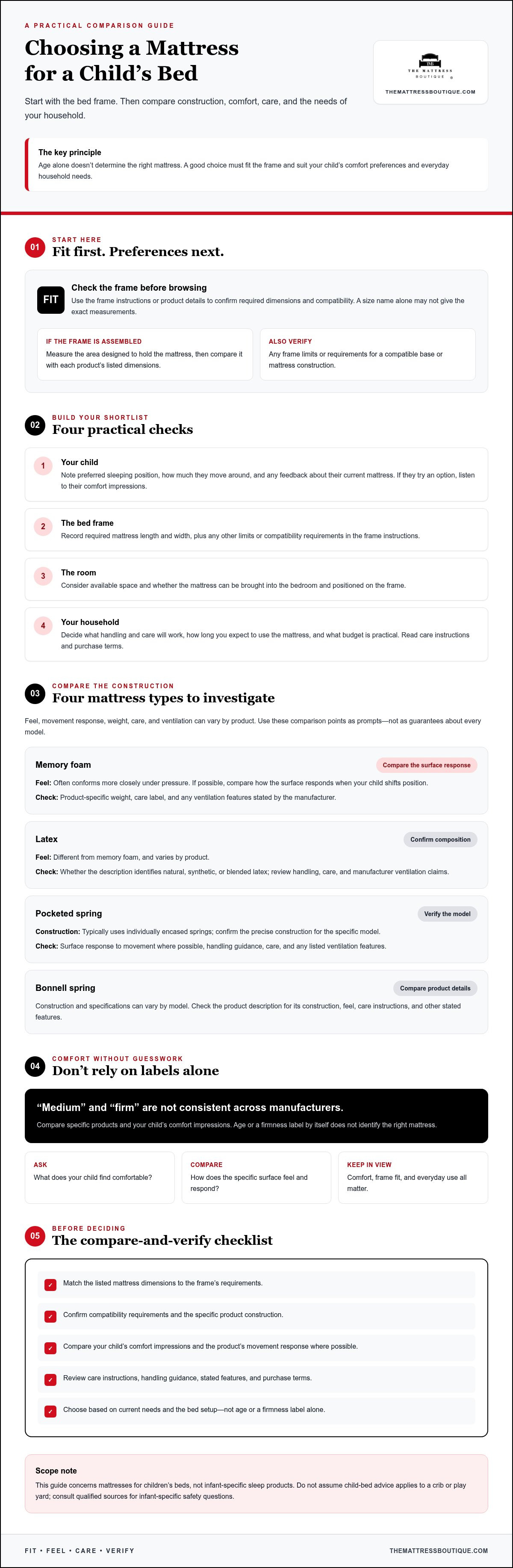
Child Bed Mattress Buying Checklist: Measure, Compare, and Verify
A few checks before ordering can help you avoid a mattress with the wrong dimensions, height, or construction for the bed. Work through the steps below, and ask the frame maker or retailer to clarify anything you can’t verify.
How do you confirm the mattress fits the child’s bed frame?
Measure the frame’s internal mattress area, then compare those measurements with the exact dimensions listed for the mattress. Don’t rely on a bed-size label alone: naming conventions can vary, and a label may not confirm the dimensions the frame requires. Check the frame maker’s instructions for compatible mattress sizes and any height limits. For more context on bed frames and room planning, see this Singapore bed size and room-planning guidance.
Use this five-step checklist when choosing a mattress for a child's bed:
- 1. Measure the frame. Record the internal length and width of the space designed to hold the mattress. Check the frame instructions for any additional size requirements.
- 2. Confirm compatibility. Compare the frame’s requirements with the mattress’s stated dimensions. Check the mattress height too, especially if the frame has rails, a guard, or another feature that may affect how it sits.
- 3. Compare construction. Review the listed materials and firmness description. Confirm details for the specific mattress instead of assuming every model in a material category feels or performs alike.
- 4. Inspect care and purchase terms. Read the care instructions and check the retailer’s current policies for delivery, returns, and mattress handling. Ask for clarification before buying if any term is unclear.
- 5. Decide against your priorities. Weigh verified fit, your child’s comfort preference, care needs, and household budget together. A brand name or material label alone doesn’t prove that a mattress is designed specifically for children.
Singapore’s warm, humid conditions may be one factor in your household’s comfort considerations. Review the manufacturer’s care guidance and any ventilation features stated for the specific mattress, but don’t assume a material or feature guarantees a particular temperature or sleep experience. Consider how the room is used and what your child finds comfortable.
Before deciding, confirm that the exact mattress dimensions and current availability match your needs. You can compare mattress materials and brands at The Mattress Boutique, then check the product specifications and retailer terms for the option you’re considering.
Where to Compare Children’s Mattresses and Choose Your Next Step
You can now build a practical shortlist: mattresses that match the frame’s exact dimensions, have a construction worth considering, feel comfortable to your child, and come with care instructions and purchase terms you understand. These checks make choosing a mattress for a child's bed more manageable, without assuming that a particular brand or material is automatically right for children.
A specialist retailer can help explain product details and compare available options. Ask about the mattress materials, firmness description, dimensions, and care requirements. The Mattress Boutique offers memory foam, latex, pocketed spring, and Bonnell spring mattresses, alongside trusted sleep brands and specialized sleep solutions. Verify the dimensions, current availability, and suitability of the specific mattress for your child’s bed.
What can a mattress retailer help you compare?
Bring your frame measurements and ask how each shortlisted mattress compares with them. When comparing options, ask for the specifications of the individual product rather than relying on brand reputation or a general material description. For background on mattress selections available from the retailer, review dedicated buying guides and product descriptions. Use them to support your research, then verify dimensions and suitability for the bed you have.
What should you do before making the final choice?
Before ordering, match the product’s stated dimensions and height to the bed frame requirements. Review its construction, firmness description, and care guidance, then confirm current availability and read the retailer’s terms for delivery, returns, and mattress handling. If anything is unclear, ask the retailer to explain it before completing your purchase.
Keep the decision grounded in your child’s current comfort and your household’s practical needs. A brand name or construction doesn’t replace checking the product itself, and not every mattress suits every frame. Comparing the specific options is more useful than choosing by age or label alone.
Ready to review the available options? Explore mattresses and bedding at The Mattress Boutique. Compare the listed materials and features, then verify the exact product details before deciding.
Make Your Child’s Mattress Choice with Confidence
Start with the bed frame’s exact requirements, then narrow your options by construction, comfort, care instructions, and purchase terms. Firmness labels can help you compare products, but your child’s current comfort and the specific mattress details matter more than age alone.
As you continue choosing a mattress for a child's bed, compare the exact dimensions with the frame and confirm that the mattress suits the setup. Memory foam, latex, pocketed spring, and Bonnell spring constructions have different characteristics. Consider what fits your child and household rather than expecting one type to suit everyone.
The Mattress Boutique offers mattresses from King Koil, Slumberland, Dunlopillo, SofzSleep, and MaxCoil, as well as these four mattress constructions. Bed frames and pillows are also available. Check current availability and product specifications before deciding; a brand or material alone doesn’t confirm child-specific suitability.
Ready to compare options? Explore mattresses and bedding at The Mattress Boutique, then use your measurements and priorities to guide your shortlist. Verify the details for the product you are considering before making your choice.
Frequently Asked Questions
What type of mattress is best for a child’s bed?
There isn’t one mattress type that’s best for every child. Memory foam, latex, pocketed spring, and Bonnell spring mattresses differ in feel, movement response, weight, and care requirements. First check the bed frame’s dimensions, then compare product specifications with your child’s comfort preferences. When choosing a mattress for a child's bed, assess the specific product and its intended use rather than assuming a material or brand guarantees suitability.
Should a child’s mattress be firm or soft?
Choose a feel that suits your child’s comfort and the mattress’s intended use, rather than relying on age alone. “Soft,” “medium,” and “firm” aren’t universal measurements, so check how the manufacturer describes each product and compare options consistently. If possible, let your child try the mattress and describe how it feels. Infant sleep guidance is separate from general mattress shopping for a child’s bed.
How do I choose the right mattress size for my child’s bed frame?
Measure the frame’s internal mattress area and compare it with the exact dimensions listed for the mattress. Don’t rely only on a size label, which may not give the measurements the frame requires. Check the frame maker’s instructions for compatible mattress sizes and any height limits too. Before ordering, confirm that the specific mattress dimensions match the frame and that its height works with the bed’s design.
Is memory foam suitable for a child’s mattress?
Memory foam may be an option, but suitability depends on the specific mattress, bed frame, and child’s comfort preference. The term describes a material category, not a guarantee of health or developmental benefits. Check the manufacturer’s dimensions, firmness description, construction details, and care instructions. For a particular model, confirm its current availability and that its specifications suit the child’s bed instead of relying on the material name alone.
Are spring mattresses a good option for children?
Spring mattresses can be compared with foam and latex options, but their feel and movement response depend on the specific construction. Pocketed spring mattresses generally use individually encased springs, while Bonnell spring mattresses use interconnected springs. Check the product details, dimensions, and care guidance, and let your child try the mattress if possible. Neither construction is automatically right for every child or bed frame.
Can a child use an adult mattress?
A child may be able to use a mattress also marketed for adults if its dimensions and height suit the bed frame and it feels comfortable to the child. Check the product specifications against the frame requirements rather than assuming an adult size will fit. Consider practical needs such as handling and care as well. An adult label, brand, or mattress material doesn’t confirm child-specific suitability.
When should I replace a child’s mattress?
There’s no replacement interval that applies to every mattress and household. Check the manufacturer’s care and use guidance, and assess the mattress for visible damage, sagging, or a fit that no longer matches the bed frame. Consider replacement if its condition or comfort has changed, or if the child’s bed setup has changed. If you’re unsure, ask the retailer or manufacturer about the product specifications and care guidance.