

Most shoppers decide on a thousand-dollar investment after just thirty seconds of sitting on the edge of a bed, but that is the fastest way to guarantee years of morning back pain. It is understandable why this happens. Between the pressure of a hovering salesperson and the confusing jargon of pocketed springs versus bonnell coils, the showroom experience often feels more like a hurdle than a help. You want a bed that supports your spine and stays cool in Singapore's humidity, not a costly mistake that you are stuck with for a decade.
We agree that choosing the right sleep surface should be a methodical process rather than a guessing game. This expert guide will teach you exactly how to test a mattress in a store using our proven 15-minute physical assessment framework. By mastering these specific movements, you can confidently evaluate premium brands like King Koil, Slumberland, or Dunlopillo. We will walk you through the essential steps to verify structural integrity, understand how different materials perform in tropical climates, and ensure your next mattress delivers the restorative sleep you deserve for years to come.
Key Takeaways
- Learn how to prepare for your showroom visit by identifying your primary sleep position and wearing comfortable clothing for an accurate assessment.
- Master how to test a mattress in a store using the 15-minute rule to move past surface-level softness and evaluate true spinal alignment.
- Discover the tactile differences between responsive latex, contouring memory foam, and pocketed springs to determine which material best handles Singapore's humidity.
- Use partner testing protocols and motion isolation checks to ensure your choice provides undisturbed sleep for both individuals.
- Verify compatibility between your chosen mattress and your bed base, particularly when considering the structural requirements of storage bed frames.
Preparing for Your Showroom Visit: The Pre-Test Checklist
Walking into a mattress showroom without a strategy is like grocery shopping while hungry; you are likely to make a snap decision based on immediate comfort rather than long-term health. Learning how to test a mattress in a store begins long before you touch a single bed. It starts with an honest assessment of your current sleep environment and your physical requirements. By arriving prepared, you transform the showroom into a productive sleep lab where you can objectively compare the structural integrity and comfort of various models.
Start by identifying your primary sleep position. Side sleepers generally require a softer surface to accommodate the shoulders and hips, while back and stomach sleepers need firmer support to prevent the spine from bowing. With so many different types of mattresses available today, from sophisticated hybrids to traditional coils, knowing your baseline requirements prevents you from becoming a victim of marketing hype. You should also establish a realistic budget range. This focus helps you filter out options that don't align with your financial goals, allowing you to concentrate on the best value-driven choices within your reach.
Spatial awareness is equally vital, especially in Singapore where HDB and condo layouts often have strict footprints. Take precise measurements of your existing bed frame or the available floor space in your bedroom. A mattress that looks small in a cavernous showroom can easily overwhelm a modest master suite. Having these dimensions ready ensures you don't fall in love with a King-sized model only to realize it blocks your wardrobe doors.
Dress for Success: Why Clothing Matters
Restrictive denim or heavy layers can create a false barrier between your body and the comfort layers. This makes it nearly impossible to feel how the materials contour to your pressure points. Wear loose, breathable clothing that mimics what you might actually wear to bed. Slip-on shoes are a practical necessity, as you'll be frequently moving between different models. This efficiency allows you to compare the tactile response of cooling covers and foam layers without the distraction of fumbling with laces or stiff fabrics.
Defining Your Sleep Profile
Be prepared to discuss your physical health with a showroom specialist. Mention any recurring neck or back pain, as this dictates the level of lumbar support you require. If you tend to wake up feeling clammy, you are likely a "hot sleeper" who would benefit from natural latex or specialized cooling technologies. Your profile should also include size requirements. Perhaps your room layout necessitates a specific super single mattress size to maximize floor space without sacrificing comfort. Clear priorities ensure you find a solution tailored to your lifestyle.
The 15-Minute Rule: The Correct Way to Test a Mattress
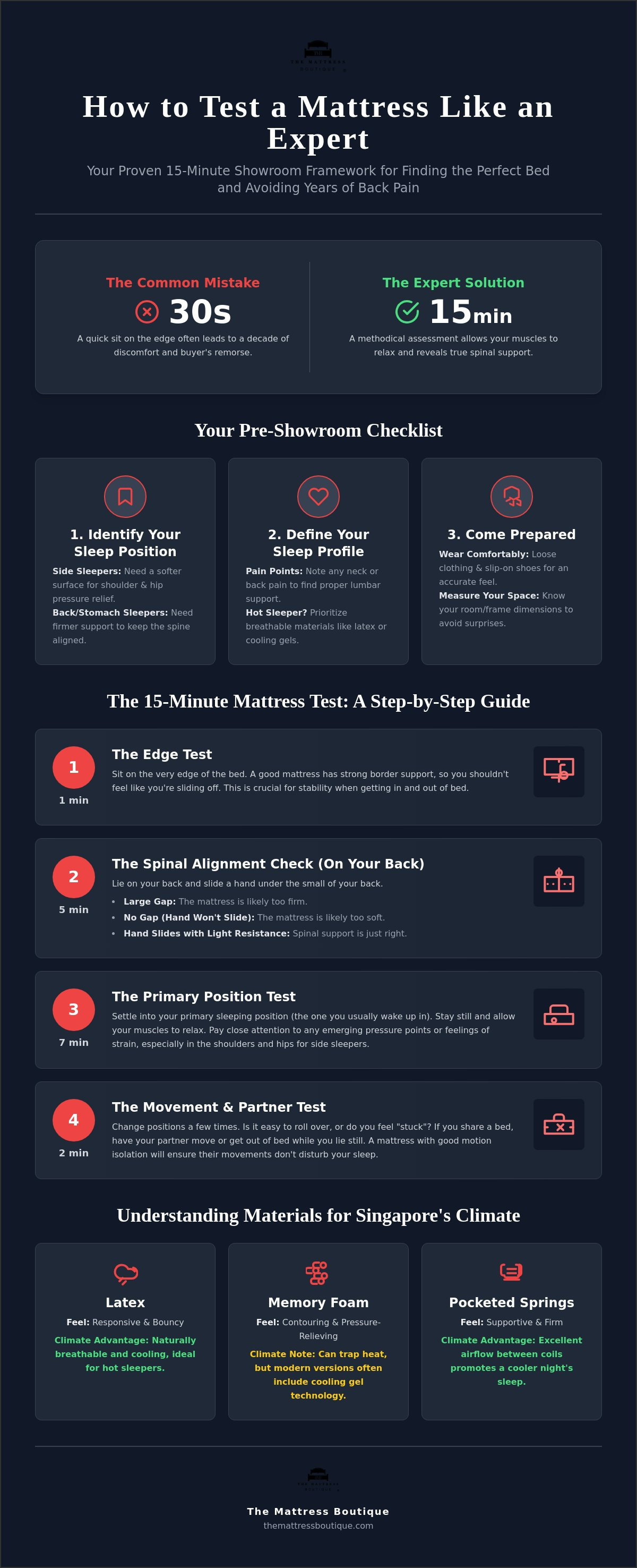
Many shoppers feel self-conscious when lying down in a public showroom, but a quick thirty-second "sit test" is the most common reason for buyer's remorse. Don't rush. Understanding how to test a mattress in a store requires a shift in mindset; you are not just checking for softness, you are evaluating how your musculoskeletal system reacts to support layers over time. It takes roughly ten to fifteen minutes for your muscles to fully relax and for modern materials like high-density foam or pocketed springs to reach equilibrium under your body weight.
We recommend spending at least 15 minutes on each of your top three candidates. This duration allows you to move past the initial "showroom feel" and identify potential pressure points that only emerge once you have settled. This structured approach aligns with , which emphasizes that your body needs time to register true comfort versus temporary relief. When you are learning how to test a mattress in a store, your focus should be on spinal alignment rather than just the initial cloud-like surface. Test the mattress in the exact position you usually wake up in, as this is when your body is most likely to signal if the support is insufficient.
The Testing Sequence: From Edge to Centre
Start your assessment by sitting on the very edge of the bed. This allows you to evaluate the border support, which is vital for sitting while dressing or getting in and out of bed without feeling like you are sliding off. Next, move to the centre and lie on your back. Slide your hand under the small of your back; a significant gap suggests the mattress is too firm, while a complete lack of space often indicates it is too soft. Finally, roll to your side and have a partner check if your spine remains a straight, horizontal line from your neck to your hips. If your shoulders or hips feel jammed, the mattress isn't providing enough contouring for your frame.
Evaluating Pressure Relief
Pay close attention to any "pins and needles" sensations in your extremities, as this indicates restricted blood flow caused by excessive pushback. A high-quality mattress should distribute your weight evenly without creating hot spots on your joints. While memory foam creates a "sink" feel that hugs your body, latex and pocketed springs offer a "float" sensation that keeps you positioned on top of the mattress. If you want to experience these differences firsthand, our specialists at The Mattress Boutique showroom are happy to guide you through a full 15-minute trial without any sales pressure.
Testing for Materials: Latex vs. Memory Foam vs. Pocketed Springs
Once you have settled into your 15-minute assessment, you need to analyze what is happening beneath the surface. Different materials respond to your body heat and weight in vastly different ways. Knowing how to test a mattress in a store effectively means recognizing whether you prefer the contouring "hug" of memory foam or the buoyant, responsive lift of natural latex. If you find yourself struggling to turn over during your trial, the comfort layers may be too dense for your sleeping style. Restless sleepers usually thrive on surfaces that offer a bit of "bounce" to facilitate easy movement throughout the night, preventing that "stuck" feeling that can lead to frequent waking.
Many homeowners in Singapore gravitate toward pocketed spring mattresses because they offer a familiar, traditional feel enhanced by modern engineering. Unlike older coil systems, these individual springs move independently. This means the mattress contours to your specific curves rather than creating a broad, stiff plane. This is a critical distinction to make during your showroom visit, as it directly impacts how much you feel your partner moving beside you or how well the bed supports the specific lumbar curve of your spine.
The Pocketed Spring Test
You can physically verify the quality of a spring system by pressing your hand firmly into different zones of the bed. Feel for how the springs react; they should compress individually without pulling the surrounding fabric or neighboring coils. Lie near the edge of the bed to see if the border support holds firm under your full weight. If you feel like you are rolling off, the edge reinforcement may be insufficient for your needs. Contrast this experience with a Bonnell spring model to immediately feel how the linked coils create more surface vibration and significantly less localized support.
Testing for Singapore’s Heat
Humidity and heat are the enemies of deep sleep in our tropical climate. To understand how to test a mattress in a store for breathability, place your palm flat on the surface for thirty seconds. When you lift your hand, the fabric should feel neutral or cool, not damp or overly warm. Ask our specialists to demonstrate the difference between standard foams and gel-infused variants or natural latex. Natural latex features an inherent open-cell structure that promotes air circulation. This makes it a superior choice for those who want to avoid waking up in a sweat, as it does not trap heat as readily as traditional synthetic foams.
Partner Testing and Motion Isolation Protocols
If you share your bed, the showroom experience must be a team effort. Testing a mattress solo when you intend to sleep as a couple is one of the most common oversights shoppers make. When you are learning how to test a mattress in a store, the goal is to find a surface that accommodates two different body weights and movement patterns without compromising on individual support. You need to ensure that your partner's midnight movements don't become your 3 AM wake-up call. Motion isolation is not just a luxury; it is a fundamental requirement for undisturbed, restorative sleep.
One specific phenomenon to watch for is "roll-together." This occurs when a mattress lacks sufficient structural integrity in the centre, causing both sleepers to gravitate toward the middle. This not only leads to physical discomfort but also generates excess body heat as you end up closer than intended. During your trial, both of you should lie in your preferred positions to check if the mattress maintains its shape or if you feel a "dip" forming between you. Premium models from brands like Slumberland or King Koil are specifically engineered with independent pocketed springs to mitigate this effect, ensuring each sleeper has a stable, level surface.
The Motion Transfer Drill
This is the most critical part of how to test a mattress in a store for couples. Have one person lie perfectly still while the other performs a "toss and turn" routine or mimics getting out of bed. Pay close attention to the surface vibration. In a mattress with poor motion isolation, you'll feel every ripple of movement across the fabric. Pocketed spring systems and memory foam layers are the gold standard here, as they absorb energy locally rather than transferring it across the entire width of the bed. We recommend trying this specifically on our Slumberland and King Koil models to feel the difference that advanced coil technology makes for light sleepers.
Compromising on Firmness
It's rare for two people to have identical firmness preferences. If one of you prefers a plush feel while the other needs rigid support, don't settle for a middle-ground that leaves both of you unhappy. You might consider mattresses with dual-firmness cores or discuss how a specific topper might bridge the gap between two different comfort needs. Space is also a factor in overall comfort. Consult our specialists about king size bed dimensions to ensure you both have enough personal "buffer zone" to move freely without disturbing each other. If you're ready to find a bed that works for both of you, visit The Mattress Boutique today for a personalized couple's fitting session.
Beyond the Feel: Testing for Frame Compatibility and Durability
A mattress does not exist in a vacuum; it is part of a sleep system. Even the most advanced pocketed spring mattress will underperform if it is paired with an incompatible base. When you are learning how to test a mattress in a store, you must consider the foundation beneath the comfort layers. If your bed frame at home is a solid platform, testing a mattress on a flexible slatted base in the showroom will give you a false sense of its firmness and support. Always ask the specialist to place your top choices on a base that mirrors your own setup to ensure the feel you experience in the shop is the one you get in your bedroom.
Durability is the second half of the investment equation. While comfort is immediate, structural integrity is what keeps your spine aligned five years from now. Inquire about the internal construction and coil count. A higher density of springs often translates to more precise support and better longevity. You should also inspect the ticking, which is the outer fabric of the bed. Look for high-quality stitching and durable materials that won't snag easily. A well-constructed mattress should feel solid and silent when you move, without any squeaks or shifting of the internal components.
Storage Bed and Mattress Synergy
In Singapore, where maximizing floor space is a priority, many homeowners opt for a storage bed singapore setup. However, the synergy between the frame and the mattress is vital. Heavy hybrid or natural latex models can put significant strain on hydraulic lifts. You should verify that the mattress weight is compatible with the lift capacity of your frame. Additionally, consider the total height. A very thick mattress on top of a high storage base might make getting into bed difficult or block access to nearby nightstands. Testing these dimensions in the showroom prevents logistical headaches later.
Consulting the Showroom Specialist
The final step in how to test a mattress in a store is a thorough consultation with a knowledgeable curator. Ask about the "break-in" period. Just like a new pair of leather shoes, a mattress often feels slightly firmer for the first few weeks before the materials settle. This is also the time to ask about heritage brands like Dunlopillo and their specific natural latex layers, which are renowned for their resilience and cooling properties. Finally, confirm the practicalities. Ensure you understand the delivery logistics and whether the retailer offers disposal services for your old mattress, as this simplifies your transition to better sleep.
Just as you might consult a specialized retailer like Bath & Shower Supermarket for expert advice on premium bathroom collections, our showroom consultants are here to help you navigate the technical specifications of high-end sleep systems.
Secure Your Decade of Restorative Sleep
Choosing a mattress is a long-term commitment to your physical health and daily energy levels. By following the 15-minute rule and prioritizing spinal alignment over surface-level softness, you have already moved ahead of the average shopper. You now understand the technical differences between responsive latex and pocketed springs, along with the importance of testing for motion isolation with your partner. Mastering how to test a mattress in a store ensures that your final choice is based on objective comfort and structural integrity rather than a rushed decision under pressure.
As an authorized retailer for heritage brands like King Koil, Dunlopillo, and Slumberland, we provide the ideal environment for your "Sleep Lab" assessment. Our showroom features specialized storage bed and mattress bundles to ensure total frame compatibility. Our on-site sleep consultants are always ready to guide your testing with technical expertise rather than high-pressure tactics. Visit The Mattress Boutique showroom to test our King Koil and Slumberland collections today and take the first step toward perfect sleep. Your back will thank you for the extra time spent today for years to come.
Frequently Asked Questions
How long should I lie on a mattress in the store to test it properly?
You should lie on a mattress for at least 15 minutes to allow your body weight to fully settle into the comfort layers. This duration is necessary because your muscles need time to relax and register true pressure points. A brief sit on the edge only tests the border support, not the long-term spinal alignment you require for restorative sleep.
Is it okay to bring my own pillow when testing mattresses in a showroom?
Bringing your own pillow is an excellent way to ensure an accurate assessment. Your pillow provides essential support for your neck and shoulders, and using your own allows you to focus purely on the mattress feel. It's a key part of learning how to test a mattress in a store because it mimics your actual home environment more closely.
What is the best way to test for back support in a mattress?
The best way to test for back support is to check your spinal alignment while lying in your usual position. Your spine should form a straight, neutral line from your neck to your tailbone. If you feel a gap at your lower back or if your hips sink too deeply, the mattress is likely not providing the correct level of lumbar support for your frame.
Why does a mattress feel different in the store than it does at home?
Differences in bed frames and room temperatures often make a mattress feel different at home. Showroom floors often use specific divan bases that can make a mattress feel slightly more resilient. Additionally, materials like memory foam are sensitive to ambient temperature; a cooler bedroom at home may make the foam feel firmer than it did in a warmer showroom environment.
Should I test a mattress on a bed frame or on the floor?
You should always test a mattress on a proper bed frame rather than the floor. Placing a mattress on the floor doesn't allow for the natural airflow or the subtle "give" that a divan or slatted base provides. If you are considering a storage bed frame, testing on a similar solid base is vital to ensure compatibility and consistent comfort levels.
How do I test for motion isolation if I am shopping alone?
If you are shopping alone, you can test for motion isolation by placing a weighted object, like a half-full water bottle, on one side of the bed. Move or roll over on the opposite side and observe how much the object shifts. This simple trick helps you understand how to test a mattress in a store for motion transfer without needing a partner present.
What should I do if my partner and I have different firmness preferences?
Many premium collections offer dual-firmness options where each side of the mattress is tailored to a different preference. This is a common solution for couples with varying support needs. Alternatively, you can explore mattresses that use responsive materials like natural latex, which provides a balanced feel that often satisfies both firm and plush preferences within a single sleep surface.
Are showroom mattresses softer because they have been "broken in"?
Showroom mattresses are usually slightly softer because they have been "broken in" by many visitors over time. A brand-new mattress might feel about 10% firmer during the first few weeks of use. This is a standard settling period for the internal fibers and foam layers as they adjust to your specific body weight and sleep patterns once delivered.