

Could the very springs inside your bed be the reason you're waking up every time your partner tosses and turns? Choosing between a bonnell spring vs pocketed spring mattress is often the difference between a restorative night and a series of interrupted naps. Many people assume all spring systems are the same. However, the internal architecture of your bed dictates everything from spinal alignment to how much heat you'll trapped in Singapore's humid climate.
It's understandable to feel confused by technical specs and pricing when you just want a bed that stops your back from aching. We've done the background work for you, acting as a knowledgeable curator to help you compare these two primary technologies. This guide provides a clear look at durability, motion transfer, and support levels. You'll learn how to pick a mattress that lasts 7 to 10 years and provides the specific comfort your body requires for truly undisturbed sleep.
Key Takeaways
- Identify the structural differences between interconnected coils and individually wrapped springs to determine your specific firmness needs.
- Discover how the choice between a bonnell spring vs pocketed spring mattress directly impacts motion isolation for couples and spinal alignment for back pain.
- Evaluate the cooling benefits of innerspring technology to ensure your bed remains breathable and comfortable in Singapore's tropical humidity.
- Learn how to assess the long-term value of your investment by understanding manufacturing quality and the expected 10-year lifespan of premium models.
- Receive a definitive verdict on which spring system best aligns with your sleep style, partner needs, and personal budget.
Understanding the Core: What Are Bonnell and Pocketed Springs?
To make an informed decision on a bonnell spring vs pocketed spring mattress, you first need to look beneath the upholstery. The internal support system defines how a bed feels, how it reacts to your weight, and how long it lasts. While both systems rely on steel coils to provide lift, their engineering and construction methods are fundamentally different. One acts as a cohesive mesh, while the other functions as a collection of individual actors.
The Bonnell spring is the industry's original innerspring technology, with roots stretching back to the 19th century. In contrast, pocketed springs, also known as Marshall coils, revolutionized the 20th-century bedroom by solving the problem of motion transfer. Understanding the basics of Mattress coil construction helps you see why one system feels like a unified, bouncy platform while the other behaves like a series of independent support pillars.
The choice between a bonnell spring vs pocketed spring mattress often comes down to how you prefer your support to be distributed. Visualizing the two is simple. Imagine a chain-link fence versus a box of individual vertical shocks. The fence moves as a whole, while the shocks respond only where you press. This distinction is the primary reason why different sleepers gravitate toward one over the other based on their body type and lifestyle.
When comparing these technologies, you'll often hear about "spring count." It's a common misconception that a higher number always guarantees better quality. For Bonnell systems, the focus is on the gauge of the wire and the strength of the connections. In pocketed systems, a higher spring count typically allows for more precise contouring, as smaller coils can better map the specific curves of your body.
The Traditional Bonnell Spring Mechanism
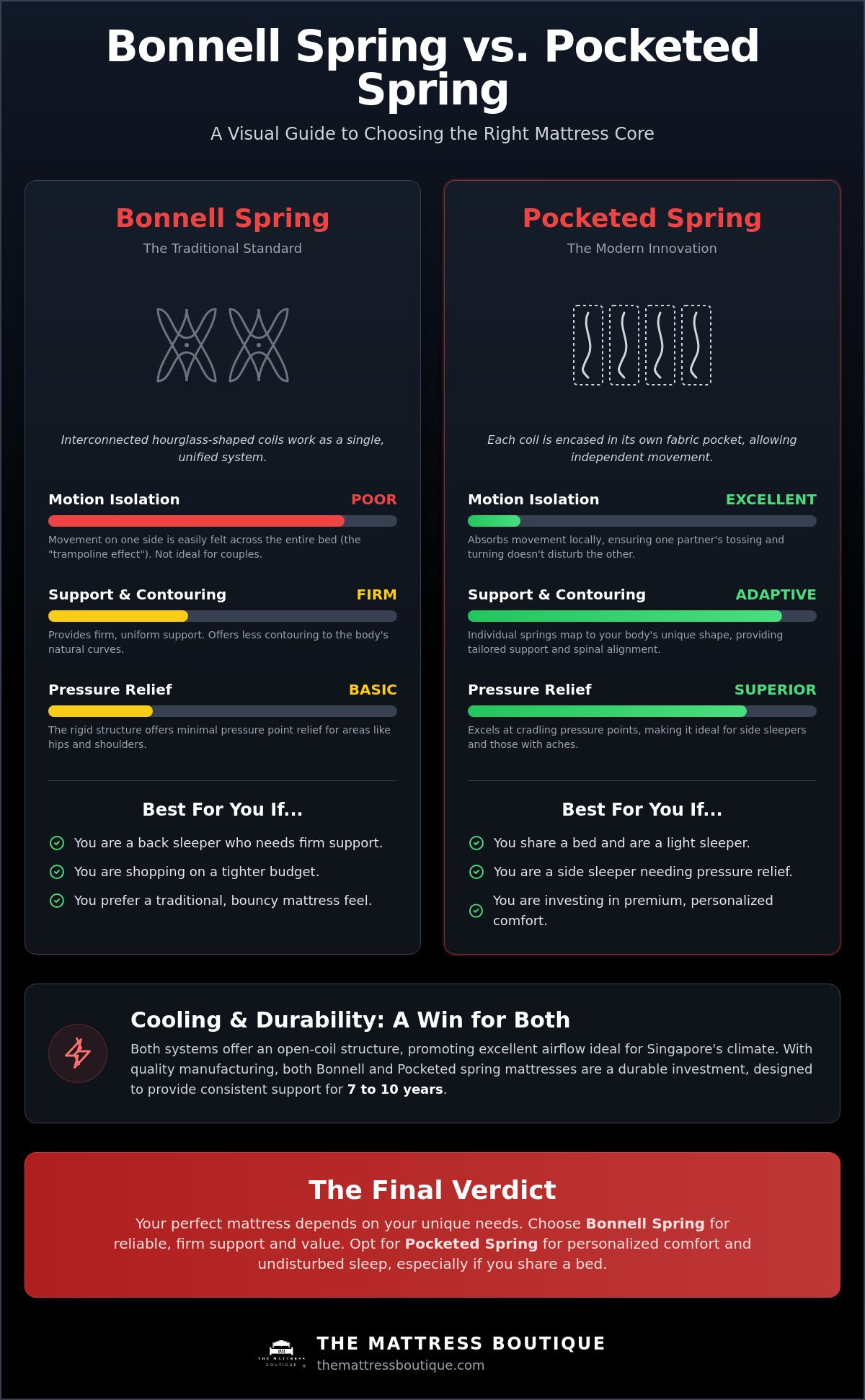
Bonnell coils are easily identified by their hourglass shape, being wider at the top and bottom than in the middle. These individual springs are interconnected by a thin, helical wire, which creates a single, solid mesh of steel. Because the coils are joined, the entire system works as a unified unit. When you apply pressure to one area, the surrounding springs react in tandem. This creates a very durable, firm sleeping surface that provides a traditional "push-back" feel. To ensure longevity, quality manufacturers use tempered steel, a heat-treatment process that helps the metal retain its shape for years without sagging.
The Modern Pocketed Spring Innovation
Pocketed springs represent a major leap in sleep engineering. Instead of being wired together, each coil is encased in its own independent fabric sleeve or "pocket." This simple change allows every spring to move on its own without pulling its neighbors down. This characteristic is known as point elasticity. It means the mattress can contour precisely to your shoulders and hips while maintaining firm support for your lower back. Because the springs aren't linked, they don't transmit movement across the bed. This independence is why pocketed springs are often considered the premium choice for modern bedrooms, especially for those who share a bed.
Support and Motion Isolation: How They Impact Your Sleep
When you compare a bonnell spring vs pocketed spring mattress, the most immediate difference you'll feel is how the bed handles weight. One system responds to your body as a single unit, while the other treats every inch of your frame individually. This distinction isn't just about comfort; it's about the physics of how you spend eight hours every night. Your choice dictates whether you'll feel every movement from your partner or enjoy a surface that contours specifically to your shape.
Motion Transfer: The Dealbreaker for Couples
If you share a bed, motion transfer is likely your biggest concern. Bonnell springs are interconnected by helical wires, creating what many call a "trampoline effect." When one person moves, the energy travels through the entire wire mesh, potentially waking the other sleeper. Pocketed springs solve this by encasing each coil in fabric. This design allows the springs to absorb energy locally. Movement stays right where it started. For light sleepers, this "zero motion transfer" means the bed remains still even if a partner gets up in the middle of the night.
Contouring and Pressure Relief
Your sleep position dictates which support system will serve you best. Side sleepers often struggle with pressure points on their shoulders and hips. Pocketed springs are generally superior here because they offer point elasticity, allowing heavy areas to sink in while the waist remains supported. Conversely, the "push-back" feel of Bonnell springs provides a very stable, firm surface that many back sleepers prefer. Scientific research on bedding systems and sleep quality suggests that these specialized support layers can significantly reduce back pain by maintaining proper spinal alignment.
Many premium options, such as the King Koil mattress line, utilize chiropractor-tested technology to ensure these spring systems work in harmony with your body. These designs focus on keeping your spine neutral regardless of your preferred position.
Edge Support and Body Weight
Heavier sleepers often have different requirements for structural integrity. A Bonnell system's unified mesh provides a robust, consistent feel across the entire surface. This often results in excellent edge support, preventing that "roll-off" sensation when you sit on the side of the bed. While high-quality pocketed springs also offer great perimeter support through foam encasement or thicker gauge edge coils, the inherent firmness of a Bonnell unit is hard to beat for those who prioritize a very sturdy feel. If you're looking for a balance of these features, you can explore our curated collection to find a model that matches your weight and support needs.
Durability and Breathability in Singapore’s Tropical Climate
Singapore's relentless humidity is a silent enemy for many household items, and your bed is no exception. When you're deciding between a bonnell spring vs pocketed spring mattress, you have to consider how each system handles heat and moisture. Unlike solid foam beds that can act as heat sinks, spring systems are inherently more breathable. They create a natural chimney effect where air circulates between the coils, helping to regulate your body temperature throughout the night. This is a vital feature in a climate where night-time temperatures rarely dip below 25 degrees Celsius.
Beating the Heat: Airflow and Ventilation
The open architecture of a Bonnell unit is arguably the gold standard for cooling. Because the hourglass coils are joined only by thin helical wires, the interior of the mattress is mostly empty space. This allows for maximum airflow. It's an ideal setup if you prefer sleeping without air conditioning. Modern pocketed springs have made significant strides here too. While each coil is encased in fabric, reputable manufacturers use non-woven, breathable materials that don't trap heat. To maximize this effect, it's wise to pair your spring system with a mattress Singapore cooling cover made of Tencel or ice-silk. These fabrics work in tandem with the springs to wick away sweat and keep the surface dry even on the most humid nights.
Long-term Structural Integrity
Durability often comes down to how the steel reacts to years of pressure and environmental exposure. Bonnell springs are the "tanks" of the mattress world. Their interconnected nature means they share the weight of the sleeper across the entire unit, which often prevents the localized sagging that can plague softer beds. However, the bonnell spring vs pocketed spring mattress choice also involves looking at the risk of "pocket failure." In cheaper pocketed models, the fabric sleeves can wear out or tear, causing the springs to shift or lean. A long-term mattress durability study indicates that while pocketed systems offer better contouring, their longevity is tied directly to the quality of the encasement fabric and the tempering of the steel.
You'll know your spring system is nearing the end of its typical 7 to 10-year lifespan if you notice these specific changes:
- Visible dips or "hollows" that don't return to a flat surface when you get up.
- New, localized back pain that wasn't there during the first few years of use.
- Audible squeaking or metallic clicking sounds when you shift positions.
- The feeling of "bottoming out" where you can sense the hard base beneath the springs.
Maintaining a dry bedroom environment with proper ventilation will help prevent coil oxidation, ensuring your investment remains supportive for its full intended life.
Price vs. Value: Decoding the Cost Difference
Understanding the price gap in a bonnell spring vs pocketed spring mattress comparison requires looking at the labor involved in their creation. One system is mass-produced as a single interconnected unit, while the other involves hundreds of individual components. While the upfront cost varies, the true value is found in the "cost per sleep" over a decade of use. A quality mattress should last 7 to 10 years. This makes the daily cost of a premium system relatively low when you consider the long-term benefits of undisturbed rest and proper spinal support.
Why Pocketed Springs Are a Premium Investment
Pocketed springs are inherently more complex to manufacture. Each coil is individually wrapped in its own fabric sleeve, requiring significantly more material and specialized assembly machinery. Because these springs offer superior contouring on their own, manufacturers don't always need to rely on excessively thick layers of expensive foam to provide comfort. You're paying for a sophisticated mechanical system that responds precisely to your body's weight. Established brands like King Koil and Slumberland often bundle these systems with high-end materials like latex or specialized cooling fabrics. This increases the overall value for sleepers who prioritize back health and motion isolation.
The Budget-Friendly Appeal of Bonnell Springs
Bonnell springs remain a highly effective choice for specific scenarios. They're the standard for guest rooms, rental properties, or solo sleepers who prefer a very firm, traditional surface. Because the design is simpler and the manufacturing process is streamlined, they offer incredible durability for the price. They often outlast entry-level foam mattresses that tend to soften and sag within just a few years. Choosing a Bonnell unit is a smart way to manage your budget, perhaps allowing you to invest more in a high-quality storage bed singapore to maximize your bedroom's utility and organization.
Deciding which system fits your lifestyle depends on your long-term goals and whether you share your bed with a partner. If you're ready to experience the difference in person, you can browse our full collection of spring mattresses to find the perfect balance of comfort and economy for your home.
The Final Verdict: Which Spring System Should You Choose?
Choosing the right support system shouldn't be a guessing game. While the bonnell spring vs pocketed spring mattress debate involves technical details, the decision usually aligns with your specific lifestyle. One isn't objectively better than the other; they simply serve different purposes. Your body weight, sleeping position, and whether you share your bed are the primary factors that should guide your choice. It's about finding the balance between your comfort preferences and your budget.
Best for Side Sleepers and Couples
If you sleep on your side, you need a mattress that allows your shoulders and hips to sink in while pushing up against your waist. Pocketed springs excel here because they offer the necessary point elasticity for joint health. For couples, the motion isolation provided by these individual coils is practically non-negotiable. It prevents one person's movement from disturbing the other's sleep. At The Mattress Boutique, we recommend exploring pocketed options from brands like King Koil, Slumberland, and Dunlopillo. These manufacturers specialize in high-contouring systems that adapt to your body's unique shape, providing that sought-after "cloud-like" feel without sacrificing core support.
Best for Back Sleepers and Guest Rooms
A Bonnell spring mattress is often the preferred choice for those who crave a traditional, firm "orthopedic" feel. Back sleepers benefit from the unified support mesh that keeps the spine on a level plane, preventing the sagging that can lead to morning aches. These units are also incredibly practical for guest rooms or rental properties where durability and a consistent feel are priorities. When selecting a Bonnell unit for your home, ensure it complements your storage bed frame singapore requirements. The robust, interconnected nature of Bonnell springs makes them a sturdy partner for heavy storage bases, ensuring the mattress stays flat and supportive over its entire lifespan.
To truly understand the bonnell spring vs pocketed spring mattress difference, we always suggest a hands-on test. Visit a multi-brand showroom and lie down in your usual sleeping position for at least 15 minutes. This timeframe is essential because it takes a few minutes for your muscles to stop supporting your weight and for the mattress to take over. Remember that Singapore mattress sizes differ from IKEA or international standards, so always verify your dimensions before finalizing a purchase. We've done the background work to curate the best models from trusted brands, so you can focus on how the bed feels. Our goal is to act as your knowledgeable guide, helping you secure a mattress that provides a decade of restorative, undisturbed sleep.
Transform Your Sleep Quality Today
Selecting the right foundation for your rest is one of the most impactful decisions you'll make for your daily well-being. Whether you prioritize the firm, interconnected support of a traditional coil or the individualized contouring of independent pockets, your choice should reflect your unique body requirements. Understanding the nuances of a bonnell spring vs pocketed spring mattress ensures you invest in a bed that offers both longevity and the specific comfort you need to wake up pain-free.
As an authorized retailer for premium brands like King Koil and Slumberland, we've curated a selection that addresses everything from motion isolation to tropical breathability. Our expert sleep consultants are on hand to help you navigate these technologies and find the perfect match for our wide range of storage beds and frames. Visit The Mattress Boutique to test the best spring systems in Singapore today! You're just one step away from the restorative, undisturbed sleep you deserve.
Frequently Asked Questions
Is a pocketed spring mattress better than a Bonnell spring for back pain?
A pocketed spring mattress is usually superior for back pain because it offers localized support that follows the natural curve of your spine. Unlike the unified push-back of a Bonnell system, pocketed coils respond individually to your weight. This prevents your hips from sinking too far while keeping your lower back supported. If you struggle with chronic stiffness, the point elasticity of a pocketed system provides the precise relief needed for a restorative night.
How long does a pocketed spring mattress typically last compared to Bonnell?
Both spring types typically last between 7 to 10 years when cared for properly. Bonnell springs are often considered more heavy-duty because their interconnected wires distribute weight across the entire unit, reducing localized wear. Pocketed springs are also highly durable, but their lifespan depends on the quality of the fabric pockets. To maximize longevity, always use a supportive bed frame and rotate your mattress every few months as recommended by the manufacturer.
Can I use a pocketed spring mattress on a divan bed frame?
Yes, you can absolutely use a pocketed spring mattress on a divan bed frame. Divans provide a flat, solid surface that is ideal for maintaining the structural integrity of individual coils. This stable foundation ensures that the springs don't shift or sag into gaps, which can happen with some slatted bases. Pairing these two creates a consistent feel across the entire sleeping surface while offering a neat, space-saving aesthetic for your bedroom.
Why are pocketed spring mattresses more expensive in Singapore?
The higher price point for pocketed spring mattresses in Singapore reflects the complexity of their construction. Every coil must be individually encased in fabric, a process that requires more raw materials and specialized labor compared to the mass-produced mesh of a Bonnell unit. Additionally, many premium pocketed models sold locally incorporate advanced cooling layers or natural latex to handle the humidity, further adding to the overall value and manufacturing cost.
Do Bonnell spring mattresses make more noise over time?
Bonnell spring mattresses are more likely to develop squeaks or metallic sounds over time. This happens because the helical wires connecting the coils can rub against each other as the metal ages or the internal padding thins. In contrast, pocketed springs are virtually silent. Since each coil is isolated in its own fabric sleeve, there is no metal-on-metal contact, ensuring your movements don't create disruptive noise during the night.
Which spring system is cooler for sleeping in Singapore's humidity?
A bonnell spring vs pocketed spring mattress comparison shows that Bonnell units are slightly cooler because their open structure allows for maximum air circulation. There is more empty space between the coils for heat to escape, which is helpful in Singapore's humid climate. However, modern pocketed springs are also very breathable. If you choose a pocketed system, look for models that use non-woven fabric pockets and breathable top layers like Tencel to ensure you stay dry.
Are pocketed springs better for heavy individuals?
Pocketed springs are often better for heavier individuals because they provide tailored support without a "hammock" effect. Individual coils prevent the entire surface from dipping toward the heaviest point, which helps maintain a level spine. While a high-gauge Bonnell system is also very sturdy, it can feel too bouncy for some. A high-coil-count pocketed mattress offers a more stable, contoured feel that handles higher weight loads with greater precision and comfort.
Can I flip a pocketed spring mattress?
Most modern pocketed spring mattresses are designed as "single-sided" or "no-flip" models. These beds have a specific hierarchy of layers, starting with the support springs at the bottom and comfort materials like foam or latex on top. Flipping them would mean you're sleeping on the hard support base. Instead of flipping, you should rotate your mattress 180 degrees every three to six months to ensure even wear and maintain the bonnell spring vs pocketed spring mattress durability standards.