

What if the reason you feel exhausted every morning isn't your busy schedule, but the very surface designed to restore you? It's easy to assume a bed is fine as long as it isn't literally falling apart. However, your mattress is a technical sleep system where structural failure directly dictates your biological recovery. If you're frequently waking up with lower back stiffness or noticing the visible signs you need a new mattress, such as a subtle sag in the center, your physical health is already paying the price.
We understand the frustration of tossing and turning because you're overheated or disturbed by a partner's movements. You deserve a sleep environment that functions as a reliable foundation for your well-being. This guide provides a clear checklist to help you evaluate your current setup with professional accuracy. We'll explain how materials like natural latex and pocketed springs age over time and which specific brands provide the best support for back pain. By the end of this article, you'll know exactly how to choose a replacement that restores your sleep and protects your health.
Key Takeaways
- Identify visible structural failures like deep indentations or internal padding shifts that compromise your spinal alignment.
- Recognize the biological signs you need a new mattress, such as persistent morning stiffness or sleeping significantly better in guest beds.
- Learn how tropical humidity accelerates the breakdown of comfort layers, requiring a more nuanced approach than the standard eight-year rule.
- Assess how lifestyle changes, such as shifting body weight or sharing a bed, alter your technical support requirements.
- Discover the framework for selecting an upgrade from trusted brands like Slumberland and Dunlopillo based on your specific sleep indicators.
Visible Structural Failure: The Physical Signs of a Worn-Out Mattress
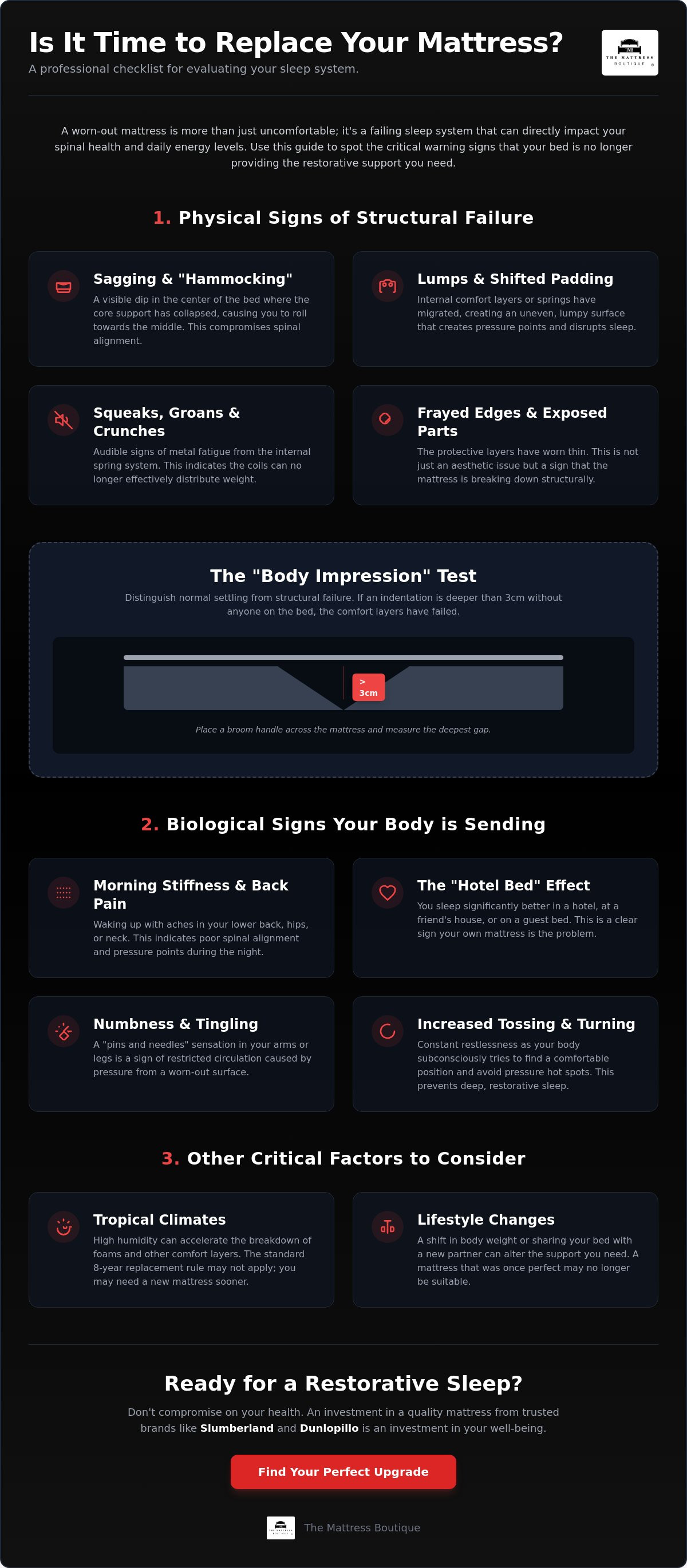
Identifying the physical decline of your bed doesn't require a degree in engineering. It does, however, require a keen eye for detail. Most people wait until a spring is poking them in the ribs before they admit there is a problem. By then, the damage to your sleep quality and spinal health has already been done. One of the most common signs you need a new mattress is "hammocking." This occurs when the core support system collapses, causing you to roll toward the center of the bed throughout the night. If you feel like you're constantly fighting to stay on your side of the mattress, the internal integrity is likely gone.
Beyond sagging, you should look for visible lumps or shifting in the internal padding. Modern Mattress construction and materials are designed to remain flat and supportive. However, lower-quality foams or aged Bonnell springs can migrate or lose their tension over time. If you hear a distinctive squeak or groan every time you sit down, that is metal fatigue. It's a clear signal that the internal structure can no longer distribute your weight effectively. You should also check for frayed edges or exposed components. These aren't just aesthetic issues; they indicate that the protective layers have worn thin, leaving you inches away from the hard internal framework.
The "Body Impression" Test: Sagging vs. Normal Settling
Is that dip a sign of failure or just normal settling? Industry experts generally follow the 3cm rule. To check this, take a long straight edge, such as a broom handle, and lay it across the mattress surface. Use a ruler to measure the gap between the straight edge and the lowest point of the dip. If the indentation is deeper than 3cm without anyone lying on it, the comfort layers have reached their limit. This foam fatigue is especially common in older memory foam models where the material fails to bounce back, creating a permanent "memory" of your body shape that restricts movement.
When the Bed Frame is the Real Culprit
Sometimes the mattress isn't the only part of the system failing. A compromised foundation can mimic the symptoms of a worn-out bed. Check your bed frame for cracked slats or a sagging central support beam. If the base is uneven, even a high-quality mattress will feel unsupportive. Many sleepers are finding that storage bed frames provide a much more stable, flat platform than traditional slatted frames. If you use a divan base, ensure the internal structure hasn't collapsed. An uneven base creates pressure points that lead to those tell-tale signs you need a new mattress much sooner than you anticipated.
Biological Indicators: Why Your Body Knows Before You Do
Your body is a highly sensitive instrument that registers microscopic changes in support long before you notice a visible dip in the bed. If you wake up feeling like you've run a marathon rather than rested, your mattress has likely stopped performing its primary job. While structural wear is easy to ignore, biological feedback is much harder to dismiss. There are several key physical signals that suggest your sleep system is no longer providing the restorative environment you need:
- Persistent Morning Stiffness: Aching in the lower back, hips, or neck that usually dissipates within thirty minutes of moving around.
- The "Hotel Effect": Experiencing deep, uninterrupted sleep at a hotel or a friend's house, only to return to restless nights at home.
- Sensory Disruptions: Numbness or a "pins and needles" sensation in your limbs caused by restricted circulation.
- Restlessness: Increased tossing and turning as your body tries to find a position that avoids "pressure hot spots."
As comfort layers thin out, your skin and muscles press directly against the rigid support core. This creates localized pressure that forces you to shift positions constantly throughout the night. If you find yourself constantly adjusting your pillows or searching for a cool, supportive spot, it's one of the clearest signs you need a new mattress. This lack of deep, stationary sleep prevents you from reaching the REM stages necessary for cognitive recovery.
To help manage the physical strain while you evaluate new bedding options, professional mobile treatments from The Outcall Spa can offer targeted relief for the muscle stiffness and fatigue associated with inadequate sleep support.
Spinal Alignment and Morning Back Pain
Proper sleep requires a neutral spinal curvature. When a mattress loses its structural integrity, it often yields too much at the heaviest points of your body, specifically the hips. This causes your spine to bow, straining the ligaments and muscles for eight hours straight. Chiropractic-tested brands like a King Koil mattress are engineered to prevent this sinking effect by providing zoned support that keeps the spine aligned. If your midsection feels unsupported, you're likely waking up with avoidable inflammation.
Allergies and Respiratory Health
Your mattress acts as a giant filter, accumulating dust mites, skin cells, and fungal spores over years of use. If you wake up with a "morning cold"—sneezing, itchy eyes, or a stuffy nose—that clears up once you leave the bedroom, your bed might be the trigger. Modern heritage brands now incorporate advanced antimicrobial treatments to combat this buildup. If you are struggling with unexplained respiratory issues, exploring our collection of premium mattresses with hypoallergenic properties could be the key to clearer breathing and better rest.
The 8-Year Rule vs. Material Durability in Tropical Climates
The "eight-year rule" is a common benchmark in the sleep industry, but it's often too simplistic for those living in Southeast Asia. Chronological age tells only half the story. You must also consider "usage age," which accounts for body weight, sleep frequency, and environmental stressors. In Singapore, the high humidity acts as a catalyst for material degradation, often making the signs you need a new mattress appear sooner than they would in cooler, drier climates.
Moisture is the enemy of traditional polyurethane foam. In tropical settings, humidity accelerates oxidation, leading to a process where the foam becomes brittle or loses its structural "memory." This chemical breakdown means that a mattress rated for a decade in a temperate climate might only provide seven or eight years of optimal support here. Protecting your investment with a high-quality mattress protector is a lifespan multiplier. It creates a necessary barrier against both moisture and the accumulation of organic matter that can further degrade internal comfort layers.
Material Lifespan Comparison
Different materials react differently to time and pressure. Understanding these variations helps you set realistic expectations for your current bed's performance:
- Bonnell Spring: These typically offer 5 to 7 years of service. Over time, the interconnected wire system loses its tension, leading to the "hammocking" effect.
- Pocketed Spring: These usually provide 8 to 10 years of independent contouring support. Because each coil is encased, they maintain their individual integrity longer than open-coil systems.
- Natural Latex: This is the gold standard for durability, often lasting 12 to 15 years. Latex is inherently resilient and resists the oxidation that plagues synthetic foams.
Heat Retention and Night Sweats
An aging mattress often loses its ability to thermoregulate. As comfort layers compress and cell structures collapse, airflow is restricted, causing the bed to trap body heat more aggressively. If you've noticed you're waking up damp or overheated despite having the air conditioning on, it's one of the subtle signs you need a new mattress. Cooling gel technologies and aerated foams are effective, but they have a functional shelf life. Once the foam begins to break down, these features lose their efficacy. When searching for a mattress Singapore sleepers should prioritize open-cell structures and breathable materials like latex to ensure long-term thermal comfort.
Changing Needs: When Your Lifestyle Outgrows Your Support
Sometimes, the most significant signs you need a new mattress have nothing to do with the bed's age and everything to do with your own life. Your body is a dynamic system. If you bought your current mattress a decade ago, you aren't the same person today. Changes in body weight, for instance, fundamentally alter how a mattress reacts to your frame. A support system that was perfect for a lighter individual may struggle to maintain spinal alignment if you've gained weight; conversely, a very firm bed may become uncomfortable if you've lost weight and now require more pressure relief for your joints.
Health milestones also dictate a need for change. Pregnancy introduces unique pressure points and a higher demand for cooling and edge support. Similarly, developing chronic conditions like arthritis or sciatica means your tolerance for poor support disappears. If your bed was a "good enough" choice five years ago but now leaves you tossing and turning, your lifestyle has simply outpaced your furniture. This is particularly true for couples who have transitioned from solo sleeping to sharing a bed. The added weight and heat of a second person can quickly overwhelm a mattress that wasn't designed for high-capacity use.
When your lifestyle evolves, it’s not just your mattress that may need an update, but your entire bedroom environment; to see how premium design can enhance your home, you can check out ReModern Living for a curated selection of contemporary European furniture.
Motion Transfer and Partner Disturbance
If you've started feeling every move your partner makes, your mattress has likely lost its ability to isolate motion. Older Bonnell spring systems use interconnected wires, meaning a movement on the left side creates a wave of energy that travels to the right. This often leads to "roll-together," where the structural integrity in the center weakens and both sleepers migrate toward the middle. Upgrading to a pocketed spring mattress is often the solution. These systems use individually encased coils that move independently, ensuring that your partner's late-night movements don't disrupt your deep sleep cycles.
Upgrading for Better Ergonomics
Your ergonomic requirements often shift as you enter different life stages. You might find that you now need a more sophisticated support profile, such as a hybrid model that combines the contouring of memory foam with the stability of springs. Edge support is another critical factor. If you find yourself sliding off the bed when you sit on the side to put on socks, the perimeter reinforcement has failed. Whether you need to accommodate a growing family or simply want better pressure relief for aging joints, it's vital to find a mattress that matches your current physical needs rather than clinging to one that worked in the past. A bed that no longer fits your lifestyle is a bed that is actively hindering your recovery.
Finding the Perfect Upgrade: The Mattress Boutique Framework
Once you've confirmed the signs you need a new mattress through our biological and structural checklist, the focus shifts toward a strategic replacement. Choosing a new bed isn't just about picking a price point; it's about selecting a technology that addresses the specific failures of your old system. At The Mattress Boutique, we use a curated framework to help you navigate these technical variations. We act as a knowledgeable intermediary, simplifying the path to a better lifestyle by matching your needs with proven engineering.
Heritage brands like Dunlopillo and Slumberland remain industry leaders because they've spent decades refining their construction methods for tropical climates. These brands offer proven durability that entry-level models often lack. When evaluating your options in 2026, pay close attention to the warranty terms. A robust warranty is a manufacturer's vote of confidence in the structural integrity of their product. However, nothing replaces the benefit of testing mattresses in a curated showroom environment. Feeling the difference between high-density memory foam and a responsive latex layer helps you make a decision based on tactile reality rather than just marketing descriptions.
Brand Solutions for Common Issues
Different sleep challenges require different material responses. If you are struggling with persistent back pain, King Koil's chiropractor-approved pocketed spring systems are designed to offer zoned support that maintains spinal neutrality. For those dealing with night sweats or high humidity, Dunlopillo's breathable natural latex options provide superior air circulation compared to traditional foams. If your primary concern is long-term durability, Slumberland's high-tensile strength spring units are engineered to resist the sagging and "hammocking" effects discussed earlier in this guide.
Completing the Sleep System
A new mattress is the foundation, but it's only one part of a complete sleep system. You should also consider how your other bedding components interact with your new purchase. A new, high-quality pillow is often necessary because your new mattress will change your shoulder alignment, meaning your old pillow may no longer provide the correct neck support. Additionally, coordinating your mattress with a storage bed frame Singapore sleepers prefer for space efficiency ensures your mattress sits on a flat, stable base. For those seeking inspiration on how bespoke cabinetry can further optimize their space, Finest Furniture Studio showcases a range of high-quality fitted furniture designs.
Use this final checklist before finalizing your upgrade:
- Firmness: Does it match your current body weight and sleep position?
- Material: Does it offer the cooling or contouring properties you lack?
- Brand: Is it a trusted specialist like MaxCoil or SofzSleep?
- Foundation: Is your bed frame sturdy enough to support the new technology?
By matching your specific physical needs to these specialized technologies, you ensure that your next investment provides the restorative sleep your body requires for years to come.
Reclaim Your Morning with a Technical Sleep Upgrade
Recognizing the signs you need a new mattress is the first step toward resolving chronic morning stiffness and improving your long-term health. Whether your current bed has fallen victim to high tropical humidity or your lifestyle has simply outpaced its support, understanding the structural limits of your sleep system allows you to make an informed choice. By matching your specific biological indicators with advanced technologies like pocketed springs or natural latex, you can ensure your next bed provides the recovery you deserve.
As an authorized retailer for heritage brands like King Koil, Dunlopillo, and Slumberland, we are dedicated to helping you find a precise fit. Our staff is expertly trained in spinal alignment and sleep ergonomics to guide you through our curated selection. We also specialize in storage bed solutions tailored for HDB and Condo living, ensuring your bedroom remains both functional and restorative. Browse our curated collection of premium mattresses and bed frames to find a system designed for your physical well-being. You don't have to settle for restless nights when a professional sleep solution is within reach.
Frequently Asked Questions
How many years does a high-quality mattress usually last in Singapore?
A high-quality mattress in Singapore typically provides optimal support for 7 to 10 years. However, the local humidity can accelerate the breakdown of certain materials. While natural latex models may last up to 15 years, standard foam layers often show signs you need a new mattress around the seven-year mark due to moisture-driven oxidation and loss of resilience.
Can a mattress topper fix a sagging mattress?
No, a mattress topper cannot fix a sagging mattress because it simply conforms to the existing dip in the bed. Toppers are designed to adjust the surface comfort, such as making a firm bed feel softer. If the internal support core has collapsed, the topper will follow that "hammock" shape, failing to provide the spinal alignment necessary for restorative sleep.
Is it normal to wake up with back pain every morning?
Waking up with back pain is not normal and is one of the most common signs you need a new mattress. If your discomfort is most intense immediately after waking but fades within half an hour of moving, your bed is likely failing to support your spine. This suggests the comfort layers have thinned, forcing your muscles to work throughout the night to maintain your posture.
What is the best mattress material for hot sleepers?
Natural latex and pocketed spring mattresses are the most effective materials for heat dissipation in tropical climates. Natural latex features an open-cell structure that encourages constant airflow. Similarly, the hollow core of a pocketed spring system allows heat to escape rather than trapping it against your body, which is a common issue with traditional, high-density memory foams.
Do I need to change my bed frame when I buy a new mattress?
You only need to change your bed frame if the current foundation is sagging, cracked, or structurally unstable. A new mattress requires a perfectly flat surface to function as intended. If you are upgrading to a heavier premium model, check that your slats are close together and the central support beam is intact to prevent premature wear on your new investment.
How do I know if my allergies are caused by my old mattress?
Allergies are likely caused by your mattress if you experience respiratory symptoms like sneezing or congestion exclusively at night or early in the morning. Over years of use, mattresses accumulate dust mites and skin cells. if your "morning cold" symptoms disappear shortly after you leave the bedroom, it's a clear indicator that the internal environment of your bed has become a trigger.
What is the difference between pocketed springs and Bonnell springs for back support?
Pocketed springs are individually encased coils that move independently to contour to your body's specific shape, providing targeted pressure relief. Bonnell springs use an interconnected wire system that moves as a single unit. For back support, pocketed springs are superior because they maintain the natural curve of your spine and prevent your partner's movements from disturbing your sleep.
How can I dispose of my old mattress when I buy a new one?
Most reputable retailers provide disposal services for a small fee when delivering your new bed. For HDB residents in Singapore, you can also contact your local Town Council to arrange for free bulky item removal. If you reside in a private condominium, you should coordinate with your building management or engage a licensed waste disposal service to ensure the item is recycled or discarded correctly.